
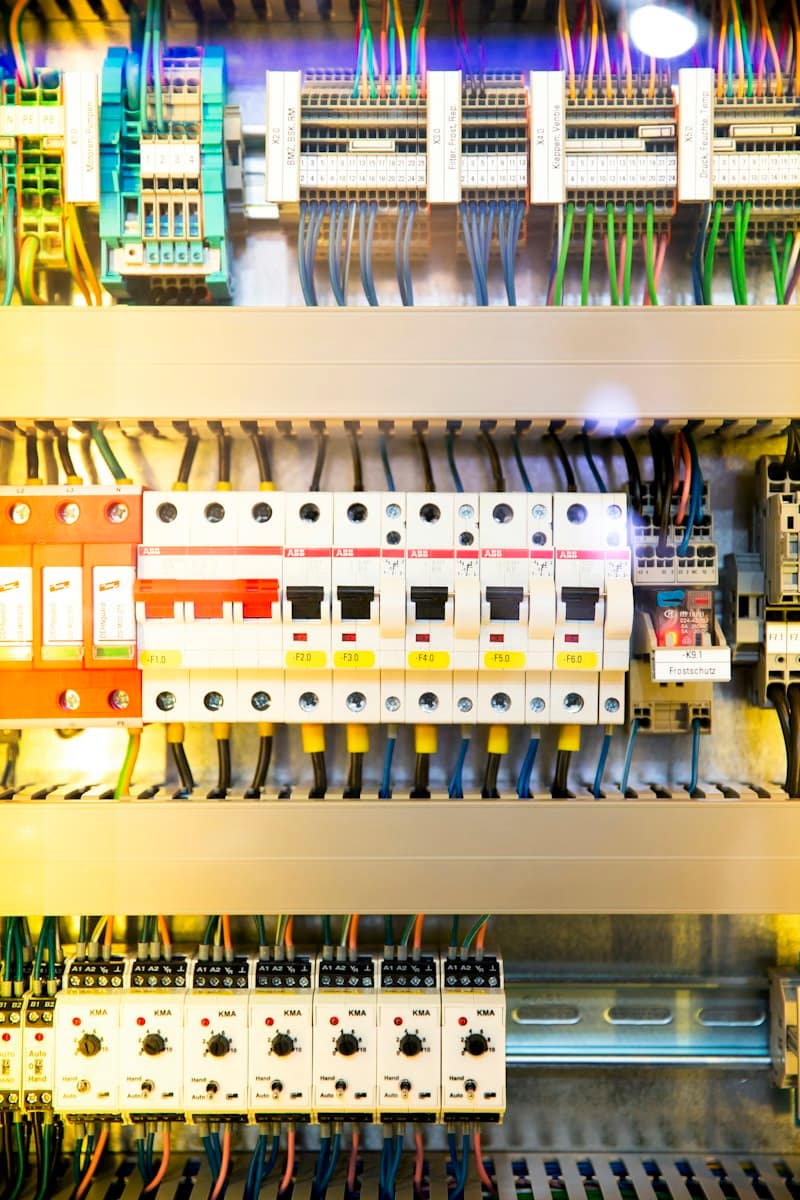
A UPS and power backup system keeps critical loads running during utility failure. It combines an online UPS, a battery bank sized for the required autonomy, and often a DG set with ATS or AMF changeover. We size by load, power factor and runtime, install and test it, and check power quality so the backup actually performs when needed.
At a glance
- Our scope
- Online UPS sizing and installation, battery banks and monitoring, DG integration with ATS or AMF, power-quality assessment
- Typical timeline
- 2 to 6 weeks, depending on UPS and battery lead time and room readiness
- Key standards
- IEC 62040 for UPS, IS 732 for wiring, IS 3043 for earthing
- What you receive
- Sizing sheet, SLD, battery test records, ATS test report and runtime test
- Best suited for
- Server rooms, control rooms, hospitals and toll plazas
- Site survey
- Load, room, ventilation and power-quality survey before sizing
UPS & Power Backup Solutions Overview
A power cut that lasts two seconds can reboot a server, corrupt a database, stop a toll lane or blank a control room. A cut that lasts two hours can shut a plant. UPS and backup systems exist to bridge those gaps, but a system that is badly sized or poorly maintained fails exactly when it is needed.
We design backup systems in layers. An online double-conversion UPS supplies clean power to the critical load at all times and switches to batteries without any break when the supply fails. A battery bank gives the autonomy, which is the number of minutes the load can run on batteries. A DG set takes over for longer outages, with an ATS or AMF panel to start it and transfer the load automatically.
The questions we help you answer are practical ones. What is the real load in kW, not just kVA? How many minutes of autonomy do you actually need before the DG is online, or before a graceful shutdown completes? What redundancy is justified: a single UPS, parallel units, or two independent feeds? Where will the batteries sit, and how will the heat and gas be handled?
Shruti IT Service has installed UPS and backup systems for server rooms, control rooms, hospitals and toll plazas since 2014. Because we also install the servers, CCTV, networks and electrical panels these systems feed, the backup design covers the full chain from the supply to the last socket.
Ideal for: Server rooms, control rooms, hospitals and toll plazas.
What Our UPS & Power Backup Solutions Includes
Our backup power scope covers sizing, equipment, wiring, changeover and the tests that prove the system works.
Online UPS sizing, supply and installation
We calculate kW and kVA with margin, supply a double-conversion UPS and install it with input, output and bypass wiring. Tip: give us real measured load, not nameplate values, because nameplates usually overstate and cause oversizing.
Battery banks and battery monitoring
We size the bank for the required autonomy at end-of-life derating, install racks with correct ventilation and fit monitoring for voltage and temperature. Tip: keep the battery room below 25 degrees Celsius where possible, as heat is the largest cause of early battery failure.
DG set integration and changeover (ATS/AMF)
We wire an ATS or AMF panel between mains, DG and the load, set transfer and retransfer delays and verify interlocks. Tip: ask for a test under real load with the DG, since many changeovers have only ever been tested without load.
Power-quality assessment
We log voltage, current, harmonics, imbalance and power factor over a period, and report findings with recommendations. Tip: run the log through a normal production week, since problems often appear only at certain machine start times.
Redundancy and parallel UPS design
For critical loads we design N+1 parallel UPS or dual-feed arrangements so that a single unit failure does not drop the load. Tip: decide the cost of one hour of downtime first, because that figure justifies how much redundancy is sensible.
Why backup power fails at the wrong moment
Undersizing is common. UPS capacity is quoted in kVA, but the real limit is kW, which equals kVA multiplied by the output power factor. A 10 kVA UPS with a 0.9 output power factor carries 9 kW, not 10. Adding loads later without recalculating leaves the unit running at its limit, and a heavy start-up load can trip it into bypass.
Batteries are the weak link. Valve-regulated lead-acid batteries typically last 3 to 5 years in warm rooms, and sooner if the room runs hot, since every 10 degrees above 25 Celsius roughly halves life. Many sites replace the UPS but never test the batteries, so a unit that looks healthy delivers two minutes of backup instead of thirty.
The third problem is integration. A DG set that does not start because the battery is flat, an ATS that was never tested under load, or a changeover that creates a surge on the UPS input can turn a short outage into a long one. Each part works alone, and the failure sits in the connection between them.
What You Gain
Clean power at all times
An online UPS conditions the supply continuously, protecting servers, switches and controllers from sags, surges and noise as well as outages.
Autonomy that matches need
Battery capacity is calculated from load and required runtime, so you get the minutes you planned for, not an estimate.
Automatic DG takeover
ATS or AMF panels start the DG set and move the load without manual action, and the sequence is tested under real load.
Battery health visibility
Monitoring of voltage, temperature and internal resistance shows weakening batteries early, so replacement is planned instead of forced.
Fewer unplanned shutdowns
Proper sizing, redundancy where justified and tested changeover reduce the number of events that stop work or damage data.
Better power quality
A power-quality assessment identifies harmonics, imbalance and voltage variation that damage equipment and shorten battery and transformer life.
How the Work Is Delivered
A backup system is only as good as its test, so our process is built around measurement and a final runtime test.
- 1
Load survey and requirement
We list every critical load with its power in watts, power factor, start-up current and growth plan. We also record the required autonomy, whether a DG exists and the available room, ventilation and cable routes.
- 2
Sizing and design
We calculate UPS kW and kVA with margin, battery capacity for the required minutes at end-of-life derating, and choose standalone or parallel redundant configuration. The SLD and room layout are issued for approval.
- 3
Supply and room preparation
UPS, batteries, racks, changeover panels and cables are ordered against the approved design. Room ventilation, floor loading and cable entries are checked before delivery.
- 4
Installation
UPS and battery racks are placed with required clearances. Battery strings are connected with correct torque and polarity. Input, output and bypass wiring is routed and labelled.
- 5
DG integration and changeover
ATS or AMF panel is wired between mains, DG and the load. Start and stop signals, interlocks and transfer times are set. We check compatibility between DG output and UPS input.
- 6
Testing and runtime test
We test mains failure, transfer to battery, return to mains, bypass operation and DG start. A load bank or live load runtime test confirms actual autonomy against the design.
- 7
Handover and AMC
You receive the sizing sheet, drawings, test records and battery details. Preventive visits cover cleaning, torque checks, battery tests and ATS exercise, planned under an AMC.
How online UPS and changeover systems work
An online double-conversion UPS rectifies incoming AC to DC, charges the batteries, and inverts the DC back to clean AC for the load. When mains fails, the batteries already feed the inverter, so the output does not break. A static bypass takes over if the UPS fails or is overloaded. Autonomy is a calculation: battery energy in watt-hours, reduced for end-of-life and efficiency, divided by load in watts. A 6 kW load with an 8 kWh usable battery runs for roughly 75 minutes in theory, and less in practice, so margin is included.
Changeover to a DG set uses an ATS, which transfers on a signal, or an AMF panel, which also starts the generator on mains failure, waits for stable voltage and frequency, and then transfers. Typical sequences include a short delay to avoid starting on a flicker, a warm-up period and a return delay to avoid bouncing back to mains. The UPS input must accept the DG supply, so UPS input range, DG voltage regulation and any harmonic filtering are checked together.
IEC 62040 series for UPS
Defines UPS performance classification, test methods and safety. We specify UPS with double-conversion topology and verify output characteristics against it.
Battery selection and derating
VRLA or lithium batteries are sized with ageing and temperature factors. We state the design life and the room temperature assumed, so replacement planning is realistic.
Output power factor and kW rating
The kW capacity is the decisive figure for sizing. We confirm the UPS output power factor and match it to the load's real power use.
IS 732 and IS 3043
Wiring, protection and earthing of UPS inputs, outputs and battery systems follow these codes, including isolators and battery breaker protection.
ATS and AMF logic
Transfer times, interlocks and retransfer delays are specified and tested, so DG and mains can never be connected together by mistake.
A typical project: backup power for a plant control room and server room
Consider a manufacturing plant with a control room running PLCs and operator stations, plus a small server room with CCTV recording and the network core. The measured critical load is about 6 kW. The plant wants 30 minutes of autonomy on batteries, automatic DG start, and no loss of CCTV recording during transfer.
We size a 10 kVA online UPS with a unity or 0.9 output power factor, leaving margin above 6 kW, and a battery bank for 30 minutes at end-of-life derating. The batteries sit in a ventilated rack away from heat, and a battery monitoring unit logs voltage and temperature. The existing DG gets an AMF panel with start delay and retransfer delay.
At commissioning we simulate a mains failure, confirm the transfer to battery, watch the DG start and take load, and return to mains. A runtime test with the actual load records the minutes delivered. The test sheet and battery data are saved for the AMC.
- Sizing sheet showing kW, kVA and battery calculation
- Mains failure, DG start and retransfer tested under load
- Runtime test minutes recorded against the 30 minute target
- Battery replacement year noted in the maintenance plan
This is an illustrative scenario built from typical site conditions. Actual quantities, timelines and results depend on your site survey.
UPS & Power Backup Solutions Across Four States
We are based in Nashik and deliver across Maharashtra, Gujarat, Madhya Pradesh and Rajasthan. Each state has its own utilities, approvals and site conditions, and these are the points that matter most for this service.
Maharashtra
Maharashtra data rooms, hospitals and toll plazas rely on UPS during frequent grid disturbances. Battery sizing should reflect real outage patterns, and rooms need cooling because heat shortens battery life. We also test battery health and runtime on a schedule, because a bank that looks fine can fail under real load.
Gujarat
Gujarat industrial users have strong power supply but voltage disturbances still damage electronics, so online UPS with proper isolation and surge protection matters. Coastal humidity calls for sealed battery rooms and corrosion checks. We also fit surge protection ahead of the UPS and check earthing, since many failures start with poor supply quality.
Madhya Pradesh
Madhya Pradesh sites in industrial areas and smaller cities can face longer outages. Autonomy targets should match the real outage and generator start time, and DG changeover with ATS or AMF must be tested under load. We also document generator start time and changeover behaviour, so the autonomy figure reflects real conditions.
Rajasthan
Rajasthan heat is hard on batteries, which lose life quickly above 25 degrees Celsius. Cooled battery rooms, correct derating and temperature monitoring are essential, and dust filters on UPS cabinets need regular cleaning. We also log room temperature against battery condition, which gives an early warning before a bank loses capacity.
Where This Work Is Most Often Needed
Why Teams Work With Us on This
Sizing from measured load
We measure and calculate kW, start-up current and autonomy, so the UPS and batteries match what the site actually uses.
Whole chain covered
We install the servers, CCTV, network and electrical systems the UPS feeds, so backup, earthing and distribution are designed together.
Tested under real conditions
Mains failure, DG start and runtime tests are performed at commissioning, and the results are given to you in writing.
AMC with battery records
Maintenance visits track battery condition against commissioning values, which lets replacements be planned before failure.
Need AMC for an existing system?
We maintain installations done by other vendors too, after a short audit of what is already on site.
Guides and Projects Related to This Service
- ArticleSizing a Rooftop Solar Plant and Checking Its Payback: A Worked Example
- ArticleWhat to Ask Before You Sign an AMC: A Checklist for Buyers
- ArticleHow to Size a UPS and Battery Bank: A Worked Example for a Small Server Room
- ArticleVoltage Drop in CCTV Cable: Choosing the Right Size for 12 V Cameras
- ArticleIndustrial Electrical Infrastructure: Earthing, Panels & Safety Compliance
Frequently Asked Questions
01How do I calculate the UPS capacity I need?
Add up the real power of all critical loads in watts, divide by the UPS output power factor to get kVA, and add 20 to 30 percent margin for growth and start-up surges. For example, 6 kW at 0.9 power factor is about 6.7 kVA, so a 10 kVA unit is reasonable. Measured load is better than nameplate.
02How long will my UPS run on batteries?
Autonomy equals usable battery energy divided by load power, reduced for efficiency and battery age. A 6 kW load on an 8 kWh usable bank runs roughly 75 minutes in theory and less after a few years. The right method is a runtime test with the real load at commissioning, then repeated checks.
03How often should UPS batteries be replaced?
VRLA batteries commonly last 3 to 5 years in controlled rooms and less in hot rooms, as each 10 degrees Celsius above 25 roughly halves life. Test them every 6 months and replace when capacity falls below about 80 percent. Replace a whole string together, because one weak battery limits the entire bank.
04What is the difference between ATS and AMF?
An ATS transfers load between mains and DG when told to, while an AMF panel also starts and stops the DG automatically when mains fails and returns. AMF includes a start delay, warm-up, stable voltage check and retransfer delay. For unmanned or critical sites, AMF is the normal choice.
05Do I need an online UPS or is a line-interactive UPS enough?
Online double-conversion UPS suits servers, control systems and toll equipment because it gives clean power and zero transfer time. Line-interactive units suit small offices and non-critical loads and cost less, but pass through some supply disturbances. If equipment fails or corrupts data during dips, choose online.
06How much does a UPS and backup system cost?
Cost depends on kVA rating, battery capacity for the required minutes, redundancy, battery type and the DG changeover scope. Batteries often account for a large share. A firm quote needs a load survey and an autonomy target. When comparing offers, check output power factor, battery design life and test scope.