
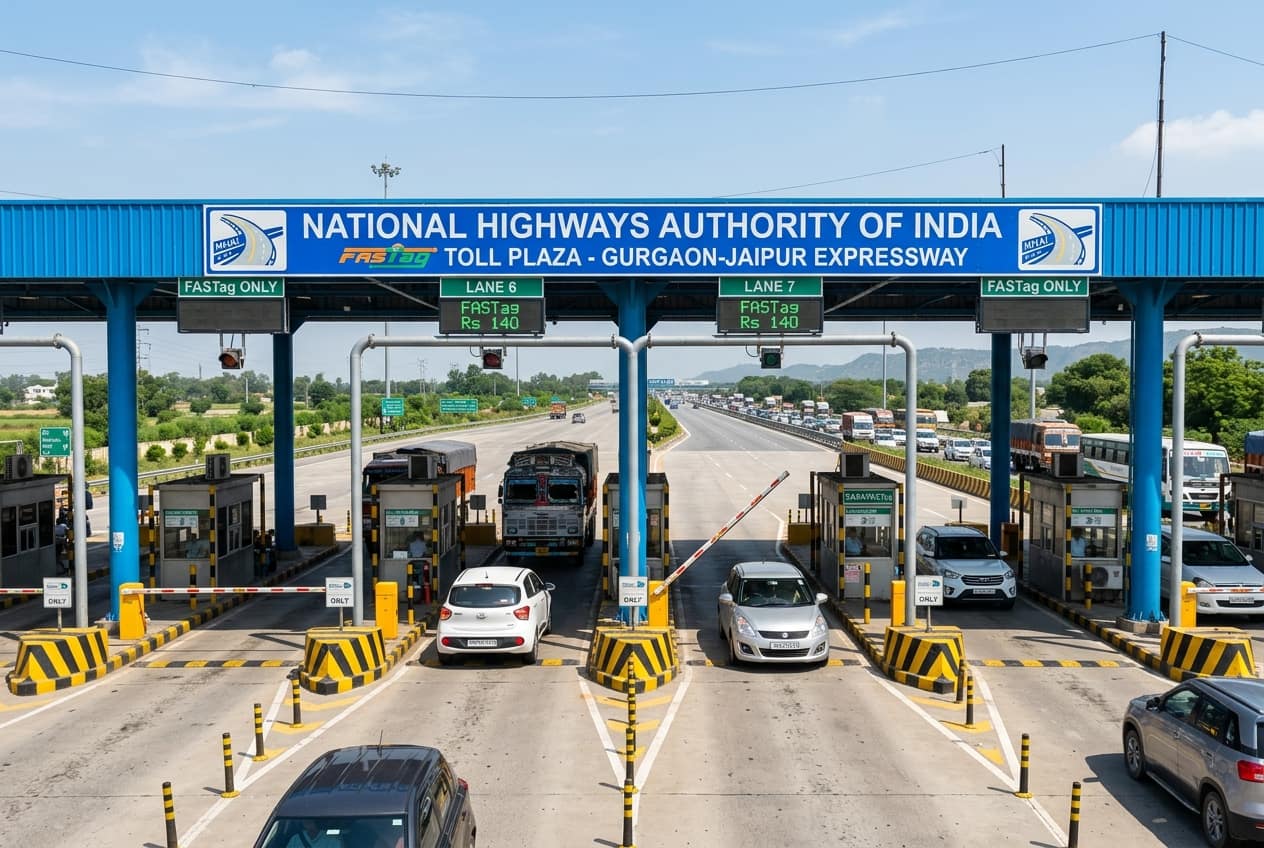
A toll management system (TMS) is the software layer that controls toll lanes, records each transaction, manages exemptions and passes, and produces shift and revenue reports. It runs at three levels: lane controller, plaza server and central server. A sound TMS keeps working offline at the lane, syncs when the link returns, and keeps an audit trail for every manual change.
At a glance
- Typical timeline
- 8 to 16 weeks for a new plaza, depending on lane count and site readiness.
- Architecture
- Lane controller, plaza server and central server with store and forward.
- What you receive
- Configured software, interface documents, test records, user manuals and trained staff.
- Key reports
- Shift, collector, class wise, exemption, pass and reconciliation reports.
- Best suited for
- New toll plazas and plaza upgrades under concession or EPC contracts.
- Our scope
- Server setup, lane integration, reporting, audit trails and reconciliation support.
Toll Management System (TMS) Overview
A toll management system is the part of a plaza that nobody sees from the highway and everybody argues about at month end. Every barrier lift, every FASTag read, every cash exemption and every receipt has to land in a record that the concessionaire, the authority and the auditor can all read and trust. Our toll management system implementation work is about building that record so it is complete, time stamped and hard to alter quietly.
The system is built in three tiers. The lane controller sits in the lane, talks to the equipment (reader, barrier, display, loop detectors, booth terminal) and makes the decision in real time. The plaza server collects lane data, handles shift closure, collector login and local reports. The central server consolidates one or many plazas for management, revenue assurance and sharing with the authority. Each tier has to survive the loss of the tier above it, which is the single most important design rule in this work.
We implement and integrate TMS software for new plazas and for plazas where an older system is being replaced or extended. Sometimes the client has already chosen the software product and needs a site integrator who can commission it with the lane equipment, the network and the bank interfaces. Sometimes the client wants us to recommend the right structure and then deliver it. Both routes need the same discipline: written interface definitions, a lane by lane test plan and a clear cut over date.
Plazas on state highways, national highways and industrial estate access roads each carry different reporting expectations, and a concessionaire running plazas in more than one state often meets a different authority format in each. We ask for the concession agreement extract, the authority's reporting formats and the bank or acquirer interface documents before we propose anything, because the agreement decides what the TMS must report and how long data must be retained.
Ideal for: New toll plazas and plaza upgrades.
What Our Toll Management System (TMS) Includes
Our TMS scope covers the software tiers, the lane integration, the reporting and the controls that make the numbers defensible.
Lane, plaza and central server setup
We install and configure the lane controllers, plaza server and central server, size storage to your retention period and set up mirrored disks and scheduled backups. Practical tip: insist on a restore test before go live, not just a backup job that reports success.
Transaction, shift and revenue reporting
We configure shift, collector, lane, class and payment mode reports, and match them to the authority's own formats where required. You receive a report catalogue with sample outputs. Practical tip: agree the exact report formats during design, because changing them after commissioning is slow and costly.
Exemption and pass management
Exempt vehicle categories, monthly passes and local concessions are held in a controlled master with validity dates, approvers and change history. We load your existing lists and clean duplicates. Practical tip: assign one person to own the master list, since uncontrolled edits are a common leakage point.
Audit trails and reconciliation support
Every manual action is logged with user, terminal, time and reason, and reconciliation views compare TMS, bank and cash totals by shift and lane. We train your finance staff to read them. Practical tip: run a mock audit in the first month so gaps appear early.
Why toll management systems fail audits and lose revenue
Most TMS trouble starts at the lane, not in the software. A lane controller that blocks when the plaza server is unreachable creates queues. A lane controller that keeps working but cannot store transactions safely creates gaps. We often see plazas where a network outage of twenty minutes produces a long tail of missing or duplicated records, because store and forward was never tested with the cable physically pulled.
The second common failure is weak control over manual actions. Collectors override a class, mark a vehicle exempt, reopen a closed shift or print a duplicate receipt. If the system does not record who did it, when, from which terminal and with what reason, then reconciliation becomes an argument about memory. Auditors ask for exactly this trail, and a plaza that cannot produce it usually pays in disputes.
The third failure is poor reconciliation design. The TMS total, the bank settlement total and the cash deposit total rarely match to the rupee on day one. A good system makes the difference visible by shift, lane and payment type so the cause can be found in minutes. A poor one shows a single daily number and leaves the finance team to dig through exports.
What You Gain
Lane keeps working offline
Lane controllers hold the tariff, exemption list and a local transaction store, so the lane continues to serve traffic when the plaza link drops and uploads records in sequence when it returns.
Complete audit trail
Every override, exemption, manual class change and shift reopening is logged with user, terminal, time and reason. This is the document trail an authority auditor or concessionaire finance team will ask for first.
Shift and revenue reporting you can reconcile
Reports are cut by shift, collector, lane, class and payment mode, so a mismatch is traced to a lane and a time window instead of being a single unexplained daily difference.
Controlled exemptions and passes
Exempt vehicle lists, monthly passes and local resident concessions are held in one master with validity dates and approvers, which reduces leakage from informal handling at the booth.
Faster fault diagnosis
Lane, equipment and interface health is visible on a status screen at the plaza, so the shift supervisor can see a dead reader or a stuck barrier before the queue shows it.
Ready for plaza growth
Adding a lane, a plaza or an interface later is a configuration job, not a rebuild, because lane templates, tariff tables and user roles are defined once and reused.
How the Work Is Delivered
We deliver a TMS in stages that match how plazas are actually opened and audited. Each stage ends with a written record you can keep.
- 1
Requirement capture and survey
We read the concession agreement extract, the authority's reporting formats and the bank interface documents, then walk the plaza to count lanes, booths, cable routes and server space. The output is a requirement sheet that both sides sign.
- 2
Architecture and interface design
We define the lane, plaza and central tiers, the database layout, backup approach and every external interface. Each interface gets a short document listing messages, timeouts and behaviour on failure, so nothing is left to assumption.
- 3
Server and network preparation
Plaza and central servers are installed with storage sized for the data retention period, time sync from a single source and a tested backup. We verify the lane to plaza network, including what happens when a switch or cable fails.
- 4
Configuration and lane integration
Tariff tables, vehicle classes, user roles, shift rules and exemption masters are configured. Each lane controller is connected to its equipment and tested one device at a time before the full lane is exercised.
- 5
Testing and failure drills
We run scripted test cases lane by lane: normal passage, exempt vehicle, class override, receipt reprint, shift close and reopen. Then we run the failure drills, such as pulling the plaza link and restarting a server, and record what the lane did.
- 6
Parallel run and cut over
Where an older system exists, we run both for an agreed period and compare totals daily. Cut over is scheduled for a low traffic window with a rollback plan, and the first week after go live has an engineer on site.
- 7
Handover, training and support
Collectors, supervisors and the plaza manager are trained on their own roles. We hand over manuals, the interface documents, test records and admin credentials, and set up support under an AMC if required.
TMS architecture: lane, plaza and central tiers
The lane controller is an industrial computer or embedded controller placed in the lane cabinet or booth. It reads the vehicle identification (tag, card or manual entry), applies the tariff, drives the barrier and displays and writes the transaction to local storage before it does anything else. Writing first is a deliberate choice. If power fails halfway through the passage, the record exists and can be resolved later, instead of the passage vanishing.
The plaza server holds the master data, collector accounts and the day's transactions, and it pushes tariff and exemption updates down to the lanes. The central server pulls from plazas, runs revenue assurance reports and exposes data to the authority or the concessionaire's head office. Between tiers we use acknowledged message delivery, sequence numbers and clock synchronisation from one source, so missing or repeated records can be detected mechanically. Database and application servers are backed up on a schedule that we test by actually restoring, because an untested backup is only a hope.
Concession agreement and authority formats
The agreement decides vehicle classes, fee rules, reporting periods and data retention. We design the TMS reports to the authority's own formats so the concessionaire does not rebuild them in spreadsheets each month.
NPCI NETC and IHMCL interface rules
Where electronic toll collection is in use, transaction messages follow the NETC specifications published by NPCI and the operating rules set with IHMCL. Our integration follows the current published specification supplied by the acquirer.
Time synchronisation design rule
All lane controllers and servers take time from one source. Transaction order, shift boundaries and dispute resolution all depend on timestamps that agree to within a second or so.
Data retention and backup rule
Retention is set from the agreement and the audit cycle, then storage is sized to match with growth margin. Backups are copied off the plaza server and restore tests are logged.
Access control and role design
Collector, supervisor, plaza manager and auditor roles carry different rights. Shared logins are not allowed in our configuration, because they make the audit trail meaningless.
Worked example: TMS for an eight lane plaza on a state highway
Take a plaza with eight lanes, two of them reversible, a plaza building with a server room and a head office link to the concessionaire. The authority wants daily class wise reports and monthly reconciliation against bank settlements. The concessionaire wants live visibility of lane status from the head office.
We would survey the lane cabinets and booth cable routes, then install a plaza server pair with mirrored storage and a central server at head office. Lane controllers are configured from one template and customised for the reversible lanes. The tariff table, exemption master and role list are loaded and verified by the plaza manager line by line. Failure drills run for two days, including a deliberate plaza link cut during live traffic in a low volume window.
In the first month, the client typically sees shift reports that close without manual correction, a short list of exceptions each day instead of a long one, and a reconciliation view that points at a lane and a time window when totals differ. Teething issues usually concentrate in master data, such as an outdated exemption list, and not in the software itself.
- Shift closure completes without manual fixes on most days after the first fortnight
- Reconciliation differences are traced to a lane and time window within the same day
- Plaza link outages no longer stop lanes or lose records
- Authority reports are produced from the system instead of rebuilt by hand
This is an illustrative scenario built from typical site conditions. Actual quantities, timelines and results depend on your site survey.
Toll Management System (TMS) Across Four States
We are based in Nashik and deliver across Maharashtra, Gujarat, Madhya Pradesh and Rajasthan. Each state has its own utilities, approvals and site conditions, and these are the points that matter most for this service.
Maharashtra
Plazas here sit under national highway authorities and the state road development corporation, each with its own reporting format. Ask which format applies before design. Monsoon and summer heat both hit booth cabinets, so we specify ventilation and sealed cable entry for server and lane controller enclosures.
Gujarat
Plazas on NH 48 and the other corridors in Gujarat carry heavy freight, so shift volumes and reconciliation load are high. Coastal sections have salt laden air that corrodes server room and cabinet fittings, so we choose coated enclosures and check terminals during the TMS commissioning visit.
Madhya Pradesh
Plazas on long inter-city stretches often have a weak or single link to the central server. We test store and forward with the link cut for hours, not minutes, and size local storage for that. Monsoon causes frequent power dips, so we verify UPS runtime at the plaza server.
Rajasthan
Rajasthan plazas on the Delhi to Mumbai Expressway and desert roads face extreme summer heat and fine dust. Server rooms need proper cooling and filtered air. Remote plazas may have limited network options, so we plan a second link and confirm failover with the concessionaire.
Where This Work Is Most Often Needed
Why Teams Work With Us on This
Single window for lane and network
The same team installs lane equipment, fibre or copper links, CCTV and power, so a TMS fault is not bounced between four vendors. One site engineer owns the fault from the lane device to the server.
Interface documents you keep
Every interface between the TMS, the equipment and the bank side is documented with message lists and failure behaviour. If you change a vendor later, the next engineer starts with facts.
Nashik based site team
Our engineers are based in Nashik and are mobilised for survey, installation and commissioning across Maharashtra, Gujarat, Madhya Pradesh and Rajasthan. That matters during cut over week, when decisions need to be made at the lane, so we plan the team around your cut over date.
AMC continuity after go live
The people who commissioned the system can stay on under an AMC, with service levels agreed in the contract for each plaza, so knowledge of your lane configuration stays with the support team.
Need AMC for an existing system?
We maintain installations done by other vendors too, after a short audit of what is already on site.
Guides and Projects Related to This Service
Frequently Asked Questions
01What is a toll management system and what does it do?
A toll management system is the software and server setup that runs a toll plaza. It identifies each vehicle, applies the correct fee, records the transaction, handles exemptions and passes, and produces shift and revenue reports. It operates in three tiers, lane, plaza and central, so a failure in one tier does not stop toll collection in the tier below.
02How long does TMS implementation take?
A typical new plaza needs about 8 to 16 weeks, depending on lane count, how ready the civil work and cabling are, and how quickly interface documents arrive from the bank or authority. Software configuration is the shorter part. Integration, testing and failure drills take most of the time, and should not be compressed.
03What happens to toll collection when the plaza server fails?
Lanes should keep working. Each lane controller holds the tariff, exemption list and a local transaction store, so it can complete passages on its own and upload records when the server returns. We test this by switching off the plaza server during live traffic windows and checking that every transaction appears afterwards.
04How much does a toll management system cost?
Cost depends on lane count, number of plazas, software licensing model, server redundancy, interface count and how much custom reporting the authority requires. A realistic way to price it is per lane for controllers and integration, plus a plaza and central layer. We give a firm number after a survey and a review of the agreement.
05Can you integrate our existing TMS software with new lane equipment?
Yes, if the software vendor provides an interface specification and test support. We need the protocol document, a test environment and a named technical contact at the vendor. Without these, integration becomes guesswork. In that case we recommend a short paid study before committing to a schedule.
06What documents should I ask a TMS vendor for?
Ask for the architecture diagram, the interface documents, the lane test plan with signed results, the failure drill record, the user role matrix, the backup and restore procedure and the training record. We hand all of these over at completion, and any vendor should be able to do the same.