
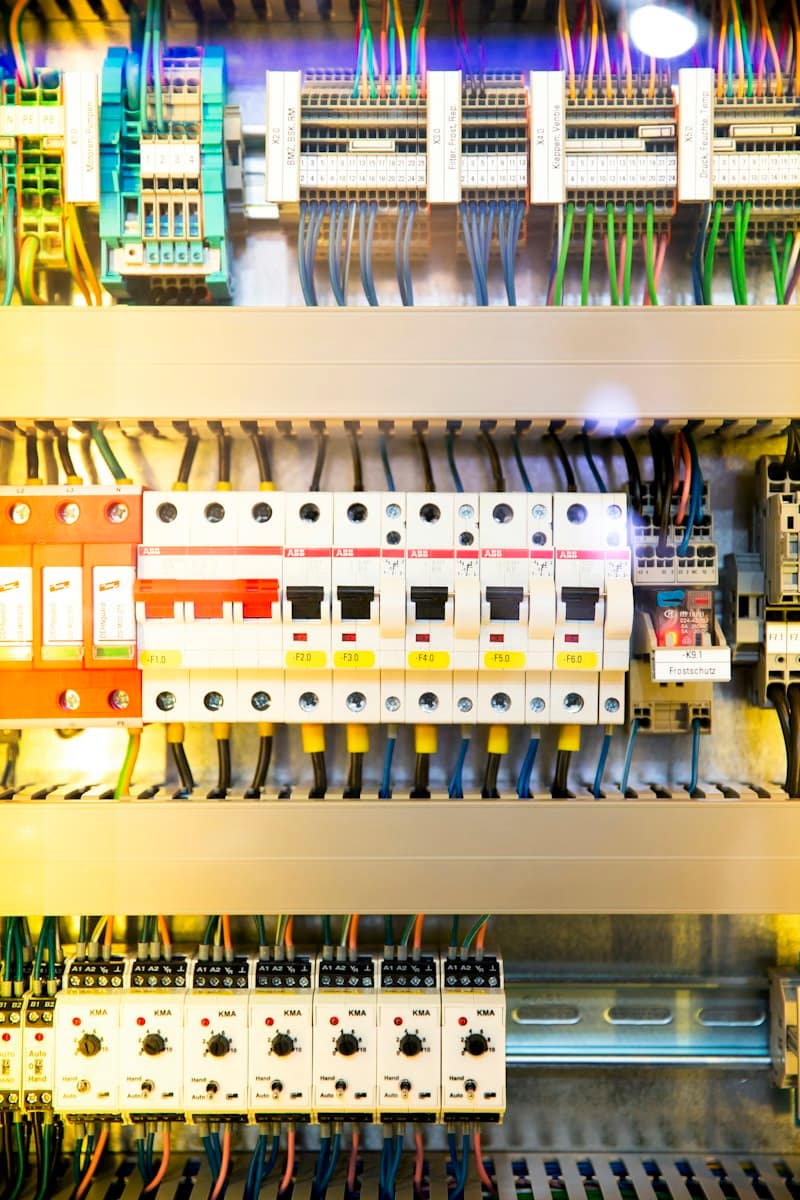
Electrical works and infrastructure covers everything between the utility connection and the last load: HT and LT installation, panels, wiring, power cables, earthing and lightning protection, outdoor lighting, UPS backup and maintenance. Shruti IT Service has delivered this since 2014 from our base in Nashik, with test reports for every system and AMC after handover.
At a glance
- Our scope
- HT/LT installation, panels, wiring, cable laying, earthing, lighting, UPS and AMC
- Typical timeline
- Small fit-outs take 2 to 4 weeks, a new plant electrical system usually 3 to 6 months, depending on site readiness and utility approvals
- Key standards
- IS 732, IS 3043, IS/IEC 62305, IS 1554 and the Indian Electricity Rules
- What you receive
- Single-line diagrams, test reports, as-built drawings, earth resistance records and maintenance logs
- Best suited for
- Industrial plants, developers, EPC contractors, highway projects and government bodies
- Site survey
- Load, route and earthing survey before any quotation is fixed
Electrical Works & Infrastructure Overview
Electrical contracting for industrial and commercial projects is a chain of dependent jobs. The transformer feeds the LT panels, the panels feed the cables, the cables reach the wiring, and every one of them needs an earth path and protection. Shruti IT Service takes that whole chain, from the utility metering point to the last socket, pole light or UPS output, under one contract and one site team.
We have worked on electrical systems since 2014 from our base in Nashik, and the team now numbers more than 50 people across supervisors, wiremen, jointers, testing engineers and project managers. We serve clients in Maharashtra, Gujarat, Madhya Pradesh and Rajasthan, mobilising crews from Nashik for survey, installation and commissioning. The work covers factories in industrial estates such as MIDC, GIDC and RIICO areas, warehouses, offices, townships, highway and toll sites, campuses and solar plants. In many of these projects we also install the CCTV, network, fire alarm or solar systems, so the electrical design is made with those loads in mind from day one.
This category groups eight services: HT and LT electrical installation, electrical panels, industrial and commercial wiring, power cable laying and termination, earthing and lightning protection, street, high-mast and area lighting, UPS and power backup, and electrical AMC. Each has its own page with scope, standards and a worked example. You can buy one of them alone, but most projects use three or four in sequence, and this page explains how they fit together.
Every job ends with paper that an inspector, a client engineer or an insurer can check: single-line diagrams, cable schedules, insulation resistance and earth resistance results, panel test sheets and as-built drawings. If a contractor cannot hand you these on the last day, the work is not finished, however good it looks.
Electrical Works & Infrastructure Services We Deliver
HT & LT Electrical Installation
Transformer, RMU and HT switchgear installation, LT distribution and sub-distribution, load calculation and single-line diagrams, with support for statutory inspections. Suited to new plants, expansions and commercial buildings that need power brought in safely and approved before energisation.
Electrical Panels: LT, MCC, APFC & DB
Supply, installation and testing of LT, PCC and MCC panels, APFC units, distribution boards and feeder pillars, built to your specification and commissioned with routine test reports. Suited to factories, commercial buildings and infrastructure projects with defined feeder lists.
Industrial & Commercial Wiring
Conduit, tray and raceway installation with power, lighting and machine wiring, office and floor fit-outs, and insulation resistance reports. Suited to factories, warehouses, offices and fit-out projects where internal wiring must be neat, labelled and code-compliant.
Power Cable Laying & Termination
Trenching, cable laying, tray and ladder installation, heat-shrink and cold-shrink terminations and joints, with route marking and testing. Suited to industrial estates, highways, solar plants and campuses where long underground or tray runs carry the main power.
Earthing & Lightning Protection
Chemical and conventional earthing pits, lightning arresters and down-conductors, surge protection for CCTV, IT and toll equipment, and earth resistance testing with reports. Suited to plants, poles, toll plazas and solar sites exposed to monsoon lightning and dry desert soil.
Street, High-Mast & Area Lighting
LED street-light installation, high-mast and mid-mast lighting, timers and controls, pole foundations and cabling. Suited to highways, toll plazas, townships, industrial yards and municipal projects where outdoor lighting must meet lux targets and survive the weather.
UPS & Power Backup Solutions
Online UPS sizing, supply and installation, battery banks with monitoring, DG set integration with ATS or AMF changeover, and power-quality assessment. Suited to server rooms, control rooms, hospitals and toll plazas that cannot tolerate even short outages.
Electrical AMC & Maintenance
Scheduled panel and switchgear maintenance, thermography and load audits, breakdown response with agreed service levels, and maintenance records with safety reports. Suited to factories, commercial buildings and institutions that want electrical reliability to be managed, not left to chance.
Where electrical projects go wrong
Most electrical failures that reach us trace back to decisions made before any cable was pulled. A transformer sized on connected load instead of demand load runs hot or sits half empty. Panels are ordered before the single-line diagram is frozen, so a feeder is added late and there is no spare way in the busbar chamber. Cable routes are drawn on paper, then a drain, a pipeline or a column footing is found in the trench, and the route is changed without anyone updating the drawing.
The second group of problems is about quality that cannot be seen. A lug crimped with the wrong die, a loose bolted joint on a busbar, an earth pit that was never watered or topped up, a conduit full of 12 cables where the derating table allowed 8. All of these pass a visual walk-through. They show up months later as a tripping breaker, a burnt terminal or a failed drive, usually in the first summer or the first monsoon.
The third problem is ownership. When civil, panel, cabling, lighting and backup power are given to five vendors, nobody owns the interfaces: who supplies the cable glands, who tests the earth, who commissions the ATS with the DG set. A single accountable contractor with a clear test plan removes most of this friction, which is the reason many plant heads now prefer to bundle electrical works with the ELV and IT systems on the same site.
What You Gain
One accountable team
Design, supply, installation, testing and maintenance sit under one contract. When a feeder trips or a test fails, you call one project manager instead of tracing responsibility between vendors.
Fewer surprises at inspection
We build the document set as the work proceeds: SLDs, cable schedules, test sheets and as-built drawings. Your electrical inspector, insurer or client engineer finds what they ask for on the first visit.
Right sizing from the start
Load lists, diversity, voltage drop, fault level and future expansion are worked out before equipment is ordered. You avoid both the oversized transformer you pay for and the undersized cable you replace.
Safer plant and people
Proper earthing, protective devices set against fault levels, labelled isolation points and tested lightning protection reduce shock, fire and equipment damage risk across the site.
Coordination with other systems
Because we also install CCTV, fiber, access control and solar, power points, UPS feeds, surge protection and earthing for those systems are planned together instead of patched in later.
Support after handover
AMC visits, thermography and load audits keep the installation healthy. Records from earlier visits let us spot trends such as a warming joint or a rising earth resistance.
How the Work Is Delivered
A multi-system electrical project works best when it runs in a fixed order, because each phase produces the information the next one needs. This is the sequence we follow on a typical industrial or commercial site.
- 1
Load study and site survey
We walk the site with your engineers, list connected and running loads, mark candidate cable routes and panel rooms, check soil conditions for earthing, and note what the utility connection allows. The output is a short survey report and a first load schedule.
- 2
Design, SLD and BOQ
We prepare the single-line diagram, cable sizing with voltage drop and short-circuit checks, protection settings, earthing layout and a priced bill of quantities. You approve drawings before any equipment is ordered.
- 3
Approvals and utility coordination
Where HT supply, a new transformer or a load increase is involved, drawings and applications go to the state electricity distribution company (MSEDCL in Maharashtra) and the state Electrical Inspectorate. We prepare the technical file. The application itself is signed by you as the consumer or by your licensed contractor.
- 4
Supply and civil interfaces
Panels, cables, transformers, poles and accessories are ordered against approved drawings. We agree trench widths, plinths, cable entries, pole foundations and panel room dimensions with your civil team before concrete is poured.
- 5
Installation and quality checks
Supervisors check each stage: cable bend radius, tray fixing, lug crimping, torque on busbar joints, earth continuity. Photographs and checklists are kept per feeder so any later question has evidence.
- 6
Testing and commissioning
We run insulation resistance, continuity, earth resistance, protection relay and functional tests, then energise in a planned sequence. Test sheets are signed by both sides and attached to the handover file.
- 7
Handover, training and AMC
You receive as-built drawings, test reports, spare lists and operating instructions, and your operators get a walk-through. An AMC contract, agreed per site, continues the preventive work with inspection records.
How the electrical subservices fit together
Think of the system in three layers. The supply layer is the utility incoming, HT switchgear, transformer and DG set. The distribution layer is the LT panels, MCC, APFC and distribution boards, joined by power cables on trays or in trenches. The load layer is wiring, motors, lighting, UPS and the ELV systems. Earthing and lightning protection wrap around all three. Changing a decision in one layer, such as moving the transformer, changes cable lengths, voltage drop and fault levels in the others, so the design has to be reviewed as a whole.
Quality at the joints decides reliability. Bolted connections are torqued to the manufacturer's value and marked. Cable terminations use lugs matched to conductor size and crimp tool. Protection devices are chosen for the prospective fault current at that point, not just for load. Critical loads such as servers, toll lanes or control rooms sit behind online UPS with defined autonomy, and the DG set is wired through an ATS or AMF panel so the changeover is tested, not assumed. These details are checked on our commissioning sheets for each subservice.
IS 732 and IS 3043
IS 732 governs wiring installations and IS 3043 covers earthing practice. We design conductor sizes, protection and earth electrode layouts against these codes and record the results in the test sheets.
IS/IEC 62305
This series sets out lightning protection risk assessment and system design. We use it to decide whether a structure needs an air-termination system, how many down-conductors, and what surge protection devices are required.
Indian Electricity Rules and CEA regulations
Statutory safety requirements apply to HT and LT installations. Inspection and energisation approvals remain the consumer's responsibility, and we prepare the technical documents that support them.
IS 8623 and IEC 61439
These cover low-voltage switchgear and controlgear assemblies. Panels are built and type or routine tested against them, and the routine test report goes into your handover file.
IS 1554 and IS 7098
These govern PVC and XLPE insulated power cables. Cable selection depends on voltage grade, installation method, ambient temperature and grouping, all of which affect current rating.
NBC 2016 Part 4 and IS 2189
Fire safety rules affect cable choice, fire-rated shafts and the power supply to fire systems. Electrical design is coordinated with the fire alarm design so supplies and cable routes meet these requirements.
Worked example: electrical scope for a new 5,000 square metre factory shed
Consider a light engineering unit in an industrial estate with a connected load of around 400 kW and a maximum demand of roughly 250 kW after diversity. The owner wants HT supply at the plot, one 500 kVA transformer, an LT main panel with APFC, a motor control centre for machining lines, lit shop floor, an office block, perimeter lighting and a small server room. The utility process runs in parallel with design work.
We start with the survey and load schedule, then freeze the SLD with the plant engineer. Earthing is designed for a target resistance suited to the transformer neutral and the electronic loads. The order of work is cable trenches and pole foundations first, panel installation second, wiring and tray work third, lighting fourth. UPS for the server room and the CCTV head-end is added in the last phase, and the AMC starts at handover. Each phase ends with its own tests so faults are found while the area is still accessible.
The common friction points on such a site are late changes in machine layout and weather delays to trenching, whether monsoon rain in Maharashtra and Madhya Pradesh or hard, dry ground in Rajasthan. We hold a buffer in the schedule for both, and we keep the revision log of the SLD so the as-built set matches what is on the wall.
- Approved SLD, cable schedule and earthing layout before equipment orders
- Panel, cable and earth test reports signed at commissioning
- Energisation sequence planned with the utility and the Electrical Inspectorate
- AMC calendar and as-built drawings handed over with spares list
This is an illustrative scenario built from typical site conditions. Actual quantities, timelines and results depend on your site survey.
Electrical Works & Infrastructure Across Four States
We are based in Nashik and deliver across Maharashtra, Gujarat, Madhya Pradesh and Rajasthan. Each state has its own utilities, approvals and site conditions, and these are the points that matter most for this service.
Maharashtra
HT supply and load enhancement run through MSEDCL, and HT installations need the state Chief Electrical Inspector's clearance. Most of our electrical work here sits in MIDC estates, townships and highway sites. Monsoon rain delays trenching and foundations, so civil and cable schedules need a weather buffer from June to September.
Gujarat
Supply comes from the GUVNL group DISCOMs (DGVCL, MGVCL, PGVCL, UGVCL) or a private licensee such as Torrent Power in some cities. GIDC estates are dense with process plants. Coastal areas in Kutch, Saurashtra and South Gujarat have salt air, so enclosure finish, lugs and fasteners need corrosion protection.
Madhya Pradesh
Three regional DISCOMs (East, Central and West) supply the state, and industrial areas such as Pithampur and Mandideep carry large manufacturing loads. Summers are hot and the monsoon is strong, so panel room ventilation and trench drainage both matter. Confirm connection and inspection steps with the regional DISCOM early.
Rajasthan
Supply comes from JVVNL, AVVNL and JdVVNL, and RIICO estates host much of the industry. Extreme summer heat and fine desert dust drive design: transformers and panels need derating for ambient temperature, sealed enclosures need filtered ventilation, and cable routes in sandy or rocky ground need careful bedding.
Where This Work Is Most Often Needed
Why Teams Work With Us on This
Electrical and ELV under one roof
We install CCTV, networks, access control and solar as well. Power feeds, earthing and surge protection for those systems are designed together with the electrical scope.
Documents you can hand to an inspector
SLDs, cable schedules, test sheets and as-built drawings are produced during the work. Nothing is reconstructed from memory at the end.
Nashik base, multi-state delivery
Supervisors and testing engineers are mobilised from Nashik for survey, installation and commissioning in Maharashtra, Gujarat, Madhya Pradesh and Rajasthan, and AMC visits are planned by route and site cluster.
Continuity from project to AMC
The team that built the installation knows its cable routes and panel layouts. The AMC starts from the commissioning records instead of from zero.
Electrical Works & Infrastructure Across Our Four States
We are based in Nashik and deliver across Maharashtra, Gujarat, Madhya Pradesh and Rajasthan. Each local page covers the power utility, climate, approvals and site types that change how this work is designed in that place.
Major cities in Maharashtra
Guides and Projects Related to This Service
- ArticleSizing a Rooftop Solar Plant and Checking Its Payback: A Worked Example
- ArticleWhat to Ask Before You Sign an AMC: A Checklist for Buyers
- ArticleHow to Size a UPS and Battery Bank: A Worked Example for a Small Server Room
- ArticleVoltage Drop in CCTV Cable: Choosing the Right Size for 12 V Cameras
- ArticleIndustrial Electrical Infrastructure: Earthing, Panels & Safety Compliance
Frequently Asked Questions
01What does an electrical contractor actually do on an industrial project?
An electrical contractor designs or implements the power distribution from the utility point to the loads. That includes HT and LT equipment, panels, cables, wiring, earthing, lighting and backup power. A good contractor also prepares drawings, test reports and statutory documents, and coordinates with civil, mechanical and ELV teams so that routes, plinths and supplies do not clash.
02How long does an industrial electrical installation take?
A small fit-out can finish in 2 to 4 weeks, while a new plant electrical system commonly takes 3 to 6 months. The range depends on utility approvals, equipment lead time for transformers and panels, civil readiness and weather. Ask for a schedule that separates our activities from approvals, because the approvals are often the longest item.
03How much does electrical work cost?
Cost is driven by connected load, voltage level, cable lengths, panel count and specification, and site conditions such as rock or high water table. A firm number needs a survey and a load schedule. Compare quotations line by line, with conductor size, panel make class and test scope stated, because a lower price often hides thinner cables or fewer tests.
04Who is responsible for statutory approvals such as the DISCOM and the Electrical Inspectorate?
The consumer or owner is legally responsible, and some applications need a licensed contractor or supervisor to sign. We prepare the drawings, load details and test reports that support the application and attend inspections with your team. Agree this split in writing at the start so the approval timeline is not left to assumption.
05Can one contractor handle both electrical and CCTV, network or solar work?
Yes, and for many sites it reduces delays. Shruti IT Service installs electrical, CCTV, IT, fire alarm and solar systems, so power points, UPS feeds, earthing and cable routes are planned once. The trade-off is that you depend on one vendor, so ask for separate test reports for each system to keep accountability clear.
06Which documents should I ask for at handover?
Ask for the final single-line diagram, panel general arrangement and wiring drawings, cable schedule, as-built layout, insulation and earth resistance reports, panel routine test reports, protection settings, and an O&M manual with a spares list. Warranties from equipment makers should be listed with dates. Without these, maintenance and future expansion become guesswork.