
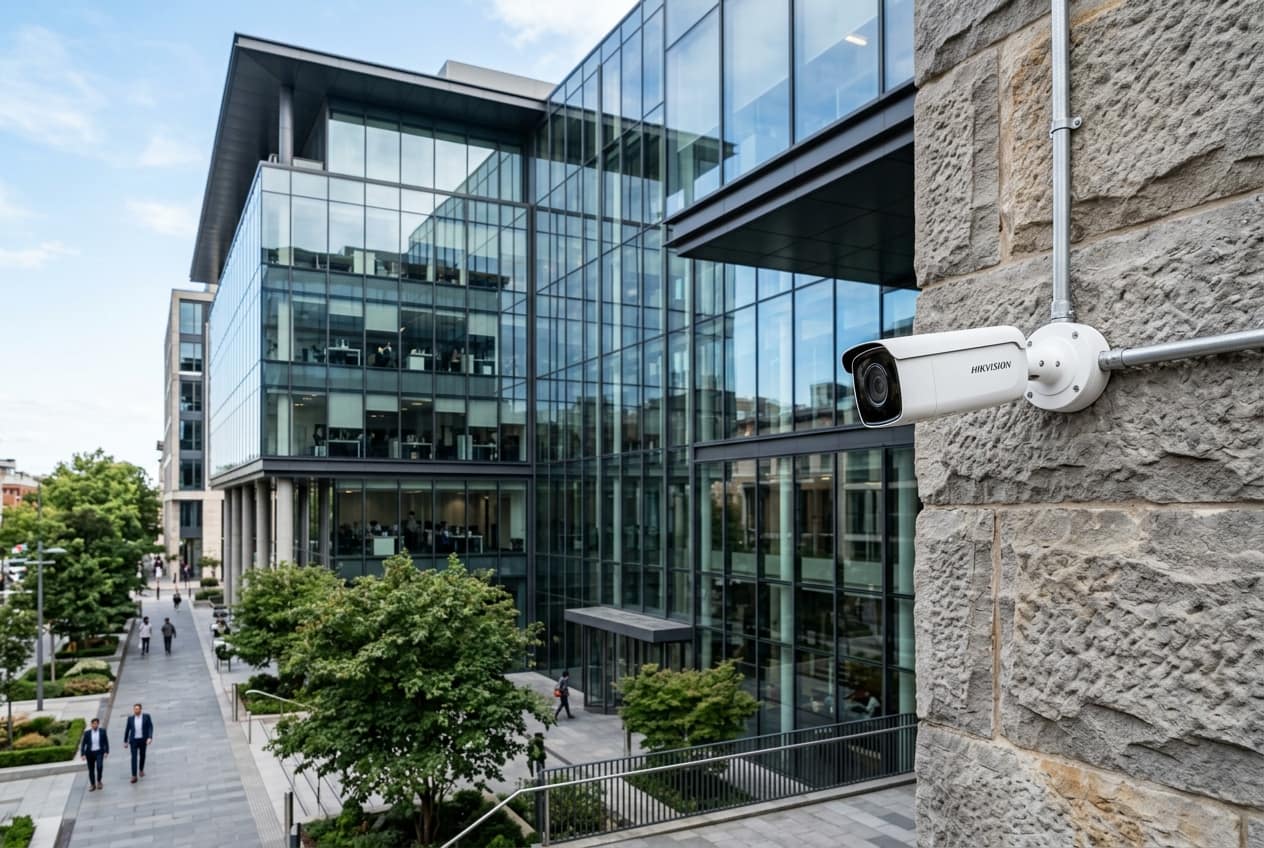
Enterprise CCTV surveillance systems combine cameras, cabling, recording, video management software and monitoring into one managed security platform. Shruti IT Service designs, installs, integrates and maintains them for plants, campuses, warehouses, highways and multi-site organisations in Maharashtra, with seven service areas from site survey and design to command rooms and AMC.
At a glance
- Typical timeline
- Design in 1 to 2 weeks, installation in 2 to 4 weeks for a mid-size site, depending on readiness.
- Key standards
- IEC 62676, ONVIF, TIA-568, IS 732, BIS CRS registration for cameras.
- What you receive
- Drawings, BOQ, installed system, test reports, configuration backups and operator training.
- Best suited for
- Facility heads, plant managers, security heads, EPC contractors and government agencies.
- Our scope
- Design, installation, IP and VMS platforms, control rooms, wireless sites, upgrades and AMC.
- Site survey
- Engineer-led survey of coverage, lighting, cable routes, power and network before any quote is fixed.
CCTV Surveillance Systems Overview
Enterprise CCTV surveillance systems are more than a set of cameras. They are a chain: cameras that capture the scene at the right quality, cable and network that carry it, storage that keeps it for the days you need, software that lets people search and manage it, and a maintenance routine that keeps the chain intact. A weak link anywhere, such as an undersized disk group or a camera pointed at the wrong place, gives you a system that exists but does not protect.
Shruti IT Service has worked on surveillance since 2014 from our base in Nashik, serving factories, warehouses, hospitals, campuses, townships, highways and government sites across Maharashtra, Gujarat, Madhya Pradesh and Rajasthan. We handle the whole lifecycle under one contract: survey and design, supply and installation, platform and software, monitoring rooms, remote locations, upgrades of older systems, and annual maintenance. You deal with a single team that is accountable for how the system performs.
The seven service areas on this page fit together as a sequence, but you can enter at any point. A new facility starts with design, moves to installation and perhaps a control room. A multi-site enterprise may begin with the IP and VMS platform. A site with failing analog cameras starts with an audit and upgrade. A site that already has a working system may need only an AMC. We guide you to the starting point that fits your situation.
We keep the advice vendor-neutral. We specify by performance, such as pixel density, retention and ingress protection, and we use open standards like ONVIF, so you retain the freedom to expand, retender or change maintainers. Our own interest is that you come back for the next phase because the first one worked.
CCTV Surveillance Systems Services We Deliver
CCTV System Design & Site Survey
Engineering-led planning before any purchase. We survey your site, set pixel density targets per zone, calculate storage and bandwidth, and issue camera plans and a tender-ready BOQ. Choose this when you are building a new facility, preparing a tender or want a design you can use to compare vendor bids fairly.
CCTV Installation & Commissioning
Turnkey supply, mounting, cabling, PoE switching and recorder setup by our site teams, finished with commissioning checks, as-built drawings, test reports and operator training. Choose this when the scope is clear and you want one accountable contractor to deliver a working, documented system on site.
IP Camera, NVR & VMS Solutions
The platform layer for organisations with many cameras or many sites. We select cameras, deploy and license the VMS, build central recording with failover and integrate access control, fire alarm and analytics. Choose this when you need one view and one set of rules across locations.
Command & Control Room Setup
Design and build of a monitoring room with video wall, ergonomic consoles, alarm management and integrated feeds from CCTV, access, PA and fire systems. Choose this when alarm volume or site count means operators need focused views and a clear response workflow.
Wireless & Remote Site Surveillance
Surveillance where cable cannot go, using point-to-point radio links, 4G or 5G cameras, edge recording and health alerts, with power coordinated for off-grid poles. Choose this for highways, quarries, construction sites, pipelines and solar parks, where connectivity decides the design.
CCTV Upgrade & Analog-to-IP Migration
Modernisation of ageing analog or mixed systems to IP, led by an audit and delivered in phases so coverage never lapses. Hybrid recorders and encoders protect past spending. Choose this when images are poor, recorders are failing or you want to reuse sound cable and poles.
CCTV AMC & Maintenance
Comprehensive and non-comprehensive annual maintenance with preventive visits, HDD and recording checks, firmware management, defined service levels and monthly reports, for systems we installed or others did. Choose this when you want footage to be there on the day you need it.
The common mistakes in CCTV projects, and how to avoid them
The first mistake is buying by camera count and price. Cameras are the cheapest part of a surveillance system and the least important by themselves. What matters is whether each camera sees what it was meant to see at a usable quality, day and night. Insisting on a written design with a pixel density target for each zone, and on a night-time check at handover, removes most disappointment.
The second is treating storage and network as an afterthought. A 4 MP camera on H.265 at a 15 fps profile typically needs in the range of 2 to 4 Mbps. Sixty-four such cameras for thirty days need tens of terabytes, and a switch uplink can overload quietly. We calculate these figures in the design stage and show you the working, so that retention days are real and not a hope.
The third is ignoring maintenance. Disks fail, domes get dirty, UPS batteries age and cameras drift out of position. Systems without an AMC tend to be discovered empty at the worst moment. A maintenance contract with health checks, retention verification and monthly reports costs far less than losing the footage of one serious incident.
The fourth is poor documentation. Without as-built drawings, port maps, credential records and configuration backups, every future fault becomes an investigation. Ask every vendor, including us, for the handover document list before the contract is signed, and tie part of the payment to its delivery.
What You Gain
Accountability from survey to AMC
One team owns design, installation, platform and maintenance. When something fails, you have one place to call and one record of what was built.
Coverage justified in numbers
Pixel density targets, storage calculations and bandwidth sheets make the design checkable. You can show an auditor or insurer why each camera exists.
Scales from one site to many
The same approach works for a single plant and for a network of branches, with a platform that adds cameras and sites without a rebuild.
Integrated with the rest of your security
CCTV can connect to access control, fire alarm, PA and analytics, so one event leads to the right view and the right response.
Open standards, no lock-in
ONVIF conformance, vendor-neutral specifications and open export formats keep your future choices open.
Support that continues after handover
Our Nashik based teams carry on with AMC and support, so people who know your system are the ones who maintain it.
How the Work Is Delivered
A multi-phase surveillance project works best when each phase has a clear output. This is how the work usually sequences across the seven service areas.
- 1
Survey and design
We start with the site survey and system design, which produces camera plans, pixel density targets, storage and network calculations and a BOQ. This is the right first step for new facilities, tenders and any project above a few dozen cameras.
- 2
Platform decision
Before ordering, we decide the recording model and VMS. Single sites may use an NVR. Multi-site organisations need a platform with central search, roles and failover. This decision sets the licence cost for years.
- 3
Supply and installation
Cameras, cabling, PoE switching and racks are supplied and installed by our site teams to the design. Work is scheduled around operations, and every cable and port is labelled to match the drawings.
- 4
Special locations
Remote sites, quarries, highways and construction zones use wireless links, 4G or 5G cameras and edge recording, with power coordinated for off-grid poles. These are planned alongside the main system so they appear in the same VMS.
- 5
Commissioning and acceptance
Views are checked by day and night, retrieval and failover are tested, and results are logged against a checklist. You sign off against evidence, and we close defects before final payment.
- 6
Monitoring room
Where many cameras and sites need watching, a command and control room puts alarms and focused views in front of trained operators. This phase often follows installation once alarm volumes are known.
- 7
Maintenance and upgrades
An AMC keeps the system healthy, and periodic reviews flag ageing equipment. Older systems from any vendor can be audited and upgraded in phases, with analog reused where it still serves.
How the pieces of a surveillance system fit together
At the edge are cameras: fixed domes and bullets for most positions, PTZ units where an operator needs to follow activity, and specialist cameras such as thermal or low-light models for difficult scenes. They connect through Cat6 or Cat6A cabling within the 100 m channel limit, or through fibre for longer runs between buildings, with PoE switches providing power and data. Recording happens on NVRs, on servers running a VMS, or on edge storage in the camera, depending on the site and its network. ONVIF profiles keep devices from different makers talking to each other.
On top sits the management layer. The VMS handles users, roles, search, alarms and integrations. A command room adds a video wall and operator consoles when volume justifies it. Beneath everything is the unglamorous infrastructure: clean power, UPS with the right autonomy, earthing, cooling for racks and a network designed so video does not drown business traffic. A good design considers all layers together. For example, a decision to use higher resolution cameras raises storage and bandwidth, which affects switches, which affects power, which affects the UPS. We model those chains before they become cost overruns.
IEC 62676 series
The international framework for video surveillance systems. We use its pixel density categories of roughly 250, 125 and 62 pixels per metre for identification, recognition and observation when we design coverage.
ONVIF profiles
Interoperability profiles for streaming, advanced video and recording retrieval. We specify them so cameras, recorders and software from different suppliers work together.
TIA-568 and ISO/IEC 11801
Cabling standards that govern channel length, termination and testing. We test and record every link in your handover file.
IS 732 wiring practice and IS 3043 earthing
Indian practice for power wiring and earthing applies to racks, poles and junction boxes, where unstable power is a leading cause of faults.
BIS CRS registration
CCTV cameras sold in India fall under compulsory registration, and we specify and record registered models for you.
Digital Personal Data Protection Act 2023
Footage of identifiable people is personal data. We configure retention, access roles and logs to support your compliance policy, while legal interpretation stays with your counsel.
A typical project: phasing CCTV across a multi-plant industrial group
Consider an industrial group with a head office in Ahmedabad, two plants in industrial areas of Maharashtra and Madhya Pradesh, and a remote storage yard. The group has old analog systems at both plants, nothing at the yard and no central view. The security head wants better gate images, 30 days of retention, one console for all sites and an annual maintenance programme, within budgets spread over two years.
Phase one is a site survey and design for all four locations, producing a BOQ and phase plan. Phase two upgrades the plant gates and dispatch areas to IP, with the rest of the analog cameras kept on hybrid recorders for now. Phase three installs a VMS with edge recording at each plant and central search, and adds a wireless link and 4G camera at the yard. Phase four builds a small control room at head office. An AMC starts as each phase is accepted.
A typical result is clear identification at entry points in the first quarter, a single console by the end of year one and documented maintenance throughout. The client usually gains cost visibility across phases and a system that grows without discarding earlier work.
- A phased plan that matches budget cycles
- Gate and dispatch identification improved first
- Single console across plants and remote sites
- AMC starting phase by phase
This is an illustrative scenario built from typical site conditions. Actual quantities, timelines and results depend on your site survey.
CCTV Surveillance Systems Across Four States
We are based in Nashik and deliver across Maharashtra, Gujarat, Madhya Pradesh and Rajasthan. Each state has its own utilities, approvals and site conditions, and these are the points that matter most for this service.
Maharashtra
Maharashtra work spans MIDC estates, hospitals, campuses and highway projects. Monsoon moisture, power quality and approvals for poles and trenches shape design, and most programmes here start with a site survey followed by a phased rollout over one or two budget cycles.
Gujarat
Gujarat clients often run large chemical, textile, pharma and port related sites. Coastal air, hazardous area rules and a strong plant safety culture influence camera enclosures, cable choices and recording policy, and many programmes link CCTV with access and fire systems.
Madhya Pradesh
Madhya Pradesh programmes cover industrial areas such as Pithampur and Mandideep, government buildings, schools and warehouses. Long distances between sites make central recording and a clear support plan important, and budgets often come through tenders that need a full BOQ.
Rajasthan
In Rajasthan, heat and dust drive equipment choice. Mines, cement units, solar parks and remote yards need sealed housings, solar or backup power and wireless links. We design for summer temperatures first, then check that night image quality still holds when lenses gather dust.
Where This Work Is Most Often Needed
Why Teams Work With Us on This
End to end, survey to maintenance
We design, supply, install, integrate and maintain, so responsibility does not get lost between a consultant, an installer and a maintainer.
Single window with other systems
Fibre, structured cabling, access control, fire alarm, PA, electrical and solar are in our portfolio, so surveillance is coordinated with the rest of your infrastructure.
Documentation as a deliverable
Drawings, calculations, test reports, configuration backups and asset registers are handed over, so you are never dependent on our memory.
Based in Nashik, serving four states
With more than 1000 projects since 2014 and a team of 50+, our site teams are mobilised from Nashik across Maharashtra, Gujarat, Madhya Pradesh and Rajasthan, with service levels agreed in each contract.
CCTV Surveillance Systems Across Our Four States
We are based in Nashik and deliver across Maharashtra, Gujarat, Madhya Pradesh and Rajasthan. Each local page covers the power utility, climate, approvals and site types that change how this work is designed in that place.
Major cities in Maharashtra
Guides and Projects Related to This Service
- ArticleHow to Calculate CCTV Storage: A Worked Example for a 64 Camera Site
- ArticleHow Many Pixels Do You Need? Choosing CCTV Resolution by Pixel Density
- ArticleWhat to Ask Before You Sign an AMC: A Checklist for Buyers
- ArticleHow to Size a UPS and Battery Bank: A Worked Example for a Small Server Room
- ArticlePoE Power Budget for IP Cameras: How to Check a Switch Before You Buy
- ArticleVoltage Drop in CCTV Cable: Choosing the Right Size for 12 V Cameras
- ArticleHow CCTV Surveillance Improves Business Security & Operational Governance
- ArticleAI Video Analytics & ANPR: Turning CCTV into Actionable Intelligence
- ProjectCommercial Complex, Nashik
Frequently Asked Questions
01How much does an enterprise CCTV system cost?
There is no useful single price, because cost depends on camera count, camera class, cable length, civil work, storage days, software licences and integrations. A design stage with a BOQ gives a firm figure. Be wary of quotes by camera count alone, since they often leave out cabling, storage and licences that appear later as extras.
02Where should I start: design, installation or an upgrade?
Start where your situation sits. New sites and tenders benefit from design and survey first. Sites with a clear scope can go directly to installation. Sites with failing analog systems need an audit and phased upgrade. Sites with a working system may need only AMC. A short call and a walk-through usually settles it.
03What is the difference between an NVR and a VMS?
An NVR is a recorder, usually a single box, while a VMS is software that manages many cameras, recorders and users, often across sites. Small single-site systems work well with an NVR. Multi-site or integrated systems benefit from a VMS for central search, role-based access and alarm handling.
04How long does it take to install a CCTV system?
A typical 30 to 60 camera site takes two to four weeks of installation after design and material arrival. Large campuses, wireless sites and control rooms take longer. The schedule depends on cable routes, work windows and site readiness. We agree a plan during design and report progress against it.
05Do you maintain CCTV systems installed by other vendors?
Yes. We carry out a baseline audit, document the condition, recover access with your authorisation and list defects before agreeing an AMC. Where equipment is too old to maintain responsibly we say so, and we propose a phased upgrade that reuses what is still sound.
06How long should CCTV footage be kept?
There is no single rule for every business. Common choices are 30 days for general sites and longer for banks or regulated places, depending on your policy, contracts and legal advice. Retention drives storage cost directly, since doubling days doubles disks. Decide the period early, then we size the system to match.