
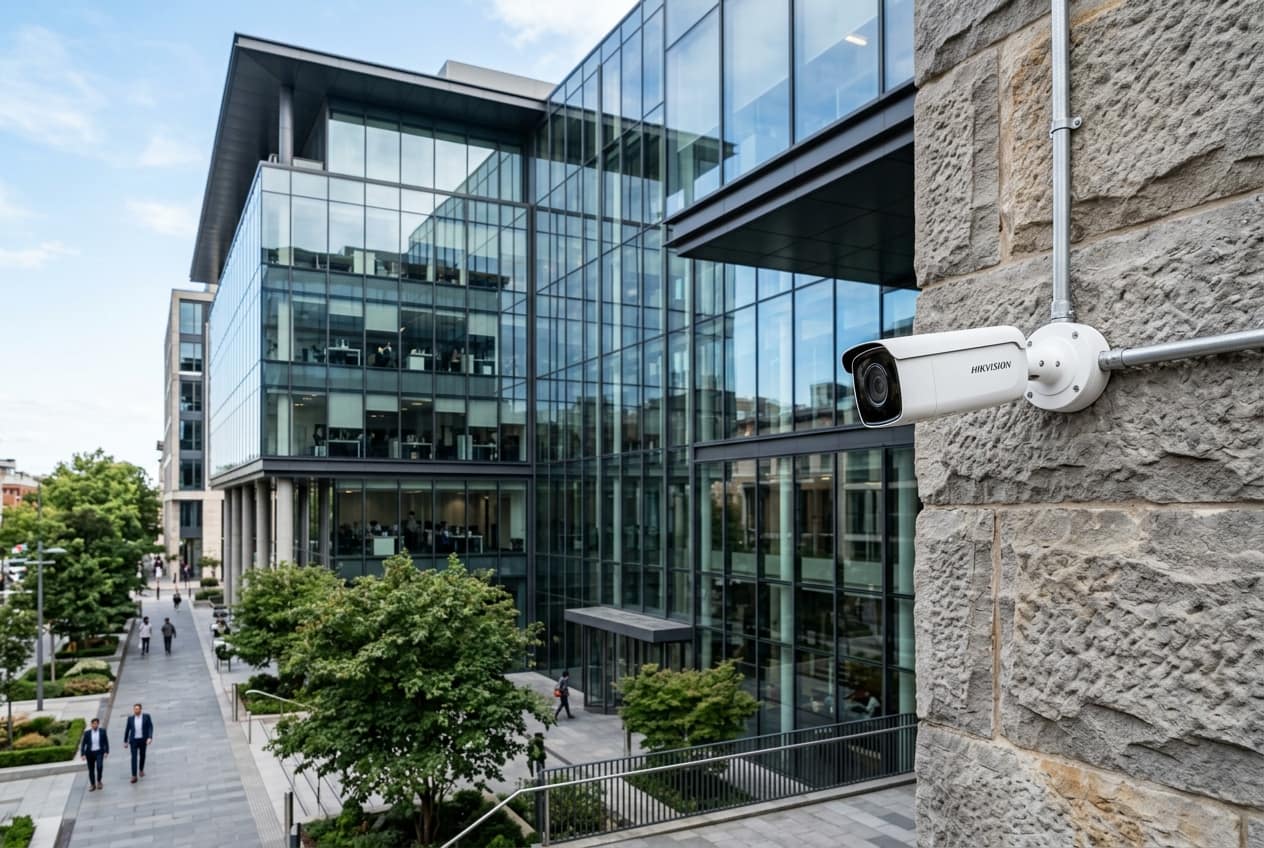
CCTV upgrade and analog-to-IP migration modernises a legacy system to high-resolution IP surveillance while reusing viable cable, poles and power. We audit existing cameras, cabling and recorders, plan a phased migration so coverage never lapses, use hybrid recorders or encoders where they protect past investment, and decommission obsolete equipment responsibly.
At a glance
- Typical timeline
- 2 to 8 weeks for most sites, phased around operations, depending on size and cabling condition.
- Key standards
- ONVIF, IEC 62676, TIA-568 cabling practice, E-waste (Management) Rules for disposal.
- What you receive
- Audit report, migration plan, upgraded system, reuse and disposal record, updated drawings.
- Best suited for
- Organisations with ageing systems, poor image quality or recorders that are failing.
- Our scope
- Audit, phased plan, hybrid options, new IP cameras, decommissioning of old equipment.
- Site survey
- Camera by camera audit of image quality, cabling and mounting condition.
CCTV Upgrade & Analog-to-IP Migration Overview
CCTV upgrade and analog-to-IP migration is for sites that already have cameras, but the cameras no longer do the job. The picture is soft, the recorder is failing, nights are black, or the system cannot connect to anything modern. Replacing everything at once is the easiest advice to give and often the most expensive. A careful audit usually shows that some cable, some poles and some power points are still worth keeping.
Our approach begins with an honest audit. We check every camera for image quality, mounting condition and field of view, every cable run for type and length, and every recorder for age, storage and health. We then sort the system into reuse, upgrade and retire, and we put numbers beside each category so you can see what each choice costs.
Migration is a project in its own right because the site must stay protected while the work happens. We plan in phases, typically starting with the highest-risk areas, and we keep old cameras recording until their IP replacements are proven. Hybrid recorders and encoders let analog and IP run side by side while you spread the investment over more than one budget cycle.
The result is a system with better images, central management and room to add analytics later, built on infrastructure that has been checked rather than assumed. We also deal with the tail end of the project: removing dead cable, recycling old equipment through authorised channels and updating drawings so the next person is not confused by the old layout.
Ideal for: Organisations with ageing systems or poor image quality.
What Our CCTV Upgrade & Analog-to-IP Migration Includes
Upgrade work is audit led. The scope below follows the order in which decisions are made and money is spent.
Audit of existing cameras, cabling and recorders
We inspect every camera, test cable runs, check recorder health and note power supplies, then give each item a reuse, upgrade or retire rating. You receive an audit report with photographs. Tip: ask for sample footage from the worst night view, since that is the quality you will actually have in an incident.
Phased migration plan to avoid security downtime
We sequence the work by risk and area, define cutover and fallback steps, and agree work windows with your team. You receive a phase plan with costs. Tip: convert the entry and exit points first, because those views matter most in any investigation.
Hybrid recorder and encoder options to protect past investment
Where analog cameras are sound, we use hybrid recorders, encoders or IP-over-coax converters to keep them working while new cameras are added. You get a comparison of options with limits stated. Tip: set a date to retire analog channels, so hybrid does not become permanent.
Decommissioning and disposal of obsolete equipment
We remove old equipment, wipe or destroy storage, route electronics to authorised recyclers and update drawings to show what remains. You receive a disposal record. Tip: do not let old recorders leave the site with data on the disks.
Verification and acceptance of the upgraded system
Each phase ends with view checks at day and night, recording tests and retrieval tests, logged against your acceptance list. Tip: compare new footage with the old at the same position, so you see the improvement, and any new blind spot, directly.
Why old CCTV systems quietly fail their owners
Analog systems degrade slowly, which is why owners tolerate them. Cameras lose sensitivity, lenses fog, cable joints corrode and recorders run hot. Typical analog resolution is far below modern IP cameras, so identifying a face or a number plate at any distance is often impossible. Owners find this out only after an incident, when the footage is unusable.
Old recorders are a risk of their own. Failing disks, discontinued firmware, default passwords and open network ports make legacy recorders an easy target. Many have no way to export footage in a standard format, and some have no recent backup of settings. A recorder failure can mean losing both the evidence and the configuration.
Mixed systems are the middle ground and the most confusing. A few IP cameras were added to an analog recorder, a second recorder was bought for a new building, and nobody knows what each device does. The result is several interfaces, inconsistent retention and gaps at the joins.
Finally, rushed replacement wastes money. Throwing out good coaxial cable and buying new cable and switches is sometimes necessary, but sometimes not. Technologies that carry IP over existing coaxial cable exist, with limits on distance and bandwidth, and in the right case they save weeks of work. The point is to decide with data, not habit.
What You Gain
Sharper, usable images
Moving from standard analog to modern IP resolution lets you identify faces and vehicles at distances where old footage showed only shapes.
Continuous protection during change
Phased cutover keeps old cameras live until new ones are verified, so there is no day when a critical area is blind.
Reuse where it makes sense
Sound conduit, poles, power points and, in some cases, cable are kept, which can cut cost and time. We show exactly what is reused and why.
Spread the spend
Hybrid recorders and encoders let you convert the most important areas first and leave low-risk areas for later years, without throwing away a working camera.
A secure, modern recorder base
New recorders and VMS bring supported firmware, access control for users, encryption options and audit logs, closing common legacy security holes.
Ready for analytics and integration
An IP base supports ONVIF integration, analytics and central management when you want them, without another rebuild.
How the Work Is Delivered
Upgrade projects need more checking than new builds. We audit first, plan in phases and verify before we remove anything.
- 1
Audit of existing system
We inspect each camera, cable run and recorder, test image quality, check disk and firmware status and record mounting and power conditions. The audit report lists every device with a reuse, upgrade or retire recommendation.
- 2
Objectives and gap analysis
We compare the current coverage and image quality with what you now need, including retention, remote access and integrations, and identify blind spots that were never covered.
- 3
Migration plan and phasing
We split the work into phases by risk and by building, define cutover steps and fallback, and set out the cost of each phase and the choice between hybrid and full IP.
- 4
Supply and staging
New cameras, recorders, switches and encoders are configured at our bench. Naming, IP plans and user roles are prepared, so on-site work is mainly mounting, cabling and testing.
- 5
Phased installation and cutover
We install new cameras next to or in place of old ones, run both systems for a verification period, then switch over and retire the old unit. Each phase has its own checklist.
- 6
Testing and acceptance
Views are verified at day and night, recording and retrieval are checked and network loads are measured. Findings are closed before the next phase starts.
- 7
Decommissioning, handover and AMC
Old equipment is removed and sent through authorised e-waste channels, drawings are updated, and documents are handed over. An AMC takes over the upgraded system.
Migration paths: hybrid, encoders, coax conversion and full IP
There are four practical paths. A hybrid recorder accepts both analog and IP inputs, so you keep analog cameras while adding IP ones, a good bridge for a multi-year plan. Video encoders convert analog signals into IP streams, so an old camera joins a modern VMS, though it keeps its original image quality. IP-over-coax converters reuse existing coaxial cable to carry IP and PoE with distance and bandwidth limits that depend on the product, so we verify the cable condition and length before promising anything. Full IP replacement uses new Cat6 or fibre and is the cleanest option when cables are old or routes are poor.
The choice depends on cable condition, distance, the number of cameras to be upgraded and the plan for the next five years. A simple example is a plant with 32 analog cameras, of which 12 cover critical areas. We might replace those 12 with 4 MP IP cameras on new cable, keep 20 analog cameras on a hybrid recorder, and plan their conversion in the next budget year. Network design for the IP portion follows the same rules as a new build, with bitrate calculations, storage sizing and PoE budgets. We also check that old power supplies, which often fail first, are replaced or tested before any camera is reused.
ONVIF Profile S and T
Ensures new IP cameras and encoders work with recorders and VMS from other makers, which protects you from being locked to one supplier again.
IEC 62676 series
Provides the framework for defining image quality and system performance, so the upgrade has a measurable target rather than a vague wish for better pictures.
TIA-568 and ISO/IEC 11801 cabling
Guides copper cabling and testing. New runs are limited to the 100 m channel and tested, and reused cable is checked before being trusted.
E-waste (Management) Rules
Old cameras, recorders and batteries are electronic waste. We route them through authorised recyclers and give you a record, as the rules expect from the owner.
Power supply and surge practice
Old 12 V adapters and shared supplies are tested or replaced, and surge protection is added on outdoor runs, since failing power is a common cause of camera loss.
Digital Personal Data Protection Act 2023
Old recorders often hold footage of identifiable people. Before disposal, drives are wiped or destroyed according to your policy, and we record the action.
Worked example: phasing an upgrade for a 40-camera analog factory
Take a factory with 40 analog cameras installed about ten years ago, recorded on two 32-channel DVRs. Images are soft, nights are almost black and one DVR restarts randomly. The owner wants to identify people at two gates and the dispatch bay, keep 30 days of video and view from a phone, but has a budget for only part of the work this year.
The audit finds that coaxial runs to the gates and dispatch bay are old and corroded, while runs inside the main shed are sound. Phase one replaces the gate and dispatch cameras with IP units on new Cat6, adds a PoE switch and a new NVR. Phase two converts the shed cameras to IP-over-coax, reusing the cable within its tested limits. Remaining analog cameras move to a hybrid recorder until phase three.
During cutover, old and new cameras overlap for a week each. A typical result is clear identification at the gates within the first month, stable recording and a plan with costs for the remaining phases. The client usually keeps the sound poles and conduit, and avoids blank periods during the switch.
- No coverage gaps during cutover
- Critical areas upgraded first
- Sound cable and poles reused where tested
- Old equipment disposed of with a record
This is an illustrative scenario built from typical site conditions. Actual quantities, timelines and results depend on your site survey.
CCTV Upgrade & Analog-to-IP Migration Across Four States
We are based in Nashik and deliver across Maharashtra, Gujarat, Madhya Pradesh and Rajasthan. Each state has its own utilities, approvals and site conditions, and these are the points that matter most for this service.
Maharashtra
Many Maharashtra factories and hospitals still run analog cameras from the early 2010s. Check existing coaxial cable condition after monsoon seasons, since moisture damaged cable is the usual reason a reuse plan fails and a new IP cable run turns out to be cheaper.
Gujarat
Gujarat industrial estates and textile units often have mixed systems added over many years by different vendors. Start with a complete audit and a single naming scheme, then migrate by zone so production areas and godowns are never left without recording during the changeover.
Madhya Pradesh
In Madhya Pradesh, older systems in government offices, schools and plants often have recorders with failing disks and no remote access. Migration here usually begins with replacing recorders and gate cameras, then extending IP coverage over a second budget cycle.
Rajasthan
Heat shortens the life of old recorders and power supplies in Rajasthan, so legacy systems often fail in summer first. Prioritise recorder and power replacement, add sunshades or cooled enclosures, and retire cameras with faded night images caused by years of dust and sun exposure.
Where This Work Is Most Often Needed
Why Teams Work With Us on This
Audit before advice
We measure what exists before recommending replacement, and we tell you when reuse is cheaper, even if it means selling fewer new cables.
Experience with mixed systems
We regularly work around other vendors' systems and old equipment, with the field experience to find the hidden fault in a ten-year-old installation.
Coordinated with network and cabling
New IP cameras need the right switching, cabling and power. Our IT infrastructure and electrical teams plan those with the camera work, in one project.
Clean exit for old equipment
We take responsibility for removal, wiping and recycling, and we update drawings, so the site is not left with dead cable and unknown boxes.
Need AMC for an existing system?
We maintain installations done by other vendors too, after a short audit of what is already on site.
Guides and Projects Related to This Service
- ArticleHow to Calculate CCTV Storage: A Worked Example for a 64 Camera Site
- ArticleHow Many Pixels Do You Need? Choosing CCTV Resolution by Pixel Density
- ArticleWhat to Ask Before You Sign an AMC: A Checklist for Buyers
- ArticleHow to Size a UPS and Battery Bank: A Worked Example for a Small Server Room
- ArticlePoE Power Budget for IP Cameras: How to Check a Switch Before You Buy
- ArticleVoltage Drop in CCTV Cable: Choosing the Right Size for 12 V Cameras
- ArticleHow CCTV Surveillance Improves Business Security & Operational Governance
- ArticleAI Video Analytics & ANPR: Turning CCTV into Actionable Intelligence
- ProjectCommercial Complex, Nashik
Frequently Asked Questions
01Can I keep my existing analog cameras?
Yes, for a while. A hybrid recorder accepts both analog and IP inputs, so existing cameras keep working while you add IP ones. Analog cameras keep their original image quality, so convert the areas where identification matters first. We decide with you after auditing each camera's condition.
02Is it possible to reuse coaxial cable for IP cameras?
Sometimes. Converters can carry IP and PoE over coaxial cable, but distance, cable quality and bandwidth are limited by the product and the cable. We test the cable, check the length and confirm the camera bitrate fits before recommending it. If the cable is corroded or too long, new Cat6 is the safer choice.
03How much does an analog to IP upgrade cost?
It depends on how much cable, power and mounting can be reused, the camera class and the storage required. A phased plan spreads cost. The audit gives the data for a firm figure, with separate prices for reuse, hybrid and full replacement options so you can compare them.
04Will my site be unprotected during the upgrade?
No, if the migration is phased correctly. We keep old cameras recording until their replacements are working and verified, and we cut over area by area. Short interruptions at a single camera may occur during swap, but we schedule them and arrange temporary cover for critical points.
05What is the difference between a hybrid recorder and an NVR?
A hybrid recorder accepts analog and IP cameras in one box, which suits a gradual upgrade. A pure NVR takes IP cameras only. Hybrid units usually have fewer IP channels and less flexibility, so they are a bridge rather than a destination. Plan a date for retiring analog channels.
06What happens to the old equipment and recordings?
We remove it, wipe or destroy storage as your policy requires, and send electronic waste through authorised recyclers, giving you a disposal record. If footage must be preserved, we export and hand it to you before decommissioning. Retention duties for old footage remain with your organisation.