
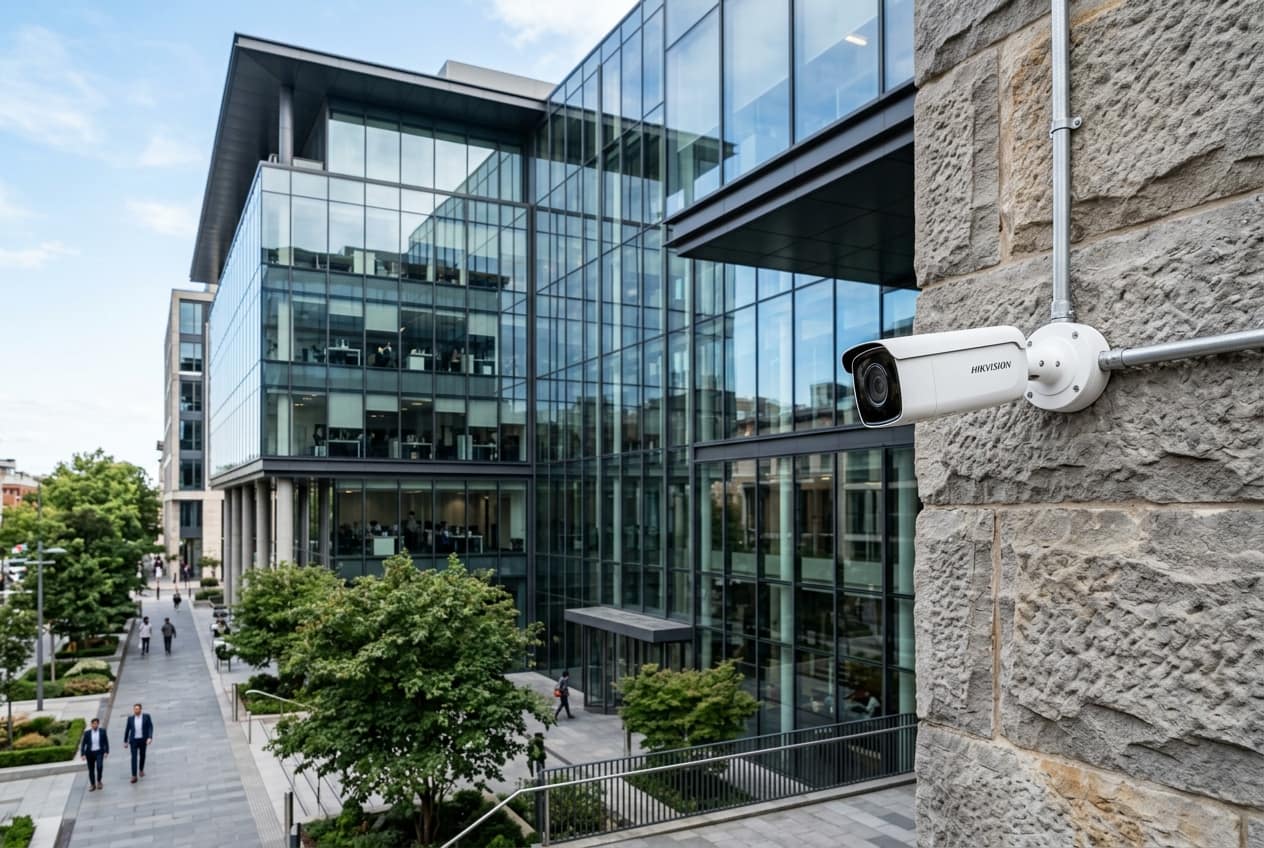
A CCTV AMC (annual maintenance contract) is a yearly agreement to inspect, clean, test and repair a surveillance system so it keeps recording. We offer comprehensive and non-comprehensive contracts with preventive visits, breakdown support under agreed service levels, recording health and HDD checks, firmware updates, and monthly service and uptime reports, for systems we installed or others did.
At a glance
- Typical timeline
- Baseline audit in 1 to 2 weeks, then a quarterly or monthly visit pattern for the contract year.
- Key standards
- IEC 62676 image criteria, ONVIF, manufacturer maintenance guidance, IS 732 for power checks.
- What you receive
- Visit reports, device health log, recording verification, monthly uptime report and firmware record.
- Best suited for
- Any organisation with installed CCTV, including systems installed by other vendors.
- Our scope
- Preventive visits, breakdown support, HDD and recording checks, firmware, monthly reporting.
- Site survey
- Baseline audit of every camera, recorder and power point before the contract starts.
CCTV AMC & Maintenance Overview
A CCTV AMC exists for one reason: so that the footage is there on the day you need it. Cameras rarely fail loudly. A dome gets dirty and the image goes soft. A disk begins to throw errors and nobody sees. A camera loses its IP address after a power cut and is simply not recording. The system looks fine at the monitor on Monday, and is found to be empty when an incident is reviewed on Friday.
Our CCTV AMC and maintenance service is built around preventing those silent failures. We begin with a baseline audit of every camera and recorder, record the state of each, and build a visit schedule around the real risks of your site: dust, heat, insects, power quality and vandalism. Visits follow a checklist, and each ends with a report that you can read in five minutes.
We maintain systems that we did not install. Many clients come to us after an installer has disappeared or an AMC has lapsed. In those cases the baseline audit matters even more, because it tells you the true condition of the system and what needs fixing before an AMC can promise anything. We say plainly when a recorder is too old to maintain responsibly.
Contracts come in two forms. A comprehensive AMC includes parts replacement within defined limits, while a non-comprehensive AMC covers labour and inspection, with parts charged separately. We explain the trade-off in rupees and risk terms, and help you pick the form that fits the age of the system and your budget.
Ideal for: Any organisation with installed CCTV: including systems installed by other vendors.
What Our CCTV AMC & Maintenance Includes
The AMC scope turns maintenance into a checklist with evidence, so the contract can be measured, not just signed.
Scheduled preventive maintenance visits and cleaning
Technicians clean domes and housings, check mounts and seals, verify views against the baseline and test PoE and power, following a written checklist. You receive a signed visit report with photographs of any findings. Tip: ask for the checklist before signing, and compare it with what the technician actually did.
Breakdown support with defined response and resolution SLAs
Faults are logged, triaged and attended under service levels agreed per site, with remote diagnosis first where possible and spares kept for common failures. You receive a fault log. Tip: make sure the SLA separates response from resolution, and states what happens when parts are delayed.
Recording health checks, HDD monitoring and firmware updates
We review SMART data and RAID status, verify retention days, test clip retrieval, confirm time sync and manage firmware with a pilot and rollback. You get a health summary each month. Tip: ask for a retrieval test of footage from the oldest day, not the newest.
Monthly service reports and uptime tracking
A monthly report lists visits, faults, camera uptime, open items and equipment nearing end of life, in plain language. You get trends over the year. Tip: use the report in your insurance and audit files, since it shows a documented maintenance programme.
Baseline audit and asset register
Before the contract begins we document every device with serial number, firmware, IP, location and condition, plus photographs of views. You get the register in soft copy. Tip: update the register when anything is added or moved, otherwise it stops being useful within a year.
What goes wrong when CCTV has no maintenance
The most expensive failure is the empty disk. Surveillance disks run around the clock under heavy write load, and they fail on a timeline that surprises most owners. Without monitoring, a failed disk in a RAID group may degrade the array silently, and a second failure then takes everything. SMART data and RAID status exist, but only if somebody reads them.
Image quality fades in ways nobody notices day to day. Dust and spider webs gather on domes, IR illuminators glare off insects at night, lenses shift after vibration, and cameras are knocked out of position by cleaners and forklifts. A camera that shows the wrong area is worse than no camera, since it gives false comfort.
Power and network faults are the third cause. A UPS with a dead battery fails exactly when the power does. A switch port flaps, a PoE budget is exceeded after cameras are added, or an IP conflict knocks a camera offline. These faults are cheap to fix when found, and costly to find after an incident.
Finally, many AMCs are paper contracts. They list a visit per quarter, but the visit is a signature on a register. A good contract specifies what is checked, what is reported, how fast a fault is attended and what happens if the service level is missed. Without those details, the contract protects the vendor, not you.
What You Gain
Recording you can rely on
Daily or weekly health checks and monthly verification of recorded days catch silent failures before an incident does. You know the retention you paid for actually exists.
Cleaner, correctly aimed cameras
Scheduled cleaning and view checks restore image quality and fix cameras that have drifted. Picture quality returns to the commissioning standard.
Faster fault resolution
A baseline file of devices, IPs and cable maps means technicians arrive knowing what to look for, so a fault is traced in less time.
Predictable maintenance cost
An AMC turns surprise repair bills into a known annual figure, and the report highlights ageing equipment before it fails, so replacements can be budgeted.
Reports that support audits
Monthly service and uptime reports provide evidence for insurers, auditors and your own management that the system is maintained.
One vendor for mixed systems
We maintain cameras, recorders, network and power for systems from several vendors, replacing the patchwork of separate service calls.
How the Work Is Delivered
A maintenance contract works only if it is run as a process. Ours has a baseline, a schedule, a response path and a report.
- 1
Baseline audit and asset register
We inspect every camera, recorder, switch and power supply, record serial numbers, firmware, IPs and condition, and photograph key positions. This becomes the asset register.
- 2
Contract design and service levels
We agree comprehensive or non-comprehensive cover, visit frequency, escalation and response targets per site, and exactly which items are covered. The contract states what happens if a target is missed.
- 3
Preventive maintenance visits
Technicians clean domes and housings, check mounting, verify views against the baseline, test PoE and power, check UPS batteries and clean racks. Each visit follows a written checklist.
- 4
Recording and storage health checks
We review disk SMART data and RAID status, verify that recording covers the retention period, test retrieval of an old clip and check time sync. Faults are corrected or escalated.
- 5
Breakdown support
Faults are logged, triaged and attended under the agreed service level. Remote diagnosis is tried first where possible, with a site visit and parts replacement as needed.
- 6
Firmware and configuration management
Firmware updates are tested on a pilot group, applied with a rollback plan and recorded. Configuration backups are refreshed after any change.
- 7
Monthly reporting and annual review
A monthly report shows visits, faults, uptime and open items. At the year end we review trends, ageing equipment and recommendations for renewal or upgrade.
What a maintenance visit actually checks
A real visit is more than a wipe of the lens. On the recorder we check disk status through SMART attributes such as reallocated sectors, confirm that RAID is healthy with no rebuild pending, and compare recorded days against the retention target. If a system is meant to hold 30 days and holds 22, that is a finding. We confirm time sync, because footage with the wrong clock is hard to use as evidence, and we review user accounts and remove stale ones. On cameras we check that the view still matches the commissioning image, that IR works at night, and that housings are sealed against moisture.
On the network and power side, we test PoE draw per switch against budget, look for port errors, check the cable condition at terminations and test the UPS under load. A UPS battery typically needs replacement every 3 to 5 years depending on type and temperature, and Maharashtra summer heat shortens it. Firmware is managed with care: we check release notes for security fixes, update a pilot group first and keep the previous version. Any camera with default credentials is corrected. Findings are recorded against the asset register so trends are visible over the year.
IEC 62676 image criteria
We use the pixel density and image quality targets from commissioning as the benchmark for each visit, so cameras are judged against the original design intent.
Manufacturer maintenance guidance
Cleaning methods, torque values, firmware procedures and battery replacement intervals follow the equipment maker's instructions to keep warranty valid.
ONVIF and open export formats
Retrieval tests use standard export formats, so evidence plays on an ordinary PC and does not depend on a proprietary player alone.
IS 732 power checks
Supply voltage, earthing and loose terminations are inspected, since unstable power is a leading cause of recorder and camera faults.
Service level definition
A good SLA defines fault classes, response and resolution targets, working hours and exclusions. We agree these per site in the contract rather than quoting generic hours.
Digital Personal Data Protection Act 2023
Maintenance staff may access footage. We limit access, log it, and remove or protect data when disks are replaced, as your policy requires.
A typical contract: a 64-camera system installed by another vendor
A manufacturer has 64 cameras on two recorders installed five years ago by a vendor who no longer responds. The owner wants to renew insurance and needs evidence that the system is maintained. Nobody has the passwords, two cameras are known to be dead and the recording period is believed to be 30 days.
We start with a baseline audit. We recover access through the proper reset procedure with the owner's authorisation, build the asset register and find that five cameras have dirty or misaimed views, one disk has reallocated sectors and the UPS battery is at the end of its life. The recorded period turns out to be 19 days because motion recording was enabled on some channels and the disk group is undersized.
A comprehensive contract is agreed for items under defined limits, with quarterly visits and monthly health checks. After the first month, the system shows full coverage, a healthy array, a new UPS battery and a clear report. The client typically gains documented maintenance evidence, a list of ageing equipment with budget estimates and fewer unexplained gaps in footage.
- Asset register for every camera and recorder
- Verified recording period against target
- Monthly reports usable for audit and insurance
- Ageing equipment flagged before failure
This is an illustrative scenario built from typical site conditions. Actual quantities, timelines and results depend on your site survey.
CCTV AMC & Maintenance Across Four States
We are based in Nashik and deliver across Maharashtra, Gujarat, Madhya Pradesh and Rajasthan. Each state has its own utilities, approvals and site conditions, and these are the points that matter most for this service.
Maharashtra
Many of our AMC sites sit in MIDC estates, warehouses and hospitals where power cuts and monsoon damp are the usual causes of recorder and camera faults. We time visits before the rains to reseal junction boxes, test UPS batteries and clear drainage near outdoor poles.
Gujarat
Coastal districts and chemical zones in Gujarat bring salt laden humid air that corrodes connectors, brackets and housings faster than inland sites. AMC visits here should include corrosion checks, replacement of failed glands and cleaning of dome covers, with a shorter inspection cycle for poles near the sea.
Madhya Pradesh
Industrial areas such as Pithampur and Mandideep have dust from cement, engineering and food units, plus hot summers and a heavy monsoon. Contracts for these sites should list lens cleaning, fan and filter checks in recorder racks, and a firmware review before the monsoon season.
Rajasthan
Extreme summer heat and fine desert dust are the main enemies in Rajasthan. We plan AMC for RIICO estates, mines and remote yards around cooling of rack rooms, sealed enclosures, heat related hard disk failures and frequent lens cleaning, because dust films quickly reduce night image quality.
Where This Work Is Most Often Needed
Why Teams Work With Us on This
We maintain what others installed
Our teams audit and take over mixed systems, which is common in older sites, and we state clearly what condition they are in before the contract begins.
Local engineers, not call centres
Technicians are mobilised from our Nashik base, with visits planned by route and site cluster across Maharashtra, Gujarat, Madhya Pradesh and Rajasthan, so attendance depends on the contract terms and not on a distant dispatch queue.
Reports that mean something
Each visit and month ends with findings, trends and recommendations written for your facility or security head, not generic ticket counts.
Integrated with other systems
We also maintain fire alarm, access control, network and electrical systems, so one AMC partner can cover the whole security and IT estate.
Guides and Projects Related to This Service
- ArticleHow to Calculate CCTV Storage: A Worked Example for a 64 Camera Site
- ArticleHow Many Pixels Do You Need? Choosing CCTV Resolution by Pixel Density
- ArticleWhat to Ask Before You Sign an AMC: A Checklist for Buyers
- ArticleHow to Size a UPS and Battery Bank: A Worked Example for a Small Server Room
- ArticlePoE Power Budget for IP Cameras: How to Check a Switch Before You Buy
- ArticleVoltage Drop in CCTV Cable: Choosing the Right Size for 12 V Cameras
- ArticleHow CCTV Surveillance Improves Business Security & Operational Governance
- ArticleAI Video Analytics & ANPR: Turning CCTV into Actionable Intelligence
- ProjectCommercial Complex, Nashik
Frequently Asked Questions
01What is the difference between comprehensive and non-comprehensive CCTV AMC?
A comprehensive AMC covers labour and replacement of faulty parts within agreed limits, while a non-comprehensive AMC covers labour and inspection but charges parts separately. Comprehensive cover costs more but gives a predictable annual outlay. For older systems with likely failures, the comprehensive option often gives better cost certainty.
02How much does a CCTV AMC cost?
Price depends on camera count, system age, site spread, visit frequency, service levels and whether parts are included. AMCs are often priced as a percentage of system value or per camera, with variation for the conditions. After a baseline audit we can give a firm quote that lists exactly what is covered.
03Can you maintain a CCTV system installed by another company?
Yes. We begin with a baseline audit to document condition, recover access with your authorisation and list defects. Some older equipment may be beyond reasonable maintenance, and we say so. After the audit we agree what the contract will cover and what repairs are needed first.
04What should a CCTV AMC include?
At minimum, scheduled preventive visits, cleaning, view checks, disk and RAID health checks, retention verification, firmware management, breakdown support with defined response and resolution targets, and monthly reports. It should also state exclusions, such as vandalism or power surges, and what is the escalation path if a target is missed.
05How often should CCTV be maintained?
Quarterly visits suit many sites, with monthly remote health checks. Dusty, hot or exposed sites, such as cement plants or highway locations, benefit from more frequent cleaning. Critical systems may need weekly remote checks. We set frequency from the baseline audit and adjust it after the first few reports.
06What response time can I expect for a breakdown?
That is set in the contract per site, based on location, fault class and the cover you choose. We do not quote a single hour figure for all clients. A good SLA separates response, meaning someone attends or diagnoses, from resolution, meaning the fault is fixed, and defines what happens when parts are needed.