
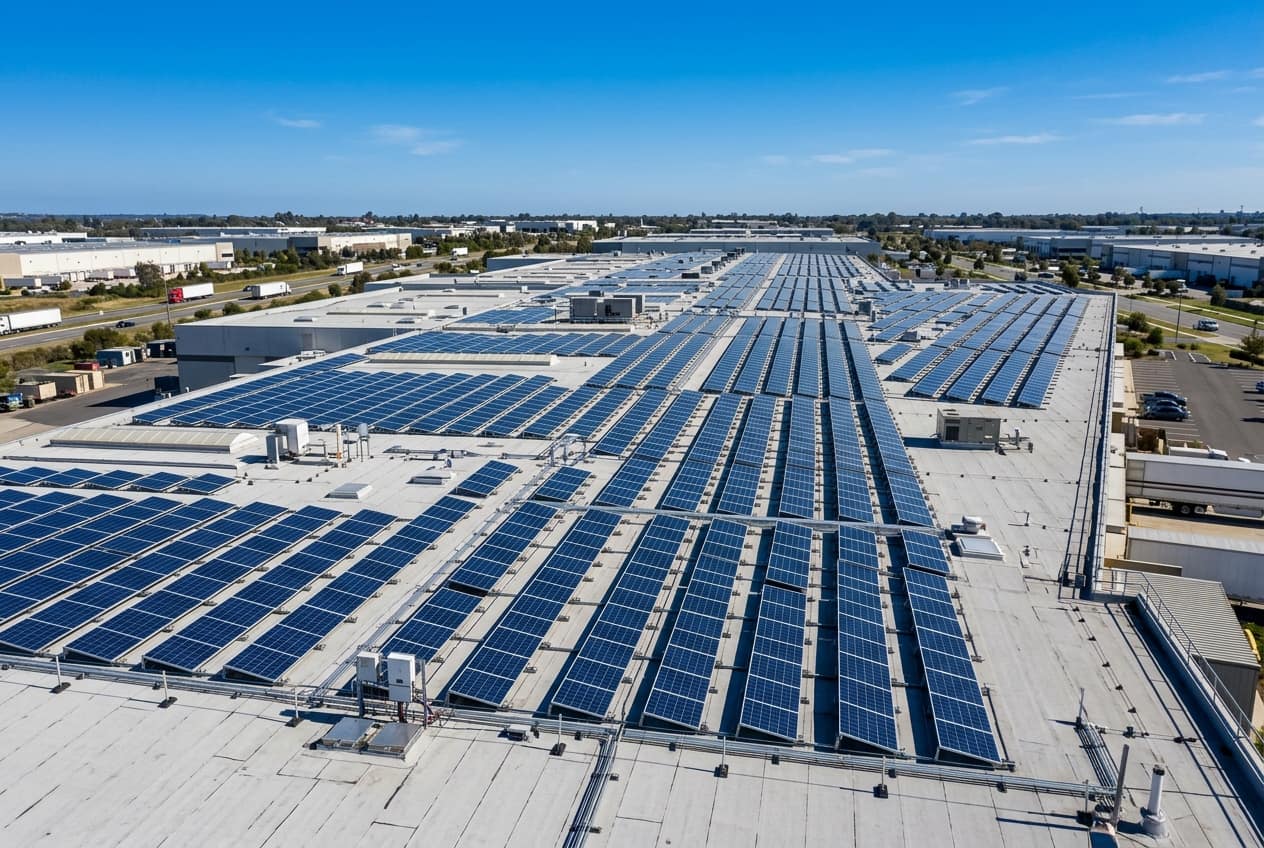
Solar energy solutions for commercial and industrial users cover rooftop plants, ground-mounted plants, off-grid and hybrid systems with batteries, solar-powered CCTV poles, solar street lights and ongoing O&M. The right choice depends on your load, roof or land, grid reliability and tariff. Shruti IT Service designs, installs and maintains all six from our Nashik base for sites across Maharashtra, Gujarat, Madhya Pradesh and Rajasthan, from survey to AMC.
At a glance
- Services covered
- Rooftop solar, ground-mounted plants, off-grid and hybrid, solar CCTV, street lights and O&M.
- Typical timeline
- From 3 weeks for pole systems to 5 to 9 months for large ground plants, depending on site and approvals.
- Key standards
- IEC 61215, IEC 61730, IEC 62109, IEC 62446-1, IS 3043 and CEA regulations.
- What you receive
- Survey, energy estimate, drawings, test records, as-built file, monitoring and service plan.
- Best suited for
- Factories, warehouses, institutions, highway projects and remote infrastructure owners.
- Delivery model
- One accountable team from site survey to maintenance, with teams mobilised from our Nashik base.
Solar Energy Solutions Overview
Solar energy solutions for businesses are no longer a single product. A factory with a large roof and a heavy daytime load needs a grid-tied rooftop plant. A company with open land and a high demand may need a ground-mounted captive plant. A farm, telecom site or camp with weak or no grid needs batteries and an inverter that can work with a generator. A highway contractor needs cameras and lights that run without any cable. Each need leads to a different design, and we cover all of them in one service category.
Our solar work is delivered as EPC: engineering, procurement and construction. That means we study your bills and your site, design the plant, supply the equipment against an approved bill of quantities, build it, test it, and hand over a documented system. For grid-connected plants we also support the application and coordination with the DISCOM. For every plant we offer an O&M and AMC arrangement so that generation is protected after handover.
The six services on this page fit together as a decision tree. If your site is on the grid and has a good roof, start with rooftop solar. If roof area or strength is the limit, consider a ground-mounted plant. If the grid fails often or does not exist, look at hybrid and off-grid. If you need to light or watch a place with no supply, look at solar street lights and solar CCTV. Whichever you choose, O&M decides how much of the promised energy you actually receive.
Shruti IT Service has worked since 2014 across ELV, IT, electrical and infrastructure projects for industrial, government and enterprise clients, based in Nashik and mobilising teams across the region. Solar sits naturally beside that work, because the same site teams already handle panels, earthing, cabling, CCTV and networks. That single-window approach reduces the gaps that appear when five vendors share one site.
Solar Energy Solutions Services We Deliver
Commercial & Industrial Rooftop Solar
On-grid rooftop plants for factories, warehouses, offices and institutions. We start from your bills and a shadow study, design structure and electrics, support the DISCOM net-metering file, and monitor generation against the estimate. The right choice when you have a sound roof and a strong daytime load.
Ground-Mounted Solar Plants
Ground-mounted plants for captive consumption where roofs are too small or too weak. We assess land, soil and evacuation first, then build foundations, structure, inverters, transformer and the line to your load. Suits industries with open land, institutions and developers needing multi-hundred kW or MW capacity.
Off-Grid & Hybrid Solar Systems
Solar with battery storage and generator integration for sites with an unreliable grid or none. We size from measured loads and surge currents, choose battery chemistry honestly, and set generator logic that cuts fuel use. Fits remote facilities, farms, telecom sites and backup-critical operations.
Solar-Powered CCTV & Remote Site Power
Self-powered camera and communication poles for places without electricity. We write a power budget, size panel and battery for your worst monsoon month, and build locked, theft-aware mounting with remote health alerts. Fits highways, construction sites, farms, pipelines and solar parks.
Solar Street Lighting
Standalone solar street lights for campuses, villages, townships and roads, with no trenching and no electricity bill. We design from the lux you need, size for two to three nights of autonomy, build proper foundations, and plan battery replacement so lights stay bright over the years.
Solar O&M and AMC
Operations and maintenance for rooftop and ground plants, including those built by others. Cleaning schedules, inverter and connector checks, thermography, monitoring and monthly loss analysis protect generation. Service levels and scope are agreed per site, and reports show where energy is lost.
Common mistakes in buying solar for a business
The first mistake is choosing on price per kWp alone. Two quotations at the same rate can differ widely in module quality, inverter class, structure galvanising, cable size, earthing and documentation. A cheaper bid that omits the shadow study, uses thin structure or ignores the DISCOM paperwork will cost more in the end. Compare bills of quantities line by line, along with the assumptions behind the generation estimate and the warranty terms.
The second mistake is choosing the wrong type of system. A site with frequent outages may buy an on-grid plant expecting backup, and discover that it shuts down when the grid fails. A site with open land may force a rooftop design onto a weak roof. A remote camera may be fitted with a small panel that fails in the monsoon. Matching the system to your actual problem, whether that is cost, reliability or access, saves more than any discount.
The third mistake is treating solar as a one-time purchase. Plants lose output to soiling, loose connections and failed strings, and batteries and inverters have finite life. Owners who skip maintenance often lose a noticeable share of output without noticing. A plan for cleaning, inspection, monitoring and battery replacement should be agreed at the time of purchase, with the cost and the service levels written down.
What You Gain
Lower and steadier energy cost
Rooftop and ground-mounted plants replace expensive grid units with solar units at a fixed generation cost, which reduces the effect of tariff increases on your operating budget.
Power where there is no grid
Hybrid, off-grid, solar CCTV and solar street light systems serve places that cable cannot reach economically, from farms and camps to highway work zones.
Design driven by your data
We size plants from your bills, load profile, roof and soil data, so the system you buy matches your site and your questions about savings have documented answers.
Compliance and approvals handled
Net-metering applications, single line diagrams, protection settings and test records are prepared with each plant, so approvals do not become a separate chase after installation.
Single window across systems
Solar, electrical panels, earthing, CCTV and networks can be planned together on the same site, with one project manager and one handover file.
Protected generation over the life of the plant
O&M and AMC with monitoring, cleaning and loss analysis help the plant keep delivering its estimated energy over twenty-five years and more.
How the Work Is Delivered
Whichever solar service you need, the project follows the same disciplined path from survey to maintenance, adapted to the system type.
- 1
Survey and objectives
We visit the site, study your bills or load list, check roof, land and shading, and ask what you want: lower cost, backup, remote power or sustainability reporting. The answer decides which of our six services applies.
- 2
Sizing and energy estimate
We size the array, inverter and any battery from your data, then produce an energy estimate with each loss stated. Worst-month assumptions are used for off-grid systems, and annual yield with a loss breakdown for grid-tied plants.
- 3
Design and approvals
We prepare drawings, structure design, protection and earthing, and where required the application to the state distribution company or other approving bodies. Documents that the client must provide are listed early so that delays are not discovered late.
- 4
Supply and quality control
Equipment is procured against the approved bill of quantities and checked on arrival, including serial numbers, test certificates, galvanising and battery condition, so that errors are caught before installation.
- 5
Installation
Crews install structure, modules, cables, inverters, batteries or poles under safety controls for work at height and live electrical equipment, with progress records for each stage.
- 6
Testing and commissioning
We test insulation, earth resistance, string voltage and current, protection and, where relevant, battery and generator logic, then commission the system with the DISCOM or inspector present if required.
- 7
Handover and AMC
You receive drawings, test records, manuals and warranty papers, your staff are trained, monitoring is activated, and an AMC with service levels agreed for your site begins.
How the six solar services differ technically
Grid-tied plants, which means rooftop and ground-mounted systems, use modules, string or central inverters and protection that synchronises with the grid and shuts down if the grid fails. Their key design variables are shading, tilt, DC to AC ratio, cable loss and the evacuation arrangement. Off-grid and hybrid systems add batteries and charge control, so their key variables are daily energy, autonomy, depth of discharge, surge current and generator logic. Solar CCTV and street lights are small versions of the same chain, with design driven by the worst sunlight month and several nights or days of autonomy.
Across all six, a few rules hold. Size for real loads and real sun, not for datasheet figures. Choose modules and inverters with test reports against IEC standards. Treat earthing, surge protection and cable quality as part of the design, not as extras. And monitor everything, because a plant that nobody can see cannot be managed. As a rough guide, a rooftop plant in western India yields about 1,400 to 1,500 kWh per kWp per year, needs about 8 to 10 square metres per kWp, and loses about 0.5 percent of output per year to module degradation.
IEC 61215 and IEC 61730 for modules
Design qualification and safety standards for PV modules. We request test certificates for the exact model and check approved-list requirements where schemes or subsidies apply.
IEC 62109 and grid interface settings for inverters
Inverter safety standard, combined with protection settings for voltage, frequency and anti-islanding accepted by the DISCOM. Settings are recorded at commissioning.
IEC 62446-1 and IEC 62446-3 for testing and thermography
Testing and documentation of grid-connected PV systems and infrared inspection of modules. These guide our commissioning reports and O&M surveys.
IS 3043 and IS/IEC 62305 for earthing and lightning
Earthing and lightning protection practice applied to arrays, inverters, battery rooms and poles. Earth resistance is measured and recorded for each system.
CEA regulations and local DISCOM rules
Central Electricity Authority safety and connection regulations, with state regulator and DISCOM procedures, shape approvals and protection. Approvals remain the client's responsibility, and we support the file.
A typical multi-phase project: solar for a manufacturing campus
Consider a manufacturing campus in a GIDC estate in Gujarat with a daytime load of several hundred kW, a large roof, some open land, a boundary road with no lighting and a frequent need for night security. A sensible programme does not buy everything at once. Phase one is a rooftop plant sized to the daytime load, which gives the quickest saving and the clearest payback.
Phase two adds solar street lights along the boundary and the internal roads where trenching would be costly, followed by solar-powered camera poles at remote corners. If outages affect a critical process, a hybrid inverter with batteries is planned for that load only, not for the whole campus. Phase three could be a ground-mounted extension on open land once the rooftop data shows how much of the load remains uncovered.
Throughout, a single O&M contract looks after all of it, with cleaning, inspections, battery checks and monthly reports. Doing the work in this order means every phase uses what the previous phase taught, and earthing, monitoring and communication infrastructure are reused. Costs and timelines vary with site, and each phase is priced from its own survey.
- A phased plan in which each step is justified by data from the previous one.
- Shared earthing, monitoring and communication infrastructure across phases.
- One handover file and one maintenance contract for the whole solar estate.
- Clear, separate saving figures for rooftop, lighting and backup components.
This is an illustrative scenario built from typical site conditions. Actual quantities, timelines and results depend on your site survey.
Solar Energy Solutions Across Four States
We are based in Nashik and deliver across Maharashtra, Gujarat, Madhya Pradesh and Rajasthan. Each state has its own utilities, approvals and site conditions, and these are the points that matter most for this service.
Maharashtra
Maharashtra is our home state. MSEDCL is the main distribution company, MIDC estates hold much of the industrial roof space, and the monsoon shapes structure and battery design. Our Nashik base makes survey and commissioning visits straightforward, and AMC visits are planned by route and site cluster.
Gujarat
Gujarat combines strong irradiation, large rooftop demand in GIDC estates, and approvals through the GUVNL group DISCOMs or private licensees such as Torrent Power in some cities. Coastal districts add salt-laden air, so structure, fasteners and enclosures need corrosion protection. We serve Gujarat with teams mobilised from Nashik.
Madhya Pradesh
Madhya Pradesh buyers deal with three regional DISCOMs, East, Central and West, and industrial areas such as Pithampur and Mandideep. Summers are hot and the monsoon is strong, so roof loading, wind uplift and battery cooling matter. Teams travel from our Nashik base for survey, installation and commissioning.
Rajasthan
Rajasthan offers excellent sun and large open land, with JVVNL, AVVNL and JdVVNL as distribution companies and RIICO managing industrial areas. Desert dust and extreme summer heat shape cleaning cycles, inverter cooling and cable ratings. Ground-mounted and hybrid projects are common, and we plan visits by route and site cluster.
Where This Work Is Most Often Needed
Why Teams Work With Us on This
Engineering that starts with your numbers
We start from your bills, loads and site data and show our assumptions, so you can test every estimate and compare quotations on equal terms.
Single window with electrical, CCTV and networks
Solar sits next to panels, earthing, surveillance and network work we already do, so cabling, power and monitoring are coordinated rather than split across vendors.
Documents you can hand to an inspector or lender
Drawings, test records, protection settings and as-built files are delivered in an organised handover file that supports approvals, insurance and audits.
Local crews and AMC continuity
Teams mobilised from our Nashik base install the plant and then maintain it, with AMC visits planned by route and site cluster and service levels agreed per site, so the party who built it remains accountable for its performance.
Solar Energy Solutions Across Our Four States
We are based in Nashik and deliver across Maharashtra, Gujarat, Madhya Pradesh and Rajasthan. Each local page covers the power utility, climate, approvals and site types that change how this work is designed in that place.
Major cities in Maharashtra
Guides and Projects Related to This Service
Frequently Asked Questions
01Which type of solar system is right for my business?
It depends on your problem. Choose rooftop solar to cut daytime grid cost, a ground-mounted plant if roof area is limited and land is available, hybrid or off-grid for weak or no grid, and solar CCTV or street lights for remote surveillance and lighting. A site survey and your electricity bills decide the final choice.
02How much does a commercial solar plant cost?
Cost depends on type, capacity, roof or land conditions, equipment class, approvals and battery size, so a fair figure needs a survey. Larger grid-tied plants cost less per kWp. Batteries add cost to hybrid systems. We provide an itemised bill of quantities you can compare line by line with other offers.
03How long does a solar installation take?
Pole-based systems such as solar street lights and CCTV poles may take a few weeks. Rooftop plants usually take 10 to 16 weeks including approvals, and ground-mounted plants often take 5 to 9 months. Site readiness, material supply and DISCOM approvals decide the real timeline, and we share a dated plan after survey.
04What is the difference between on-grid, off-grid and hybrid solar?
On-grid systems feed your loads and the grid and shut down when the grid fails. Off-grid systems run on solar and batteries with no grid. Hybrid systems combine solar, batteries and grid or generator, so they keep critical loads running during outages. Each costs and behaves differently, so choose by your reliability need.
05Do you maintain solar plants built by other companies?
Yes. We begin with a baseline inspection and records review, then agree an O&M scope that matches the plant's condition and age. Missing drawings and test records can be rebuilt as part of that baseline, and the contract states cleaning cycles, inspections and response times for your site.
06What approvals are needed for a commercial solar plant in Maharashtra, Gujarat, Madhya Pradesh or Rajasthan?
Grid-tied plants usually need DISCOM approval for connection and net metering, with a single line diagram, meter arrangement and, depending on capacity, inspection by the relevant electrical authority. Rules and limits change, so confirm with your state distribution company. We prepare the application and track it, but approvals remain the client's responsibility.