
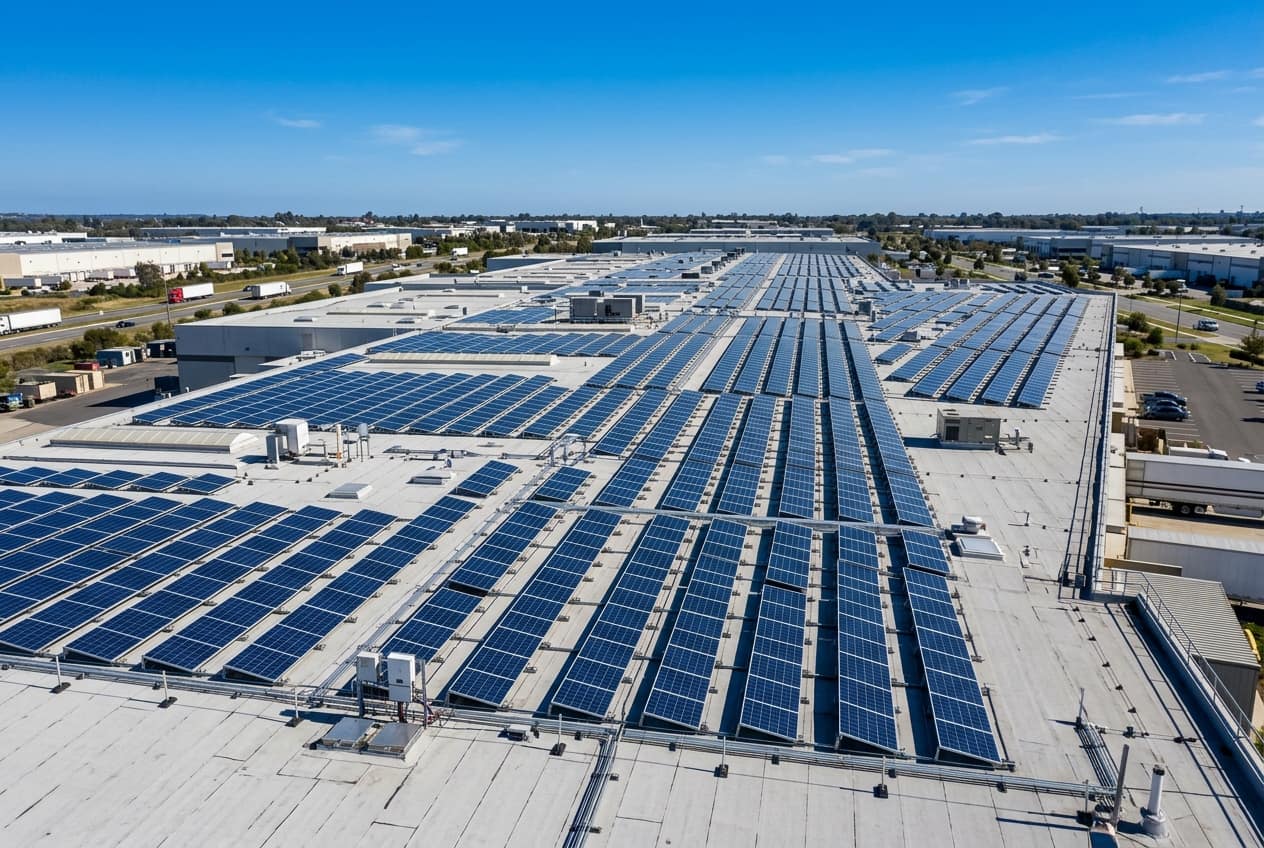
A solar-powered CCTV system is a pole or cabinet unit that runs a camera, a communication link and a recorder from a solar panel and battery, with no grid connection. A typical 4 MP IP camera with IR and a 4G router draws about 12 to 20 W, so a pole needs a panel and battery sized for the monsoon month and several days of autonomy.
At a glance
- Typical timeline
- 4 to 8 weeks from site study to commissioning, depending on pole count and civil work.
- Sizing basis
- Total watts of camera, router and recorder, hours of use, worst-month sun and days of autonomy.
- Key standards
- IP66 enclosures, IEC 61215 modules, IEC 62676 video practice and IS 3043 earthing.
- What you receive
- Power budget sheet, pole drawings, test records, network details and monitoring access.
- Best suited for
- Highways, construction sites, farms, pipelines and solar parks without reliable grid power.
- Our scope
- Panel, battery and controller sizing, pole and camera set-up, enclosures, anti-theft mounting and monitoring.
Solar-Powered CCTV & Remote Site Power Overview
A solar-powered CCTV system takes video surveillance to places where nobody will bring a cable. Each unit has a solar panel mounted on a pole, a battery and charge controller in a locked enclosure, a camera, and a communication link, normally a 4G router or a wireless radio. The system generates its own power during the day and stores enough to run all night and through cloudy days.
This page is about the power side of remote surveillance. How video gets from the pole to your control room, through point-to-point radio, cellular or fibre, is covered on our wireless and remote site surveillance page, and the two are usually designed together. Here the question is energy: how many watts the load draws, how many hours of sun the site gets in its worst month, and how many dark days the battery must carry.
Typical users include highway contractors guarding work zones, construction firms watching material yards, farms and orchards, pipeline operators, quarries and solar parks. In each of these places the cost of trenching power cable, or of a diesel set that needs refuelling, exceeds the cost of a self-powered pole within a short distance. Theft and vandalism are also real risks, so mounting and enclosure design matter as much as the electronics.
Shruti IT Service designs and installs solar-powered camera and communication poles from our Nashik base for sites in Maharashtra, Gujarat, Madhya Pradesh and Rajasthan, backed by our CCTV and network teams. We give you a power budget you can read, a pole that is built for local wind and monsoon, and monitoring that tells you when a battery is weak before the camera goes dark.
Ideal for: Highways, construction sites, farms, pipelines and solar parks.
What Our Solar-Powered CCTV & Remote Site Power Includes
The scope below covers the power, mounting and monitoring of a self-powered camera pole. Network design for longer links is coordinated with our wireless and remote site surveillance work.
Solar panel, battery and controller sizing
We write a power budget, size panel, battery and MPPT controller for the worst month and your chosen autonomy, and give you the sheet. You can verify every watt. Tip: ask each vendor for the daily Wh and the days of autonomy, because those two numbers expose weak designs quickly.
Pole-mounted camera and 4G or wireless setup
We install the camera, router or radio, optional local recorder and cabling on a purpose-built pole, aligned to the scene you need to watch. You receive image samples at day and night. Tip: test signal at the exact pole location, since a few hundred metres can change it.
Weatherproof enclosures and anti-theft mounting
We supply sealed, ventilated, locked enclosures, welded or tamper-resistant brackets and hidden cabling, with the pole foundation designed for local wind. You get drawings and a fixings list. Tip: mount panels high and use security fasteners, and put a camera view on the pole itself.
Remote health and power monitoring
We configure monitoring of battery voltage, charge current, camera status and signal strength, with alerts to your team. You get a dashboard and an alert plan. Tip: set the low-battery alert early enough to give a technician time to reach a remote site.
Why solar CCTV poles go dark
The usual reason is a power budget that was never written down. A camera datasheet may quote 6 W, but with IR on at night, a heater in winter, a 4G router at 5 to 6 W and a controller drawing its own share, the real load can be double. Systems built on the datasheet figure run fine in March and fail in July, when several overcast days drain a battery that was sized for sunshine.
Monsoon is the second reason. In Maharashtra and Madhya Pradesh the peak sun hours available in June to September can fall to well under the annual average, so a panel sized on yearly figures starves the battery for weeks. Designers must use the worst month, not the average. Panel angle, shading from trees and dirt on the glass also reduce charge in ways that a quick calculation ignores.
The third is theft and weather. Panels and batteries are valuable, poles in remote places are easy targets, and enclosures that are not sealed to IP65 or better let moisture and insects in. Poor earthing makes lightning damage likely. A pole without a proper foundation can lean or fall in a storm. Good design assumes the site will be visited by thieves, wind and water.
What You Gain
Surveillance without grid dependency
You can monitor perimeters, work zones and assets that have no electricity, without laying cable or running a generator. The pole works wherever there is sun and a signal.
Lower running cost
After installation there is no electricity bill and no fuel to carry. Costs are limited to battery replacement over its life and periodic cleaning and checks.
Faster deployment
A pole system needs a foundation and a day or two of installation, with no trenching or utility approvals. Units can also be relocated when a construction front moves.
Resilience through outages
Because each pole is independent, a grid failure elsewhere does not blind the site. Battery autonomy of two to four days keeps recording and alerts working through bad weather.
Remote health visibility
Monitoring shows battery voltage, panel current, camera status and signal strength. You see a falling battery trend days before a failure, and you send a technician with the right part.
Theft-aware construction
Tamper alarms, welded or locked brackets, high mounting and hidden cabling make it harder to take panels and batteries, and a camera watches the pole itself.
How the Work Is Delivered
Our process for solar CCTV starts with a power and signal check at the exact pole location, because both sun and network coverage vary within a few hundred metres.
- 1
Site study and objective
We visit each pole position to check shading, soil, signal strength, access and what the camera needs to see. We agree whether the aim is recognition, observation or detection, which drives the camera choice and the power load.
- 2
Power budget and sizing
We list every load in watts, multiply by hours, and size the panel for the worst sunlight month and the battery for the chosen days of autonomy. As an example, a 15 W load running 24 hours uses 360 Wh a day, and three days of autonomy on a lithium iron phosphate battery calls for roughly 1.5 kWh nominal.
- 3
Pole, foundation and enclosure design
We design pole height, foundation size and wind loading for local conditions, plus a ventilated, locked enclosure with IP65 or better rating. Panel tilt, cable entry, earthing and anti-theft fittings are specified.
- 4
Supply and pre-assembly
Controllers, batteries, panels, cameras and routers are assembled and bench-tested before they go to site. Pre-testing finds faulty units in the workshop, and it cuts hours on a remote location.
- 5
Installation and alignment
We cast or fix foundations, erect poles, mount panels facing true south at the designed tilt, install the camera and communication equipment, and connect earthing. Camera view is aligned on site to the agreed scene.
- 6
Testing and commissioning
We confirm charge current in sunlight, night-time load, camera image quality in IR, 4G or radio signal, recording and remote access. A load test shows the battery voltage curve overnight, and results are recorded.
- 7
Monitoring handover and AMC
Alert thresholds for battery, signal and camera are set, your staff are trained, and a visit schedule for panel cleaning, tightening and battery checks begins under AMC with service levels agreed per site.
Power, camera and communication on one pole
The energy chain is panel, MPPT charge controller, battery and load. An MPPT controller extracts more power from the panel than a basic PWM one, particularly in cool weather and low light, and it is worth the added cost on larger loads. Lithium iron phosphate batteries handle daily cycling and heat better than lead acid, though both can be used. Low-voltage disconnect on the controller protects the battery from deep discharge, and a load schedule can reduce IR or lower frame rate when the battery is low, so the camera keeps recording rather than shutting off.
Worked sizing: take a 4 MP IP66 bullet camera with IR at 8 W, a 4G router at 6 W and a controller loss at 1 W, so 15 W or 360 Wh a day. With worst-month sun of 4 peak hours and a derating of 0.7 for losses, the panel needs 360 divided by 4 divided by 0.7, or about 130 Wp, so a 200 Wp panel gives margin for dirt and shade. For three days of autonomy at 90 percent usable depth and 90 percent efficiency, the battery is near 1.3 to 1.5 kWh. Where the camera records locally to an SD card or small NVR, the recorder load is added, and lower resolution or motion-based recording can cut it.
IP66 camera and IP65 enclosure ratings
Cameras and enclosures must resist dust and water jets, which matters in monsoon and dusty quarry conditions. We check ratings against test claims and look at gland quality and seals, not just the rating label.
IEC 61215 for solar modules
Module qualification covers mechanical load, thermal cycling and damp heat. For pole systems, modules also need adequate frame strength for wind and anti-theft fasteners.
IEC 62676 for video system practice
This series guides video surveillance design, including image quality targets such as pixel density per metre for identification, recognition and observation. We use it to set camera placement and resolution.
Battery management and controller limits
Charge voltage, temperature cutoffs and low-voltage disconnect follow the battery maker's limits. Wrong settings are a leading reason batteries fail early, so we record settings at commissioning.
IS 3043 earthing and surge protection
A pole in open ground is a lightning target. We provide an earth electrode, surge protection on DC and signal lines, and bonding of pole, panel frame and enclosure, with measured earth resistance noted.
Worked example: a highway work zone with six camera poles
Picture a highway widening project in the Nashik region, with a six-kilometre construction stretch, material yards at both ends and no grid power along the carriageway. The contractor wants camera coverage at yards, a crusher area and a bridge site, viewable in the project office over 4G. Six solar poles are proposed, each with a 4 MP IR camera, a 4G router and local SD recording.
Each pole is sized for a 15 to 20 W load, a 200 to 250 Wp panel and a battery of about 2 kWh, giving three to four days of autonomy in the worst monsoon month. Poles are 5 to 6 metres high, with anti-climb collars, welded panel brackets and a locked enclosure facing away from the road. Before installation, signal strength is measured at each spot, and one pole is moved 80 metres to reach a usable cell tower signal.
In operation, the contractor sees live view and battery status for every pole. When one battery trends low after a week of rain, the monitoring alert triggers a visit to clean the panel and check connections. When the work front moves, two poles are relocated to the next yard in a day. Actual uptime depends on weather, signal and maintenance, and the service levels are set in the contract.
- A written power budget for every pole, based on measured or declared loads.
- Signal strength tested at each pole location before installation.
- Battery and panel alerts sent to the project team before cameras go offline.
- Poles that can be moved to a new location when the work front shifts.
This is an illustrative scenario built from typical site conditions. Actual quantities, timelines and results depend on your site survey.
Solar-Powered CCTV & Remote Site Power Across Four States
We are based in Nashik and deliver across Maharashtra, Gujarat, Madhya Pradesh and Rajasthan. Each state has its own utilities, approvals and site conditions, and these are the points that matter most for this service.
Maharashtra
Maharashtra work zones range from Samruddhi Mahamarg and other long highway stretches to urban road projects. The monsoon from June to September cuts charging, so panels are sized for the worst month. We check 4G signal at each pole position, because coverage on long rural stretches is uneven, and set panel tilt so rain runs off.
Gujarat
Gujarat poles protect port-side yards, salt works, industrial estates and NH 48 construction stretches. Coastal salt air corrodes brackets, glands and enclosures, so we specify marine-grade coatings, stainless fasteners and sealed housings. Strong irradiation helps sizing, but dust and salt film on panels need a planned cleaning cycle.
Madhya Pradesh
In Madhya Pradesh, poles serve highway packages, mines and quarries, forest-edge assets and industrial areas such as Pithampur. Monsoon charging gaps and hot summers both drive the design. Mobile coverage can drop on forest and ghat sections, so we survey signal at each pole and may choose a directional antenna or local recording.
Rajasthan
Rajasthan gives excellent sun for poles along the Delhi to Mumbai Expressway corridor, solar parks and mining areas. The challenge is heat and fine desert dust: panels need frequent cleaning, enclosures need dust-tight seals and shade, and batteries need temperature limits. Long gaps between sites make theft protection and remote alerts essential.
Where This Work Is Most Often Needed
Why Teams Work With Us on This
CCTV and solar skills in one team
Camera placement, image quality and network design sit with the same company that sizes the solar and battery system, so power and video requirements are matched in one design.
Worst-month design discipline
We size for the weakest sun month and a stated number of dark days, and we show the calculation. That avoids systems that work in summer and fail in monsoon.
Field-hardened mounting
Our installation practice covers foundations, wind loading, locked enclosures, tamper alarms and earthing, because unattended poles face theft and weather as much as technical faults.
Monitoring and AMC from the same team
You get remote health data and a maintenance schedule from the team that built the pole, with service levels agreed per site rather than a generic promise.
Need AMC for an existing system?
We maintain installations done by other vendors too, after a short audit of what is already on site.
Guides and Projects Related to This Service
Frequently Asked Questions
01How much power does a solar CCTV camera need?
A typical 4 MP IP camera with IR draws about 5 to 10 W, and with a 4G router and controller the pole load is commonly 12 to 20 W. That is roughly 300 to 480 Wh a day. Heaters, PTZ motors and local recorders add more, so we always list each load before sizing.
02How big a solar panel and battery do I need for one camera?
For a 15 W continuous load, about 360 Wh a day, a panel near 200 Wp and a battery of roughly 1.5 kWh nominal give around three days of autonomy in most cases. The exact figures depend on worst-month sun, battery chemistry, temperature and how many dark days you want to cover.
03Will solar CCTV work during the monsoon?
Yes, if it is sized for the monsoon. Designers must use the lowest sunlight month and add enough battery for several overcast days. Systems sized on annual averages tend to fail in July. Panel cleaning, tilt and shading checks also help, and monitoring alerts you before the battery runs flat.
04What is the difference between solar-powered CCTV and wireless surveillance?
Solar-powered CCTV answers how the camera gets power, while wireless surveillance answers how video gets to you. Many remote sites need both. Our solar CCTV page covers the energy side, and the wireless and remote site surveillance page covers links, bandwidth and network design for the data path.
05How do I protect a solar camera pole from theft?
Use layers: a high panel, welded or security-fastened brackets, a locked and hidden battery enclosure, anti-climb features and a camera watching the pole. Add a tamper or tilt alarm and remote alerts. No pole is theft-proof, but these measures raise the effort and the risk for a thief.
06How long does a solar CCTV pole last?
Panels often last 20 years or more, and poles and enclosures last as long as their corrosion protection holds. Batteries are the main wear item. Lithium iron phosphate batteries commonly last several years of daily cycling, while lead acid may need earlier replacement, depending on heat and depth of discharge.