
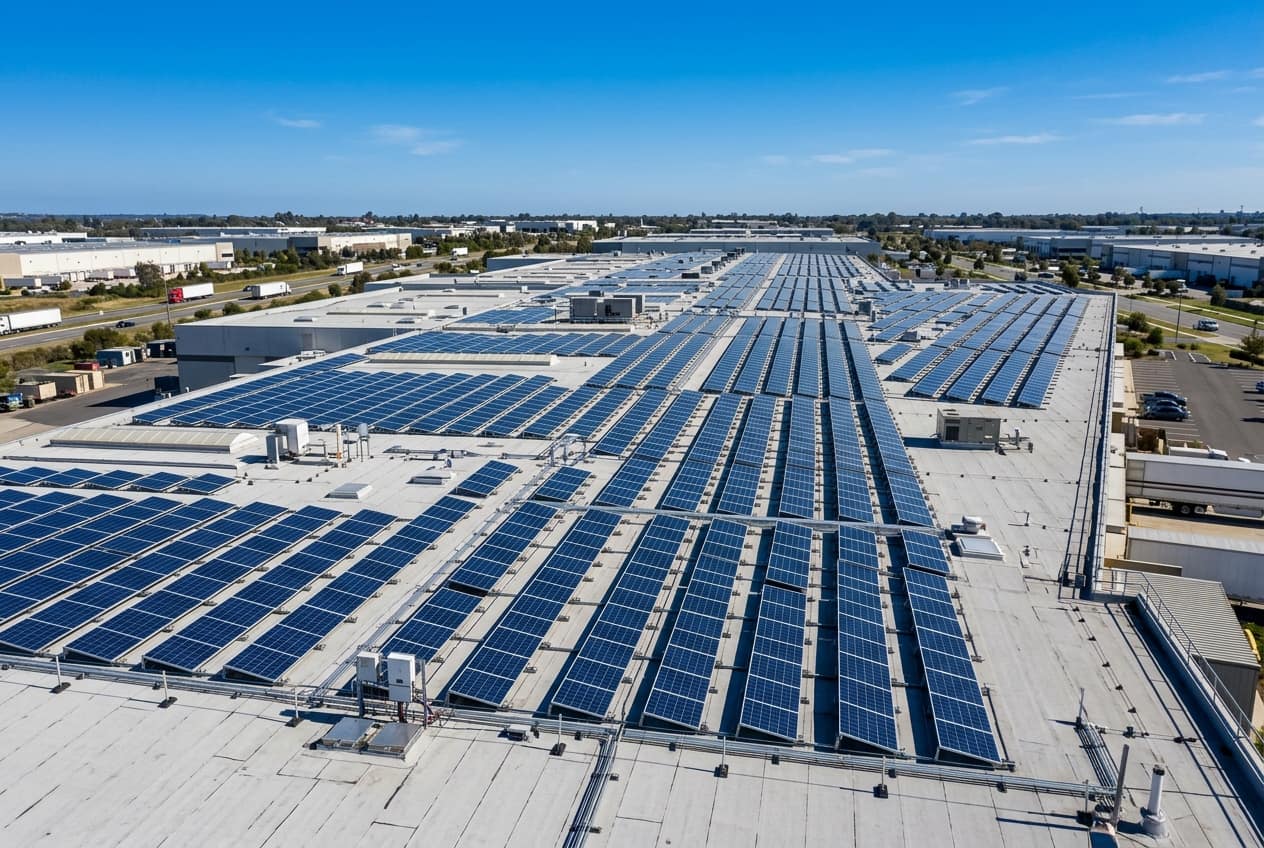
Commercial and industrial enterprises across Maharashtra, Gujarat, and neighbouring states face steadily escalating grid power tariffs, often touching ₹9 to ₹12 per kWh. With substantial unshaded roof space across warehouses, factories, and corporate offices, investing in commercial rooftop solar power plants has shifted from a corporate social responsibility token to an urgent financial imperative.
Key Engineering Takeaways
- Payback period on commercial solar systems typically ranges between 3.2 to 4.2 years with accelerated depreciation benefits.
- Payback and returns depend on your tariff, how much of the generation you use on site and the system cost, so ask for the calculation behind any figure.
- Grid-tied net metering allows industrial plants to bank surplus generation during plant shutdowns and weekends.
- Quality modules lose a small share of their output each year. The module datasheet states the output the maker guarantees at year 25, so read that figure and not a brochure claim.
1. Significant Reduction in High Commercial Power Tariffs
Industrial power consumers in Maharashtra (MSEDCL/Adani) and surrounding states operate under complex tiered tariff slabs with peak-hour time-of-day (TOD) penalties. Because solar electricity generation aligns precisely with peak commercial manufacturing hours (9:00 AM to 5:00 PM), on-site solar directly offsets expensive grid units.
A standard 100 kWp rooftop solar plant generates approximately 1,40,000 to 1,55,000 units (kWh) annually in high-insolation zones like Nashik and Pune. At a blended industrial tariff of ₹9.50/unit, the annual power savings surpass ₹13,50,000 to ₹14,70,000.
- A lower monthly electricity bill, in proportion to how much of your daytime load the plant supplies.
- Insulation against future regulatory tariff hikes over the 25-year panel design lifespan.
- Minimal transmission and distribution losses because generation occurs at point of consumption.
2. Tax Incentives & Accelerated Depreciation Benefits
Many businesses can claim accelerated depreciation on solar equipment under the income tax rules in force. The rate and the conditions change from time to time, so ask your tax adviser for the current treatment before you build it into a payback figure.
3. Engineered Mounting & Structural Integrity
A rooftop solar installation is only as resilient as its mounting superstructure and cable routing. Industrial tin-shed rooftops require non-penetrative aluminium standing seam clamps or robust hot-dip galvanized purlin mounts to preserve roofing warranties without puncture leaks.
Shruti IT Service designs solar installations considering coastal wind-zone parameters (up to 150 km/h wind shear ratings), lightning protection arcing, and heavy-duty IP67 junction enclosures suited for dusty industrial zones.
- Wind tunnel compliance and structural load calculations for metal sheds and RCC slabs.
- Integrated DC isolation switches and surge protection devices (SPDs) at each string.
- Cloud-connected IoT inverters delivering real-time yield monitoring per string.
4. Maintenance and Longevity Best Practices
Commercial solar needs regular maintenance. Dust on the modules can cut generation noticeably, more so at dry or highway-adjacent sites. A cleaning schedule with clean water and soft brushes or microfibre, plus monitoring that shows when output drops, keeps the plant close to its design output.
Conclusion & Next Steps
For plant heads, managing directors, and commercial facility leaders, transitioning to commercial rooftop solar is one of the highest-yield, lowest-risk infrastructure upgrades available today. Shruti IT Service provides turnkey EPC delivery from site survey, DISCOM liaisoning, and net-metering approvals to final commissioning and ongoing AMC support.
Need a site survey or project quote?
Our engineers provide comprehensive BOQs, system designs, and turn-key execution across Maharashtra and neighboring states.
Related services
Want this done at your site? These pages explain the scope, the process and the standards we work to.