
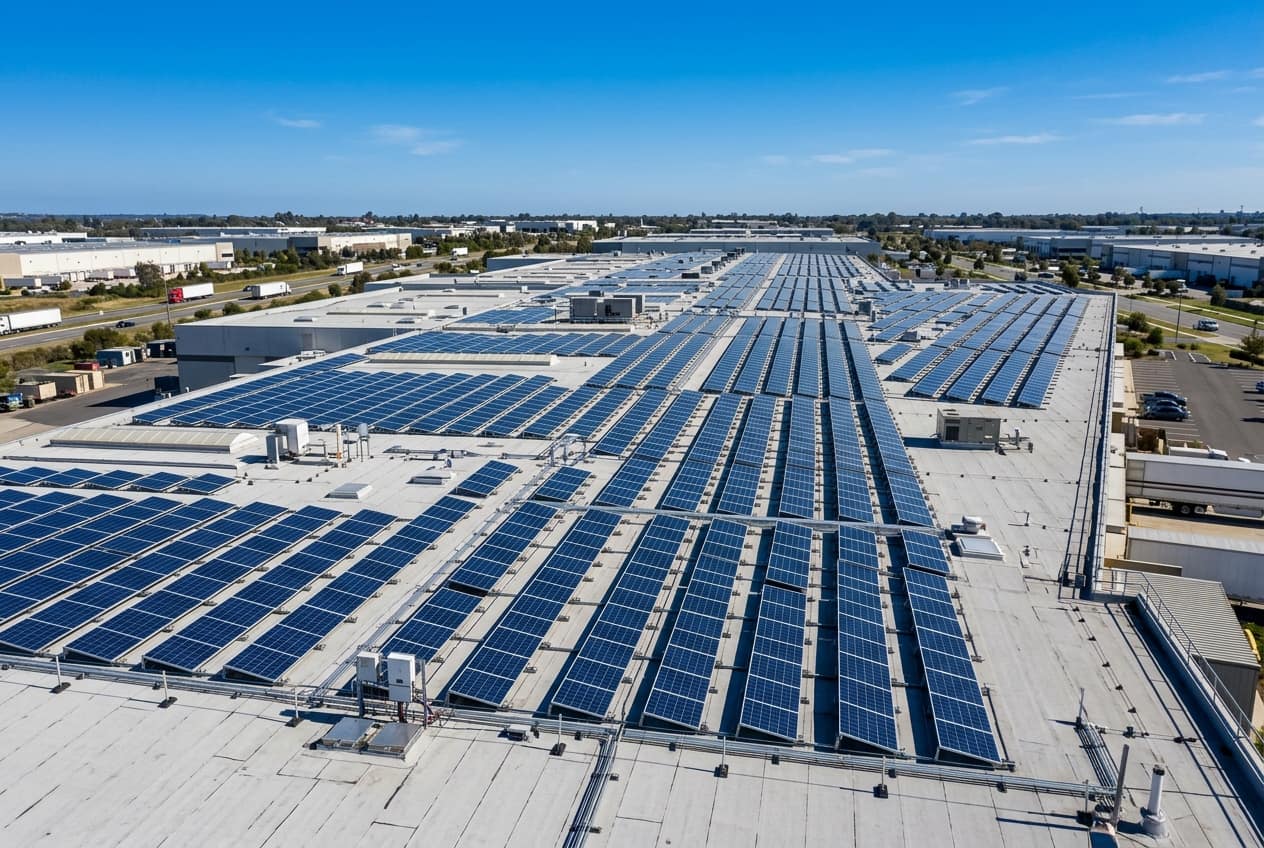
Commercial and industrial rooftop solar is a grid-connected photovoltaic plant installed on the roof of a factory, warehouse, office or institution to offset daytime electricity use. In most of western and central India a well-sited plant typically yields about 1,400 to 1,500 kWh per kWp per year, needs roughly 8 to 10 square metres of shadow-free roof per kWp, and is connected through net metering approved by the DISCOM.
At a glance
- Typical timeline
- 10 to 16 weeks from survey to commissioning, depending on roof readiness and DISCOM approval.
- Roof area rule of thumb
- About 8 to 10 square metres of usable, shadow-free roof per kWp.
- Key standards
- IEC 61215 and IEC 61730 for modules, IEC 62109 for inverters, IS 3043 for earthing, IEC 62446-1 for documentation.
- What you receive
- Generation estimate, drawings, approvals support, test reports, as-built file and monitoring access.
- Best suited for
- Sites with strong daytime load, sound roofs and a sanctioned load large enough to absorb the output.
- Our scope
- Survey, design, supply, installation, DISCOM paperwork support, commissioning, monitoring and AMC.
Commercial & Industrial Rooftop Solar Overview
A commercial and industrial rooftop solar plant converts unused roof area into a source of power that runs in parallel with your grid connection. During daylight hours the plant feeds your own loads first, so every unit it generates is a unit you do not buy from the DISCOM at your commercial or industrial tariff. Whatever you cannot use at that moment is exported under net metering or net billing, depending on the rules that apply to your consumer category.
The economics depend on three things: how much of the generation you consume on site, what your tariff is, and how well the plant performs over twenty years or more. A factory running two or three shifts with air compressors, chillers and motors uses almost every unit it generates. An office that is empty on Sundays exports more and earns less per unit. We start every project by studying your last twelve months of bills and, where possible, your load profile, because the size of the plant should follow your consumption and not the other way round.
Rooftop plants look simple from the ground, and that is where many go wrong. The roof has to carry the dead load of structure and modules plus wind uplift. Shadows from parapets, water tanks, chimneys and neighbouring buildings change through the day and the year. Cable routes have to avoid sun-baked trays and sharp edges. Fire access, walkways and earthing all have to be planned before a single module is lifted.
Shruti IT Service designs and installs rooftop solar for industrial estates, warehouses, hospitals, schools, offices and institutional campuses from our Nashik base, serving Maharashtra, Gujarat, Madhya Pradesh and Rajasthan, with teams mobilised for survey, installation and commissioning. We also look after the paperwork with your state distribution company (MSEDCL in Maharashtra), the monitoring set-up and the maintenance that follows, so the plant is one project with one owner of responsibility, not three vendors pointing at each other.
Ideal for: Factories, warehouses, offices, hospitals and institutions.
What Our Commercial & Industrial Rooftop Solar Includes
Our rooftop solar scope covers four connected packages. You can buy them together or ask us to take on only the parts you need, such as design review or approvals.
Site survey, shadow analysis and generation estimate
We measure the roof, mark obstructions and run a shading model for the whole year, then give you a generation estimate with each loss stated. You receive a roof layout drawing and a capacity recommendation tied to your bills. Tip: ask every bidder for the same assumptions, otherwise estimates cannot be compared.
Design, structure and module installation
We prepare structural, electrical and earthing drawings, order materials against an approved bill of quantities, and install structure, modules, cables and inverters. You get torque records, string maps and as-built drawings. Tip: insist on hot-dip galvanised structure with stated coating thickness, especially near chemical or coastal-like industrial air.
Net-metering application support with the local DISCOM
We prepare the application, single line diagram and supporting documents for your DISCOM, track the file and coordinate meter installation and inspection. You get a clear checklist of what the DISCOM needs from you. Tip: confirm your sanctioned load and tariff category early, because they decide the allowed capacity.
Monitoring portal and performance reporting
We connect inverters and a meter to a monitoring platform with alerts and monthly reports comparing actual generation against the estimate. You get portal access and a simple performance ratio trend. Tip: make sure the data logger has a reliable internet link, since many plants lose data to weak Wi-Fi.
Why many rooftop solar plants underperform
The most common failure is an optimistic generation estimate. A quotation that promises 1,600 kWh per kWp per year without a shadow study, a tilt and azimuth assumption and a loss breakdown is a sales figure, not an engineering figure. Real plants lose energy to soiling, temperature, mismatch, cable resistance, inverter conversion and shading. A fair estimate for most rooftops in this region sits well below the best-case number, and you should ask to see the loss tree behind it.
The second failure is the roof itself. Metal sheet roofs with corroded fasteners, asbestos or fibre cement sheets that cannot be walked on, old RCC slabs with leaking waterproofing, and sheds designed with no spare capacity for added load all create problems that show up only after installation. Drilling through a waterproofed slab without a plan for sealing the penetrations leads to leaks in the first monsoon. A structural check before design saves far more than it costs.
The third failure is the commercial one. Net metering approval, sanctioned load, contract demand, meter replacement and the inspection by the electrical inspectorate where required all take time, and each can stall a finished plant. We have seen plants sit idle for weeks because the application was filed late or the single line diagram did not match what was built. Planning the approval path alongside the design avoids that dead time.
What You Gain
Lower daytime energy cost
Solar units replace the most expensive part of your daytime consumption. For a plant that consumes most of what it generates, the saving per unit is close to your full energy charge, which is why industrial and commercial tariffs make rooftop solar attractive.
Predictable cost over decades
Module warranties usually run 25 years or more, and the plant has few moving parts. Your generation cost is fixed at installation, while grid tariffs tend to rise over time. That gap is what builds the financial case year after year.
Uses space you already own
Rooftops are idle land. A properly designed plant adds no land cost, no new building and very little disruption to operations. Cool roof benefits under the array also reduce heat load on top floors in summer.
Lower exposure to tariff and outage risk
Solar does not replace the grid, but it reduces how much of your cost depends on it. Paired with the right inverter settings and, if wanted, a storage or DG interface later, it supports a gradual move to energy independence.
Visible sustainability reporting
Monitoring data gives you daily and monthly kWh, avoided grid consumption and an estimate of avoided emissions. That helps with ESG disclosures, customer audits and group-level energy reports without guesswork.
One team from survey to AMC
Because we also handle CCTV, electrical works and network infrastructure on the same sites, rooftop cabling, earthing, lightning protection and monitoring connectivity are coordinated rather than left as gaps between vendors.
How the Work Is Delivered
A rooftop plant moves through approvals and civil checks as much as through installation. This is the sequence we follow, with documents delivered at each stage so you can review before we proceed.
- 1
Site survey and bill study
We visit the roof, measure usable area, note obstructions, check roof type and condition, and walk the cable route to the main panel. We then review twelve months of bills for sanctioned load, contract demand and tariff. The output is a shortlist of feasible capacities with a rough saving for each.
- 2
Shadow analysis and generation estimate
Using the layout and obstruction heights, we model shading across the day and year and produce a generation estimate with stated losses. You receive the assumptions in writing, so you can compare quotations on the same basis.
- 3
Design, structure and approvals
We prepare the array layout, structural drawing, string design, single line diagram, earthing and lightning protection scheme. In parallel we prepare the net-metering application for your DISCOM, with the documents the DISCOM asks for. Any structural certificate needed from your consultant is requested at this stage.
- 4
Supply and quality checks
Modules, inverters, cables, structure and protection gear are ordered against the approved bill of quantities. On delivery we check module serial numbers and flash reports against the order, inspect structure galvanising and check inverter ratings, so errors are caught before work at height begins.
- 5
Installation at height
Structure is anchored using the approved method, modules are clamped with torque checks, DC cabling is dressed in UV-resistant conduit or trays, and the AC side is terminated at the agreed point. Fall protection, permits to work and fire access are managed through the job, with the plant kept clear of roof drainage.
- 6
Testing and commissioning
We measure string open-circuit voltage and short-circuit current, insulation resistance, earth resistance and polarity before energising, then check inverter parameters, anti-islanding behaviour and the meter reading. Results go into a commissioning report in line with IEC 62446-1 practice.
- 7
Handover, monitoring and AMC
We hand over the as-built drawings, test reports, warranties and operating instructions, brief your maintenance staff, and activate the monitoring portal. An AMC covering cleaning, inspections and fault response can start the same day, with service levels agreed per site.
How a rooftop solar plant is engineered
A grid-tied plant has four main blocks. The modules, typically mono crystalline PERC or TOPCon types of 540 to 600 Wp and more, are connected in series strings to match the inverter's MPPT voltage window. String inverters of 25 to 100 kW suit most commercial roofs because they limit the damage of a single failure and allow module level monitoring by string. Central inverters appear only on very large plants. The AC output goes through protection and metering to your main LT panel.
Design choices matter more than brand names. Tilt and row spacing trade generation against area: a low tilt of 10 to 15 degrees fits more kWp on a flat roof with less wind load, while a steeper tilt raises yield per module but needs wider row gaps. The DC to AC ratio, often around 1.1 to 1.3, is chosen to keep the inverter loaded in winter and in cloudy months. Cable sizing should hold DC voltage drop to about 1 to 2 percent. On metal sheet roofs, clamp-on rails avoid drilling through the sheet. On RCC roofs, ballast or chemical anchoring is chosen after checking slab thickness and waterproofing.
IEC 61215 and IEC 61730 for modules
These cover design qualification and safety of PV modules. We ask for test certificates for the exact model supplied, and we check the module against the MNRE approved list of manufacturers where your scheme or subsidy requires it.
IEC 62109 for inverters
This sets the safety requirements for power converters in PV systems. The inverter must also carry grid-interface protection (over and under voltage, frequency, anti-islanding) set to the DISCOM's accepted values.
IS 3043 and IS/IEC 62305 for earthing and lightning
A rooftop array needs an equipotential earth that is bonded to the building earth, and lightning protection that suits the building's risk assessment. We measure earth resistance on site and document the result.
IEC 62446-1 for documentation and testing
This standard describes the documents and tests expected of a grid-connected PV system at handover. We follow its structure for the commissioning report, which also helps in later insurance or lender audits.
CEA safety and distributed generation regulations
Central Electricity Authority regulations on electrical safety and connection of distributed generation shape protection settings, isolation points and labelling. Statutory inspection or certification, where applicable to your capacity, remains a client approval that we support.
Worked example: a two-shift factory in a Nashik MIDC estate
Consider a fabrication unit with a 400 kVA sanctioned load, a daytime base load of 120 to 180 kW, and a 6,000 square metre metal sheet roof facing roughly east and west. After shading checks and a structural review, about 3,000 square metres of roof proves usable. At 8 to 10 square metres per kWp, that supports a plant in the region of 300 to 375 kWp. We would likely propose around 300 kWp, so that midday output stays below the load on working days and exports remain small.
At about 1,400 to 1,500 kWh per kWp per year, a 300 kWp plant would generate roughly 420,000 to 450,000 units annually before degradation of around 0.5 percent per year. Multiply the units by the energy charge on the factory's bill, subtract fixed charges that solar does not reduce, and the annual saving falls out. The same sum, set against installed cost, gives a payback that commonly lands in the range of a few years for industrial tariffs, though it moves with tariff, loan terms and tax treatment, which your finance team should confirm.
On site, the work would run in sequence: structural check of the sheds, clamp-on rail structure along the ridges, string inverters mounted on a shaded wall near the LT room, a new breaker in the main panel, and a bidirectional meter fitted by the DISCOM after inspection. Monsoon timing matters, so roof work is scheduled to keep sheets sealed and to avoid lifting modules in strong wind.
- A written generation estimate with a loss breakdown, against which the first year of monitoring data is compared.
- A net-metering approval path agreed with the DISCOM before material is ordered.
- A commissioning file with string test records, earth readings and the single line diagram.
- A monitoring portal showing daily generation and an alert when a string or inverter underperforms.
This is an illustrative scenario built from typical site conditions. Actual quantities, timelines and results depend on your site survey.
Commercial & Industrial Rooftop Solar Across Four States
We are based in Nashik and deliver across Maharashtra, Gujarat, Madhya Pradesh and Rajasthan. Each state has its own utilities, approvals and site conditions, and these are the points that matter most for this service.
Maharashtra
MSEDCL handles net metering for most consumers, and the state regulator sets capacity limits by consumer category. Industrial roofs in MIDC estates are often metal sheet with little spare load capacity, so we check purlins and sheeting before design. Monsoon wind from June to September drives clamp, rail and ballast choices, and roof work is scheduled around it.
Gujarat
Approvals run through the GUVNL group DISCOMs (DGVCL, MGVCL, PGVCL and UGVCL) or a private licensee such as Torrent Power in some cities. GIDC estates have large factory and warehouse roofs with strong irradiation. In coastal Kutch and Saurashtra, salt-laden air calls for corrosion-resistant structure, fasteners and cable glands.
Madhya Pradesh
Madhya Pradesh is served by three regional DISCOMs (East, Central and West), each with its own application desk. Industrial areas such as Pithampur and Mandideep have large flat and sheet roofs. Hot summers and a strong monsoon both matter, so we check roof load, wind uplift and the temperature rating of DC cables.
Rajasthan
The distribution companies are JVVNL, AVVNL and JdVVNL, and the one serving your site depends on its district. RIICO industrial areas get excellent sun but fine desert dust and extreme summer heat. Cleaning frequency, inverter derating and cable temperature ratings shape the design more than module count does.
Where This Work Is Most Often Needed
Why Teams Work With Us on This
Engineering that starts with your bill
We size the plant on your consumption and sanctioned load, not on how many modules the roof can hold. That avoids oversizing and gives you a saving figure you can verify against your own monthly bills.
Paperwork handled alongside design
Our team prepares net-metering applications, single line diagrams and test records as part of the project, so approvals do not become a separate chase after installation is complete.
Nashik base, mobilised to your site
Our engineers are based in Nashik and travel to sites across the states we serve, so they know industrial estate conditions, summer heat, monsoon wind and DISCOM practice in each. Survey, installation and commissioning visits are planned by route and site cluster.
AMC continuity and single window
The same company that installs the plant can maintain it, and can also handle the electrical panels, CCTV and network systems on your site, so responsibility does not split at the roof edge.
Need AMC for an existing system?
We maintain installations done by other vendors too, after a short audit of what is already on site.
Guides and Projects Related to This Service
Frequently Asked Questions
01How much does a commercial rooftop solar plant cost?
Cost depends on capacity, roof type, module and inverter class, structure, cable lengths and approvals, so we do not quote a single figure without a survey. Larger plants cost less per kWp because fixed items spread across more capacity. To get a firm number, share twelve months of bills and roof photographs, and we will give an itemised bill of quantities you can compare line by line.
02How long does it take to install a rooftop solar plant?
Most commercial plants take about 10 to 16 weeks from survey to commissioning. Physical installation of a few hundred kWp often takes two to five weeks. The longer part is usually structural checks, material supply and DISCOM approval, which depend on how ready your documents and roof are.
03What is the payback period for commercial rooftop solar?
For commercial and industrial users, payback commonly falls in a range of a few years, but your own number depends on tariff, self-consumption, installed cost, financing and tax treatment. The honest way to calculate it is to multiply expected units by your energy charge, subtract any extra costs, and divide installed cost by that annual saving. Ask us to show the working.
04How much roof area do I need per kW?
Plan for roughly 8 to 10 square metres of usable, shadow-free area per kWp with current modules. Usable area is always less than total roof area, because of walkways, drainage, skylights, fire access and shading. A site survey gives the real figure, and it is common for only half of the roof to be usable.
05What is net metering and do I need it?
Net metering lets you export surplus solar units to the grid and offset them against what you import, so you are billed on the net. Whether you need it depends on how much of the output you use directly. Rules and capacity limits come from the state regulator and your DISCOM, so we check your consumer category before design.
06What happens to a rooftop plant during a grid outage?
A standard on-grid plant shuts down during a grid outage, by design, to protect line workers from back-feed. If you need power during outages, you need a hybrid inverter with batteries or a DG synchronising arrangement. We can discuss that option on our off-grid and hybrid page, and plan the cabling so it can be added later.