
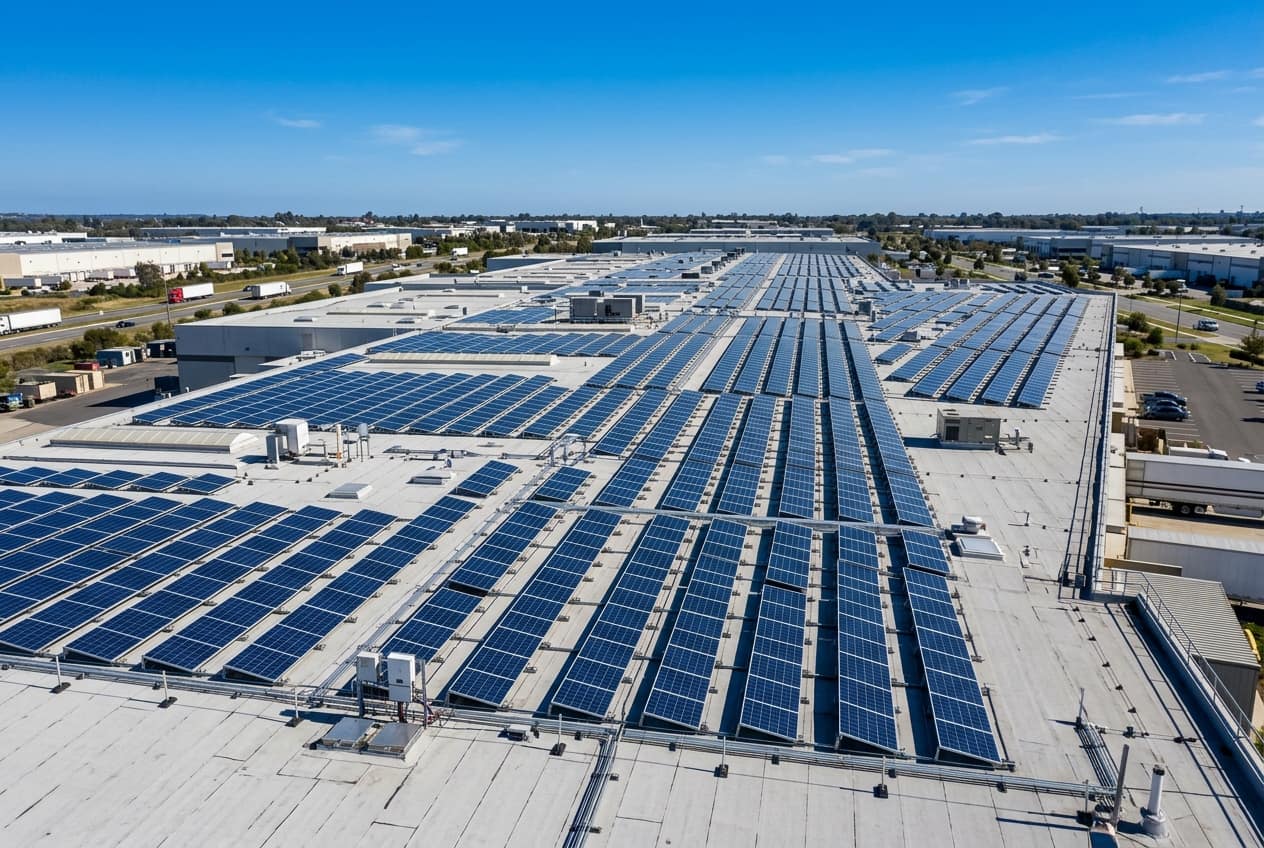
A solar street light is a standalone luminaire powered by its own solar panel and battery, switching on at dusk and off at dawn with no cable to the grid. A typical 30 W LED unit uses about 300 to 400 Wh a night. Reliable performance depends on battery capacity for two to three nights, a correct panel size for the worst month and a properly built pole foundation.
At a glance
- Typical timeline
- 3 to 8 weeks from design to installation, depending on pole count and foundation work.
- Typical load
- A 20 to 60 W LED luminaire, running 10 to 12 hours a night with dimming.
- Key standards
- IS 1944 lighting practice, IEC 61215 modules, IP65 or better luminaires and IS 3043 earthing.
- What you receive
- Lighting layout, energy sheet, foundation drawings, test records and a maintenance plan.
- Best suited for
- Industrial campuses, villages, townships, highways and municipal projects without nearby supply.
- Our scope
- All-in-one and semi-integrated lights, poles and foundations, controls, maintenance and battery replacement.
Solar Street Lighting Overview
Solar street lights light roads, paths and open areas without any connection to the electricity network. Each unit generates power through the day, stores it in a battery, and runs an LED luminaire through the night. There is no trenching, no cable theft risk, and no monthly bill, which makes the system attractive for long internal roads, boundary walls, villages, highway stretches and townships under development.
There are two common formats. An all-in-one light has the panel, battery, controller and luminaire in a single housing on top of a pole. It is quick to install and compact, but the battery is exposed to heat and the panel angle is fixed to the fixture. A semi-integrated or split design places the panel on top of the pole and the battery in a box lower down, which allows a larger panel and cooler battery. Which is better depends on lighting level, budget and maintenance access.
Light levels are the usual point of dispute. A buyer wants a bright road, a seller quotes a high lumen figure, and months later the lights are dim because the battery cannot carry the load. We design from the required lux on the road surface, the spacing and mounting height, and the energy needed per night, and we then size panel and battery to match. Dimming profiles stretch the energy over the whole night so lights do not go out at 2 am.
Shruti IT Service supplies, installs and maintains solar street lights for industrial campuses, townships and infrastructure projects from our Nashik base, serving Maharashtra, Gujarat, Madhya Pradesh and Rajasthan. Where a project needs grid-fed lighting or high mast lights, our electrical team handles that separately, and where surveillance poles are needed we can combine the two on shared structures where the design allows.
Ideal for: Industrial campuses, villages, townships, highways and municipal projects.
What Our Solar Street Lighting Includes
Our solar street lighting scope covers the four packages below, from selecting the light format to maintaining the battery that keeps it running.
All-in-one and semi-integrated solar lights
We help you choose between compact all-in-one units and split designs with a larger panel and a lower battery box, based on light level, budget and maintenance access. You receive a specification and a lighting layout. Tip: for roads above a certain width or for long nights in monsoon, a split design usually gives more reliable output.
Pole and foundation work
We design and build poles and foundations for local wind and soil, with galvanised sections, anchor cages and curing time respected. You receive drawings and a pole register. Tip: never skip the curing period before erecting poles, because early loading cracks foundations and causes lean.
Dusk-to-dawn and motion-based controls
We configure switching and dimming profiles, add motion boost where useful, and tune settings after the first weeks of data. You receive the profile written down for each light type. Tip: use dimming rather than a shorter run, so the road stays lit at low level through the whole night.
Maintenance and battery replacement
We plan panel cleaning, inspection of seals and fixings, and battery replacement at the end of its life. You receive a schedule and records of each visit. Tip: log installation dates for each battery, which lets you budget replacement and spot early failures.
Why solar street lights fail early
The most common failure is a battery that has been undersized or abused. Marketing figures often assume full sun every day. In monsoon the panel may deliver a fraction of its summer charge, and a battery that is drained to empty each night will age quickly. A good design includes two to three nights of autonomy and a controller that dims the light when the battery is low, so the road is never fully dark.
The second failure is poor mechanical work. Poles that are too thin for the wind, foundations that are too shallow for the soil, and panels that face the wrong way or are shaded by trees all reduce performance. Fasteners that rust, loose cable glands and fixtures without proper sealing admit moisture. When lights lean or fall in a storm, the repair cost often exceeds the savings of buying the cheapest option.
The third failure is no maintenance plan. Panels covered in dust or bird droppings lose a significant share of output, and nobody notices because the light still comes on, only dimmer and for fewer hours. Batteries reach end of life after a few years and need replacing on a schedule. Without a log of installed units, dates and faults, an owner cannot tell which lights are failing, and complaints pile up.
What You Gain
No cabling or trenching
Lights can be placed wherever lighting is needed, without digging, cable laying or utility approvals. That cuts installation time and avoids the risk of cable theft and damage along long roads.
Zero electricity cost
Once installed, the lights run on sunlight. There is no energy bill, and no dependence on grid availability, so the road stays lit during outages and load shedding.
Fast roll-out for new areas
Townships and campuses under development can light internal roads early, before permanent electrical infrastructure is complete, and relocate or retain the lights as the project evolves.
Controlled lighting profiles
Dusk-to-dawn switching, timed dimming and motion-based boost let you spend stored energy where it matters, giving full brightness when someone is present and a low level otherwise.
Lower long-term cost of ownership
LED luminaires and lithium iron phosphate batteries have long service life. Costs after installation are limited to cleaning, inspection and eventual battery replacement, which we plan and price up front.
Visible sustainability measure
Solar lighting is easy to see and to report. Campus owners, municipalities and developers can count avoided grid energy and show it in sustainability reports without complex measurement.
How the Work Is Delivered
A solar street lighting project begins with lighting design, not with choosing a product. Our process fixes the light level first and then sizes everything that powers it.
- 1
Site survey and lighting objectives
We walk the road or area, note widths, curves, trees, shading, soil and any grid lights already present. We agree with you the required light level for roads, junctions, pedestrian paths and parking, and the hours of operation.
- 2
Lighting layout and energy design
We select luminaire wattage and optics, pole height and spacing, and check illuminance on the road with a lighting calculation. Spacing often lands at around three to four times the mounting height, though the optics decide. The energy per night is then computed.
- 3
Panel, battery and controller sizing
From the nightly energy figure, we size the panel for the worst month and the battery for two to three nights of autonomy. As an example, a 30 W light running 11 hours with dimming uses about 250 to 330 Wh per night, so a 100 to 120 Wp panel and a battery near 800 Wh nominal are a typical match.
- 4
Pole, foundation and civil design
We choose pole sections for local wind speed and fixture weight, then design foundation size from the soil. Panel orientation, tilt and anti-shade placement are marked on the layout so each unit gets full sun.
- 5
Supply and incoming inspection
We check each luminaire, panel and battery against the specification, test samples for lumen output and capacity, and verify galvanising thickness on poles. Failed samples are rejected before they reach site.
- 6
Installation and commissioning
Foundations are cast and cured, poles erected, panels aligned and fixtures wired and sealed. Every light is tested for switching, dimming profile and charge current in sunlight, and a lux reading is taken at sample spots.
- 7
Handover and maintenance plan
We hand over a register of every pole with location, serial numbers and installation date, plus the cleaning and battery replacement schedule. Maintenance and battery swap under AMC can follow, with service levels agreed per site.
Luminaires, panels and batteries in a solar street light
The luminaire is an LED module with a lens that shapes light along the road, so it throws light forward and sideways rather than up into the sky. A good optic gives even coverage and avoids dark patches between poles. Efficacy of modern LED fixtures lets a 30 W luminaire light a narrow internal road, while wider roads need higher wattage or closer spacing. The ingress protection should be IP65 or better. The panel is usually monocrystalline, tilted towards south at a fixed angle chosen for the latitude, and the battery is lithium iron phosphate in most new designs because it handles heat and daily cycling better than sealed lead acid.
The controller does the quiet work. It charges the battery with MPPT or PWM, switches the light on at dusk using the panel voltage or a photocell, applies a dimming schedule, and protects the battery from over-discharge. A common profile gives full output for the first four hours, a reduced level for the middle of the night, and full output again before dawn. Motion sensors can boost brightness when someone approaches. Programmable controllers let us tune the profile after commissioning, so that actual battery behaviour in the first weeks guides the final setting.
IS 1944 and lighting design practice
Road lighting practice sets recommended illuminance and uniformity by road type. We use it, along with your own lux targets, to choose wattage, pole height and spacing, and we measure sample points at commissioning.
IEC 61215 for panels
Panel qualification covers mechanical load and weathering. For street lights, frame strength and secure fixing matter, since poles take wind and the panel is a target for theft.
IP65 or better luminaire protection
Fixtures must resist dust and water in monsoon. We check gasket quality and cable gland sealing, and we look at the thermal design, because LED life depends on keeping the junction cool.
Pole and foundation design for wind
Poles are designed for wind speed at the site under IS 875 Part 3 and for the weight and wind area of the panel and fixture. Foundations follow soil conditions and are cured properly before erection.
Earthing and surge protection
Metal poles in open ground can attract lightning effects. We bond pole, panel frame and controller to an earth electrode in line with IS 3043 practice, and we add surge protection where the electronics are exposed.
Worked example: lighting a 2 km internal road in an industrial campus
Take an industrial campus in a Gujarat industrial estate with a two-kilometre internal ring road, 7 metres wide, and a boundary where laying cable would cost more than the lights themselves. The owner wants safe movement for night-shift workers and vehicles. The design uses 7 metre poles on one side at about 25 metre spacing, which is roughly 80 poles, with 40 W luminaires and a dimming profile.
Each pole's energy per night is calculated at about 350 to 450 Wh with dimming. Panels of 150 Wp and lithium iron phosphate batteries near 1.2 kWh give around three nights of autonomy in the worst month, and the design checks for shade from existing trees on the east side. Where a pole sits under a tree, it is shifted slightly or the tree is trimmed, because shaded panels are the main cause of dim lights.
After installation, the contractor records a register of poles and takes lux readings at sampled points along the road. Panels are cleaned quarterly and before the monsoon, and each battery has a recorded installation date. Light output, hours and battery life will vary with weather and use, and service levels for repair and replacement are written into the maintenance contract.
- A lighting layout with pole spacing, height and lux checks at sample points.
- An energy sheet showing night-by-night consumption and autonomy for each light type.
- A pole register with serial numbers and installation dates for planned maintenance.
- A battery replacement plan with expected timing and cost, so there are no surprises.
This is an illustrative scenario built from typical site conditions. Actual quantities, timelines and results depend on your site survey.
Solar Street Lighting Across Four States
We are based in Nashik and deliver across Maharashtra, Gujarat, Madhya Pradesh and Rajasthan. Each state has its own utilities, approvals and site conditions, and these are the points that matter most for this service.
Maharashtra
Maharashtra street lighting includes MIDC roads, township layouts and village works, where monsoon cloud sets the battery size. Wind on exposed ghat and plateau sites drives pole section and foundation depth, and black cotton soil needs deeper footings. Municipal and village tenders often state lux levels and warranty terms, which we match in the design.
Gujarat
Gujarat suits solar street lights in GIDC estates, ports, coastal villages and highway service roads. Salt-laden air attacks poles, fasteners and fixtures near the coast, so we specify heavier galvanising, powder coating and stainless hardware. Good sun lets us size panels efficiently, though cyclone-season wind loads in coastal districts must be checked.
Madhya Pradesh
In Madhya Pradesh, solar street lights serve industrial areas such as Pithampur and Mandideep, township roads and village streets where cable extension is slow. Hot summers shorten battery life without ventilation, and the monsoon reduces charge for weeks. We therefore favour lithium iron phosphate batteries, three nights of autonomy and a dimming profile.
Rajasthan
Rajasthan sites, from RIICO areas to desert villages and highway stretches, get strong sun but heavy dust and heat above 45 degrees. Dust can cut panel charge sharply between cleanings, so we plan frequent cleaning and a tilt that sheds sand. Batteries need shaded, vented housing. Long distances make a pole register and route-planned maintenance important.
Where This Work Is Most Often Needed
Why Teams Work With Us on This
Design from lux, not from catalogue lumens
We start with the light level your road needs and size panel and battery backwards from it, so lights stay bright through the night and through the monsoon instead of dimming by midnight.
Civil and electrical done properly
Pole, foundation, earthing and cabling work follow engineering practice from our electrical team, which prevents leaning poles, loose fixtures and lightning damage.
Maintenance and battery planning included
We hand over a pole register and a service plan with cleaning and battery replacement timing, because the cost of ownership is decided after installation as much as before.
Local team and combined solutions
Our crews are mobilised from Nashik to install and service the lights, and where a site also needs solar CCTV poles or electrical lighting, one team coordinates all of it.
Need AMC for an existing system?
We maintain installations done by other vendors too, after a short audit of what is already on site.
Guides and Projects Related to This Service
Frequently Asked Questions
01How much does a solar street light cost?
Cost depends on wattage, battery capacity, panel size, pole height, foundation work and whether the unit is all-in-one or split. A cheap fixture with a small battery can cost less upfront but fail early. Share your road width, spacing and required lux, and we will give an itemised quote with autonomy stated.
02How many nights will a solar street light work without sun?
A well-designed unit runs two to three nights without sun, and some designs go longer with dimming. The figure depends on battery capacity, luminaire wattage and dimming profile. Ask each supplier to state autonomy in nights and the assumptions behind it, because the claim is easy to inflate.
03What is the difference between all-in-one and split solar street lights?
An all-in-one light puts panel, battery, controller and luminaire in one unit, which is quick to install and neat but limits panel size and exposes the battery to heat. A split design uses a separate panel and battery box, which allows more power and cooler batteries, at a higher installation effort.
04How far apart should solar street lights be placed?
Spacing depends on pole height, luminaire optics and the lux level you need, and it is often around three to four times the mounting height. A 7 metre pole might be spaced near 25 metres. A lighting calculation, not a rule of thumb, should confirm uniform coverage on your actual road.
05How long do solar street light batteries last?
Lithium iron phosphate batteries commonly last several years of daily cycling, while sealed lead acid batteries often need earlier replacement, especially in hot conditions. Life depends on depth of discharge, temperature and charge settings. We record installation dates and plan replacement so that lights do not fail unnoticed.
06Do solar street lights need regular maintenance?
Yes, though less than grid lights need electrical repair. Panels need cleaning every few months, more often in dusty locations, and fixings, seals and poles should be inspected yearly. Batteries need replacement at end of life. A maintenance plan with records prevents slow loss of light that nobody reports.