
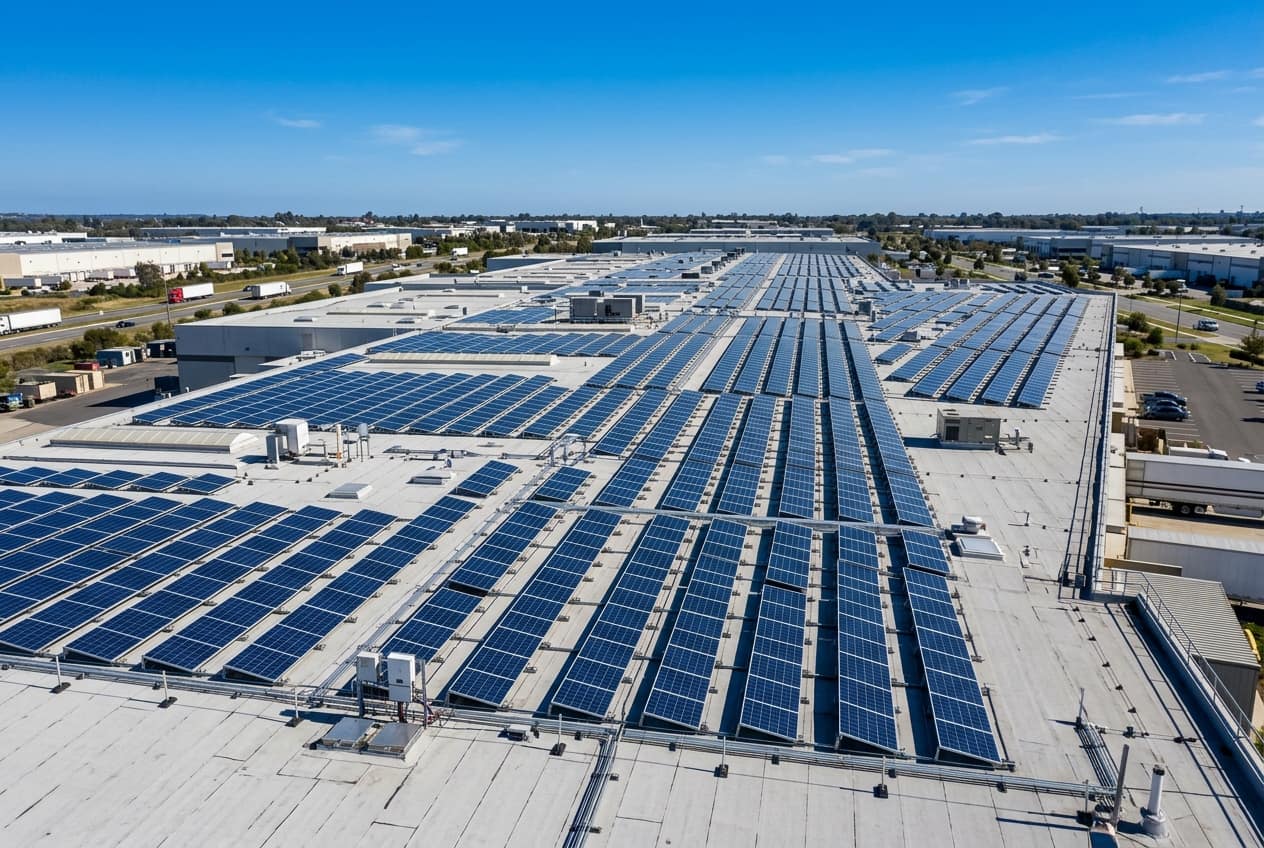
A ground-mounted solar plant is a photovoltaic array built on open land, with fixed or tracking structures, inverters, a step-up transformer and an evacuation line to your plant or the grid. It suits industries and institutions that need more capacity than their roofs allow. Land needed is roughly 1.5 to 2 hectares per MWp for fixed-tilt designs, subject to terrain and shading.
At a glance
- Typical timeline
- 5 to 9 months from feasibility to grid synchronisation, driven by land, approvals and evacuation permissions.
- Land rule of thumb
- About 1.5 to 2 hectares per MWp for fixed-tilt plants on flat, clear land.
- Key standards
- IEC 61215, IEC 61730, IEC 62548, IS 3043 and IEC 62446-1.
- What you receive
- Feasibility report, layout and energy model, civil and electrical drawings, test records and as-built set.
- Best suited for
- Industries with open land, institutions and developers seeking captive or group captive supply.
- Our scope
- Land assessment, civil, structure, modules, inverters, transformer, evacuation, commissioning and AMC.
Ground-Mounted Solar Plants Overview
A ground-mounted solar plant is the right step when your rooftops are too small, too weak or too shaded to cover the energy you want to replace. Built on open land, it gives the designer freedom that a roof never allows: modules face the best azimuth at the best tilt, rows are spaced to avoid self-shading, and access for cleaning and maintenance is straightforward. Capacities range from a few hundred kWp for a campus to several MWp for a large industrial consumer.
Most industrial ground-mounted plants in western and central India are built for captive use. Power is generated on your land and either delivered through your own line to the factory, or wheeled over the DISCOM network from a separate site. Each route has different legal and commercial conditions. A plant next to your own premises on your own land is the simplest case, while an off-site plant that serves a plant through open access brings in wheeling charges, scheduling and the captive user conditions under the Electricity Rules.
This page is about the plant that is built on the ground. If your main constraint is roof area and your load is modest, look at our rooftop solar page. If you need power where no grid exists, or you need batteries, our off-grid and hybrid page is the better match. Ground-mounted plants sit between those two: they depend on the grid, and they depend on land and civil work.
Shruti IT Service takes up ground-mounted projects from the first feasibility visit through civil work, structure, installation, evacuation and commissioning. We work with your land documents, your power consumption and your DISCOM, and we keep the electrical and civil packages under one project manager so interface issues are found on paper and not in the field.
Ideal for: Industries with open land, institutions and developers.
What Our Ground-Mounted Solar Plants Includes
Our ground-mounted solar scope covers four packages that follow the project from land to grid. They can be taken together or separately, for example when your own EPC handles civil work.
Land and feasibility assessment
We check land documents, topography, soil, drainage, shading and the evacuation route, then estimate capacity and annual generation. You receive a feasibility report with a layout sketch and a list of risks. Tip: do the soil investigation before you finalise the budget, because foundation cost swings widely with ground conditions.
Mounting structure, civil and module installation
We design and build foundations, structure, drainage and trenches, then install modules, DC cables and earthing. You get structural calculations, pile test results and string maps. Tip: ask for the wind speed and soil values used in the structural design, and have them checked by your own consultant if the plant is large.
Inverter, transformer and evacuation works
We install inverters, step-up transformer, HT or LT switchgear, metering and the line to your load or the DISCOM point. You get protection settings, factory test reports and a single line diagram. Tip: order the transformer early, since lead time often decides the commissioning date.
Commissioning and grid synchronisation
We carry out pre-energisation tests, protection checks and grid synchronisation with DISCOM and any required inspector. You receive a commissioning report and a performance baseline. Tip: record first-month generation against irradiation, because it becomes your reference for later loss analysis.
What goes wrong on ground-mounted solar projects
Land is the first source of surprises. A plot that looks flat and open may have black cotton soil that swells in the monsoon, a high water table, a drain crossing the corner, or a hill shadow at 4 pm in December. Land title, conversion status and right of way for the evacuation line need to be clear before design money is spent. A geotechnical investigation and a topographic survey cost little compared with redesigning foundations after piles have refused at shallow depth.
The second source is evacuation. Generating power is the easy part. Getting it into your plant or onto the grid requires a transformer, an LT or HT line, protection coordination and, for larger plants, a connectivity approval from the DISCOM or transmission utility. Plants have been commissioned mechanically and then left waiting for a substation bay or a metering approval. Timelines for these approvals are outside any contractor's control, so they must be tracked from day one.
The third is operations after handover. A plant with poor drainage, vegetation growth, uncleaned modules and unmonitored strings loses output slowly enough that nobody notices for a year. Cable damage from rodents, theft of copper or modules, and inverter failures in 45 degree summer heat are all predictable, and the design should plan for them with fencing, cable protection, ventilation and a monitoring system with string-level visibility.
What You Gain
Capacity beyond the roof
You are not limited by roof area or roof strength. A ground-mounted plant can be sized to your actual consumption or to a captive target, and it can be extended in phases as load grows or as approvals allow.
Better yield per module
Fixed tilt at the optimum angle, wide row spacing and no roof heat trapping give a more favourable generation profile. Single-axis trackers, where land and budget allow, can raise energy per kWp further, at the cost of moving parts.
Easier access and maintenance
Walkable rows, vehicle access and open cable trenches make cleaning, inspection and replacement faster and safer than work at height on a roof, which lowers the lifetime cost of operation.
Captive power at a stable cost
Generating on your own land fixes your cost of solar energy for the project life. For eligible captive users, this can reduce exposure to tariff revisions and certain open access charges, subject to current regulation.
Phased build and scalability
The layout can be planned in blocks, each with its own inverter and string group. You can commission the first block while later blocks wait for approvals or budget, and still have a single coherent design.
Land use with dual benefit
Raised structures can allow limited grazing or low-height activity below, and well-drained plots stay usable. We will tell you plainly when a plot is not worth developing instead of forcing a design onto poor land.
How the Work Is Delivered
Ground-mounted projects carry more civil and approval steps than rooftop work. Our sequence puts the questions that can stop a project first, so you learn early whether the site is viable.
- 1
Land and feasibility assessment
We review title documents, boundary survey, access road, shading from terrain and nearby structures, soil conditions and flood history. We check the distance to your load or to the nearest suitable substation and give a go or no-go view with a capacity range.
- 2
Energy model and layout design
We model generation using site irradiance data, choose tilt, row pitch and DC to AC ratio, and draw the array layout with roads, drains, fencing and inverter locations. You receive a layout with the energy estimate and loss assumptions.
- 3
Geotechnical and civil design
Pile load tests or soil investigation decide foundation type: driven piles, ramming, screw piles or concrete pedestals. We design drainage, internal roads, cable trenches and transformer plinths, and we plan for monsoon work where the ground softens.
- 4
Approvals and procurement
We prepare the connectivity or net-metering file, single line diagram and protection scheme, and support applications to the DISCOM. Long-lead items such as transformers and HT switchgear are ordered early, with factory test reports requested for each.
- 5
Construction and installation
Piling, structure erection, module mounting, DC cabling, inverter installation and earthing proceed block by block. We keep a daily progress log, torque records and string maps, and we protect modules from handling damage through checks at unloading.
- 6
Evacuation, testing and grid synchronisation
The step-up transformer, HT or LT line and metering are installed and tested. We carry out insulation, continuity, earth and protection relay tests, then synchronise with the grid in the presence of DISCOM representatives and inspection authorities where required.
- 7
Handover, monitoring and O&M start
You receive the commissioning report, as-built drawings, equipment manuals, warranty documents and spare lists. Monitoring is activated, operations staff are trained, and a maintenance plan with cleaning cycles and vegetation control begins.
Structures, inverters and evacuation in a ground plant
Fixed-tilt structures are the default for captive plants because they have no moving parts and need little maintenance. Mounting systems use galvanised steel or aluminium sections on driven piles or concrete footings, designed for local wind speed under IS 875 Part 3 and for soil conditions found in the geotechnical report. Bifacial modules are increasingly common on ground plants, since reflected light from the ground adds yield, but they need more clearance and a realistic albedo assumption. Single-axis trackers raise energy per kWp, but they add motors, controllers and maintenance, so they suit larger plants with skilled O&M teams.
On the electrical side, string inverters of 100 kW or more reduce DC cable length and simplify replacement, while central inverters of 1 MW and above suit multi-megawatt blocks. The inverter output is stepped up to 11 kV or 33 kV, depending on the evacuation point, using an oil-filled or dry type transformer. Protection includes an HT breaker with relays, lightning arresters, earth grids tested to IS 3043 practice and a fence-level perimeter earth. SCADA or a monitoring platform tracks string current, inverter status, meter data and weather station values, so that performance ratio can be calculated against irradiation and not just against calendar days.
IEC 62548 for PV array design
This sets design requirements for PV arrays, including cable sizing, protection and disconnection. We use it to check string fusing, DC isolation and voltage limits so the array is safe to maintain.
IEC 61215 and IEC 61730 for modules
Module qualification and safety standards. For large orders we ask for batch flash test reports and carry out incoming inspection with sample electroluminescence or visual checks where specified.
IS 875 Part 3 for wind loads
Wind load drives structure section sizes, pile depth and tie-downs. The basic wind speed for your location and the terrain category should be shown in the structural calculation you receive.
IS 3043 for earthing
Large arrays need a properly meshed earth grid, with low resistance, equipotential bonding of structures and a plan for step and touch voltage near transformers. Earth values are measured and recorded at handover.
Captive use conditions under the Electricity Rules
To qualify as a captive plant, the owner or users generally need to meet ownership and consumption thresholds set in the rules. Eligibility and wheeling treatment are the client's responsibility, and we help prepare supporting data.
Worked example: a 1 MWp captive plant for a plant with open land
Imagine an engineering company on the outskirts of an industrial town in Gujarat that owns three hectares of unused land next to its factory, and runs a connected load of about 1.5 MVA over two shifts. Its roofs can host only about 150 kWp. A ground-mounted plant of around 1 MWp on fixed-tilt structures needs roughly 1.5 to 2 hectares, leaving room for access roads, drains and a transformer yard.
The feasibility visit would check boundary survey, soil, shading from a nearby embankment and the route for a 11 kV cable from the plant to the factory's HT panel. A geotechnical report would decide between driven piles and concrete footings. If rock is shallow, footings may be cheaper and faster. If black cotton soil is present, deeper piles and drainage around the transformer plinth become the main design decisions.
Construction would proceed in blocks of 250 kWp. The first block would be energised for early testing while later blocks are installed. The final handover would include protection relay settings coordinated with the factory's incomer, a synchronisation test, and a monitoring dashboard showing generation against the model. Annual yield for such a plant would typically be in the range of 1,450 to 1,600 kWh per kWp for well-oriented fixed-tilt arrays, depending on soiling, temperature and shading.
- A land and feasibility report with a clear go or no-go decision and a capacity range.
- A civil and structural design based on actual soil data, not assumed values.
- A protection scheme coordinated with the DISCOM and the plant's own incomer.
- A staged commissioning plan so early blocks start saving energy while later blocks are completed.
This is an illustrative scenario built from typical site conditions. Actual quantities, timelines and results depend on your site survey.
Ground-Mounted Solar Plants Across Four States
We are based in Nashik and deliver across Maharashtra, Gujarat, Madhya Pradesh and Rajasthan. Each state has its own utilities, approvals and site conditions, and these are the points that matter most for this service.
Maharashtra
Open land near MIDC estates is scarce and costly, so many plants are built on private land beside the factory. Black cotton soil in parts of the Deccan swells in the monsoon and changes the foundation choice. HT connection and evacuation permissions run through MSEDCL, and the electrical inspectorate covers HT installations.
Gujarat
Gujarat has strong irradiation and large solar parks, so grid evacuation capacity near your site matters as much as the land itself. Saline soil and salt-laden air in Kutch and Saurashtra push us toward heavier galvanising and corrosion checks on piles. Connectivity runs through the GUVNL group DISCOMs or the transmission utility.
Madhya Pradesh
Plots near industrial areas such as Pithampur and Mandideep are often flat, which suits fixed-tilt arrays, but soil ranges from black cotton to rock, so pile tests come first. Captive supply and connection are handled with the East, Central or West regional DISCOM, and with the transmission company for larger plants.
Rajasthan
Rajasthan offers vast open land and strong sun, but fine desert dust, sandstorms and summer heat above 45 degrees cut yield and stress equipment. We plan cleaning cycles, inverter cooling, wind loading for sand-laden gusts and long cable runs. Connection goes through JVVNL, AVVNL or JdVVNL, and RIICO rules apply in its areas.
Where This Work Is Most Often Needed
Why Teams Work With Us on This
Feasibility before commitment
We assess land, soil, shading and evacuation first, and we tell you if a plot is unsuitable. That protects you from spending on design for a site that cannot deliver the numbers.
Civil and electrical under one manager
Foundations, drainage, cable trenches, HT equipment and modules are coordinated by one project manager, which removes the interface gaps that cause delay and rework on multi-contractor sites.
Documentation for lenders and inspectors
Test records, single line diagrams, protection settings and as-built drawings are delivered in a structured file that supports DISCOM inspection, insurance renewal and any bank audit.
Local presence and long-term O&M
Our project teams are based in Nashik and are mobilised to your site, and can stay on as the maintenance partner, with cleaning, vegetation control and fault response agreed per site in the contract.
Need AMC for an existing system?
We maintain installations done by other vendors too, after a short audit of what is already on site.
Guides and Projects Related to This Service
Frequently Asked Questions
01How much land is needed for a 1 MW solar plant?
A 1 MWp fixed-tilt plant typically needs about 1.5 to 2 hectares of flat, shadow-free land. The figure grows with sloping ground, low module efficiency, wide row spacing, trackers or the need for roads and substations. A topographic survey and shading study give the real number for your plot.
02What is the difference between rooftop and ground-mounted solar?
Rooftop plants use building area and are limited by roof size, strength and shading, while ground-mounted plants use land and need civil work, fencing and an evacuation line. Rooftop is usually faster and simpler. Ground-mounted suits larger capacity, and it allows better orientation and easier maintenance.
03How long does it take to build a ground-mounted solar plant?
Expect about 5 to 9 months from feasibility to synchronisation for a plant of one or a few MWp. Physical construction may take 8 to 16 weeks, but land clearance, soil investigation, transformer delivery and DISCOM approvals decide the overall schedule. We share a dated plan once feasibility is complete.
04What is a captive solar plant?
A captive plant generates power mainly for the owner's own use, and the Electricity Rules set conditions on ownership and consumption share for a plant to qualify. Qualification can affect certain open access charges. Because rules change, confirm eligibility with your legal or regulatory adviser before you finalise the structure.
05Can I add batteries to a ground-mounted plant later?
Yes, if the design allows for it. DC coupled or AC coupled battery systems can be added with suitable inverters and space for containers or cabinets. It helps to reserve cable routes, switchgear space and a transformer margin at the design stage, because retrofitting is more expensive than planning ahead.
06What documents should I ask for from a solar EPC contractor?
Ask for the energy model with assumptions, structural and foundation calculations, single line diagram, protection settings, module and inverter test certificates, commissioning report and as-built drawings. Also ask for warranty terms and the O&M plan. A contractor who cannot show these documents before payment milestones is a risk.