
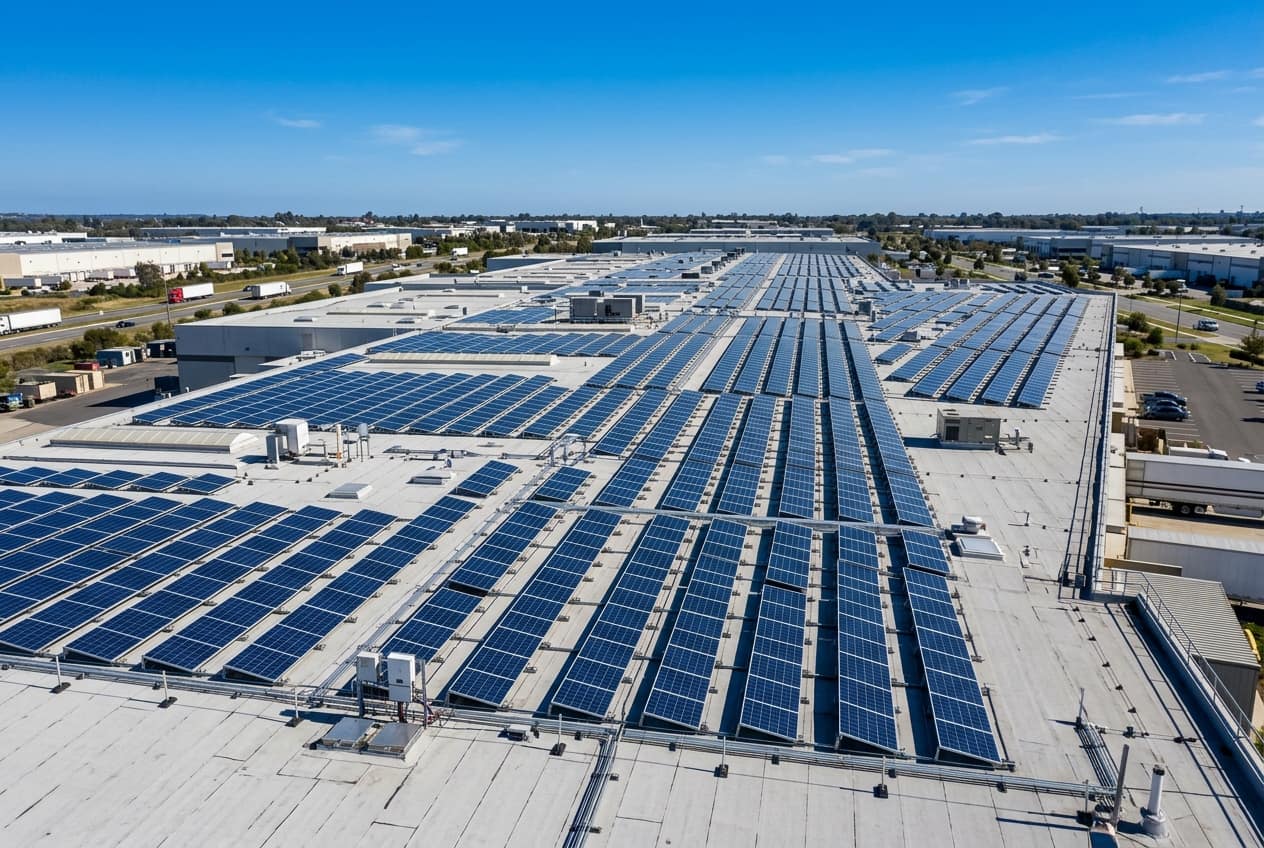
Solar O&M (operations and maintenance) and AMC (annual maintenance contract) keep a solar plant generating at its design level through cleaning, inspections, inverter and electrical checks, monitoring and fault response. A healthy plant often shows a performance ratio in the high 70s to low 80s percent. Without maintenance, soiling, loose connections and failed strings can quietly remove a noticeable share of output.
At a glance
- Typical contract
- Annual or multi-year AMC, comprehensive or non-comprehensive, with scope and service levels agreed per site.
- Visit pattern
- Cleaning cycles set by dust level, plus quarterly or half-yearly electrical inspections.
- Key standards
- IEC 62446-1, IEC 62446-3 thermography, IEC 61724 monitoring and IS 3043 earthing.
- What you receive
- Visit reports, thermography images, string data, loss analysis and a monthly generation summary.
- Best suited for
- Owners of rooftop and ground-mounted solar plants, including plants built by other vendors.
- Our scope
- Module cleaning, inverter and electrical maintenance, monitoring, fault response and performance reports.
Solar O&M and AMC Overview
A solar plant has no engine or turbine, and that leads owners to believe it needs no attention. It does need attention, because the output of a plant is the product of many small things working correctly: clean glass, tight terminals, healthy inverters, unshaded modules, working monitoring and an accurate meter. When one of them slips, energy is lost silently, and the loss shows up only as a smaller saving on a bill months later.
Solar O&M is the set of routine and corrective activities that prevent that loss. Routine work covers module cleaning, visual inspection, torque checks, thermography, inverter servicing and vegetation control. Corrective work covers fault diagnosis and repair, from a tripped string fuse to a failed inverter. An AMC puts this into a contract with a defined scope, a visit schedule and service levels, so you know who does what and when.
This service is for owners of existing plants. It applies to plants we built, and also to plants installed by others. For a plant built by someone else, we begin with a baseline inspection and a review of drawings and records, then agree a scope that matches the plant's age and condition. If you are still planning a plant, our rooftop and ground-mounted pages describe how the plant itself is built.
Shruti IT Service maintains solar installations for industrial, commercial and institutional owners across Maharashtra, Gujarat, Madhya Pradesh and Rajasthan, based in Nashik and planning visits by route and site cluster. Our teams also maintain related electrical, CCTV and network systems, so a visit to your site can cover more than the plant on the roof when you want it to.
Ideal for: Owners of rooftop and ground-mounted solar plants.
What Our Solar O&M and AMC Includes
Our solar O&M scope covers four activities. Each is recorded in visit reports, so you can see what was done and what was found.
Module cleaning schedules
We set a cleaning cycle from dust level and measured loss, using soft tools and clean water at cool hours, and log each cleaning by block. You receive dated records and photographs. Tip: avoid hard water and abrasive tools, because they leave deposits and scratch the coating.
Inverter and electrical preventive maintenance
We inspect and tighten connectors and terminals, test insulation and earth resistance, service inverter filters and fans, and check protection settings. You receive a findings list with photographs. Tip: ask for torque and connector checks on every visit, since loose joints are a main cause of heat and failure.
Generation monitoring and fault response
We compare daily generation with expected output for the irradiation, investigate alerts and respond within the service levels agreed for your site. You receive fault records with root causes. Tip: insist that the monitoring include string-level data for larger plants.
Performance and loss analysis reports
We send monthly generation and performance ratio reports, and yearly reviews with a loss breakdown and recommendations. You receive a clear summary for finance and ESG use. Tip: compare against irradiation, not against last month's output, because weather alone moves generation.
How solar plants quietly lose generation
Soiling is the most visible loss. Dust, bird droppings, industrial deposits and pollen reduce light reaching the cells. In dusty industrial belts the loss between cleanings can reach several percent, and more near cement, mining or agricultural activity. Cleaning too rarely wastes energy, while cleaning with hard water, abrasive tools or high-pressure jets scratches coatings and leaves mineral deposits. The right cleaning interval balances lost energy against cleaning cost.
Electrical faults are the less visible loss. Loose or oxidised DC connectors heat up, MC4 connectors that are not fully mated come apart or arc, and a single failed string can sit dead for months because the inverter still reports normal operation. Hot spots caused by cracked cells or bypass diode failures reduce output and, if left, can become a fire risk. Inverters also fail, and a plant running with one inverter down loses a large share of capacity until a spare is fitted.
The third problem is not knowing. Plants with no monitoring, or with monitoring that nobody reads, cannot tell whether output is normal. Comparing generation against irradiation, rather than against last month, is the only fair test. Without that comparison, owners accept falling output as weather. An O&M programme exists mainly to turn data into action before a small fault becomes a large loss.
What You Gain
Higher and steadier generation
Regular cleaning and fault correction keep output near design level. Even a few percent recovered each year on a large plant adds up to a meaningful sum over the plant's life.
Earlier fault detection
String-level monitoring and thermography find failed strings, hot spots and connector problems before they become failures, so repairs are planned, not emergency call-outs.
Safety and fire risk reduction
Torque checks, connector inspection, insulation resistance tests and earthing checks reduce the risk of arcing and fire on the roof, which matters for insurance and for your staff.
Warranty protection
Module and inverter warranties usually depend on proper installation and care. Keeping service records and acting on faults early helps when you need to make a claim.
Clear reporting for finance and ESG
Monthly generation, performance ratio and loss analysis give your finance team and sustainability reporting a reliable basis, rather than relying on bill-to-bill estimates.
Predictable maintenance cost
A defined AMC scope with agreed visits and a clear rule for spares and repairs makes yearly cost easier to budget than ad hoc call-outs.
How the Work Is Delivered
Our O&M process begins with a baseline of the plant as it is, because you cannot manage performance without knowing where it stands.
- 1
Baseline inspection and records review
We inspect modules, structure, cabling, inverters, earthing and meters, review drawings and past generation data, and note defects. For plants built by others, this step defines what the AMC must cover.
- 2
Scope, schedule and service levels
We agree whether the AMC is comprehensive, with spares and repairs included, or non-comprehensive, with labour and routine work only. Visit frequency, cleaning cycles, response times and exclusions are written in the contract for your site.
- 3
Module cleaning programme
We set a cleaning cycle based on dust level and measured soiling loss, using soft brushes or approved wipers and clean water, at times when modules are cool. Cleaning is logged by date and block, and areas near obstructions are checked.
- 4
Electrical and mechanical preventive checks
We tighten and inspect connectors and terminals, test insulation resistance, measure earth resistance, inspect structure fasteners and corrosion, and service inverter filters and fans. Findings are listed with photographs.
- 5
Thermography and string testing
We carry out infrared inspection, in line with IEC 62446-3 practice, at good irradiance, and compare string currents. Hot spots and underperforming strings are flagged, with a repair plan and priority.
- 6
Monitoring and fault response
We watch generation against expected output for the day's irradiation, and respond to alerts according to the agreed service levels. Each fault gets a root cause record, so recurring problems are fixed at source.
- 7
Performance and loss analysis reporting
Each month you receive generation, performance ratio, availability and a loss breakdown covering soiling, downtime and clipping where relevant. Yearly, we review the plant and propose improvements, such as inverter replacement or monitoring upgrades.
How we measure whether a solar plant is healthy
The core measure is performance ratio, which compares the energy the plant delivered with the energy it would have delivered if it had converted irradiation at its rated efficiency with no losses. A well-built plant in western or central India often shows performance ratio in the high 70s to low 80s percent, though it varies with temperature, design and measurement method. A sudden fall in the ratio points to a fault or heavy soiling. A slow fall of about 0.5 percent a year is normal module degradation. We calculate it against measured irradiation from a pyranometer or a reference cell where available, since without that the comparison is weak.
Diagnostic tools complete the picture. String current comparison highlights weak strings, since parallel strings in the same orientation should read within a few percent of each other on a clear day. A thermal camera shows hot cells and failing diodes. An IV curve tracer shows mismatch, shading or damage. Insulation resistance testing finds cable damage, and earth testers confirm the protective earth. Inverter logs show error codes, clipping and grid events. Together these let us locate a loss to a specific string, connector or device instead of guessing.
IEC 62446-1 and IEC 62446-3
Part 1 covers testing and documentation of grid-connected PV systems, and part 3 covers outdoor infrared thermography of modules and plants. We use them to structure inspection records and thermal surveys.
IEC 61724 for monitoring
This series describes how to monitor and analyse PV system performance, including performance ratio. We follow its logic when setting up irradiation measurement and performance reports.
Electrical safety and isolation practice
Work on live DC strings is hazardous, since modules produce voltage whenever there is light. We follow safe isolation, permit to work and appropriate PPE, and we do not open DC circuits under load.
IS 3043 earthing checks
Earth resistance and bonding are measured at set intervals and recorded. Poor earthing increases lightning damage risk and can affect protection operation.
Manufacturer maintenance requirements
Inverter and module makers specify cleaning methods, torque values and service intervals. We follow them so that warranty conditions are respected, and we keep the evidence.
Worked example: a 500 kWp rooftop plant that lost output over two years
Imagine a 500 kWp rooftop plant on a warehouse near Nashik, commissioned two years ago and cleaned only when someone remembered. The owner notices that monthly generation is falling short of the original estimate and asks for an inspection. We compare monitoring data with irradiation and find a performance ratio about eight points below what the plant achieved in its first year.
The baseline inspection finds three causes. Dust from a neighbouring yard has coated the lower rows, four strings are dead because of connectors that were not fully seated, and one inverter has a clogged filter that is derating output on hot afternoons. Thermography at midday also shows two modules with hot spots near cracked cells.
The corrective plan sets a cleaning cycle every four to six weeks in the dry season, replaces the connectors, cleans the filters and flags the two modules for warranty claim. In the next quarter the performance ratio recovers most of the gap. Actual recovery depends on the plant and the causes found, but the exercise shows why measured data and routine visits matter more than the calendar.
- A baseline performance ratio and fault list with photographs and priorities.
- A cleaning schedule tied to measured soiling and local dust, not a fixed guess.
- Replacement or warranty action for failed components with evidence from tests.
- Monthly reports showing generation against expected output for the actual irradiation.
This is an illustrative scenario built from typical site conditions. Actual quantities, timelines and results depend on your site survey.
Solar O&M and AMC Across Four States
We are based in Nashik and deliver across Maharashtra, Gujarat, Madhya Pradesh and Rajasthan. Each state has its own utilities, approvals and site conditions, and these are the points that matter most for this service.
Maharashtra
Maharashtra owners deal with MSEDCL net-meter reconciliation and MIDC industrial dust. The monsoon cleans modules but also brings vegetation growth and water ingress. Our O&M calendar adds a pre-monsoon check of connectors, drains and structure fasteners, and a post-monsoon thermography survey, so faults from wet weather are found early.
Gujarat
Gujarat plants face salt deposits in Kutch and Saurashtra, which form a film that rain alone does not remove, and industrial dust in GIDC estates. We plan washing with clean water, inspect structure and connectors for corrosion, and compare generation data with the import and export meter records from your GUVNL group DISCOM.
Madhya Pradesh
Madhya Pradesh plants see hot, dusty summers and a strong monsoon that brings vegetation under ground arrays. We schedule vegetation control, post-monsoon connector checks and thermography at peak irradiance. Visits to sites in Pithampur, Mandideep and rural clusters are grouped by route, so cleaning and inspection cost stays sensible.
Rajasthan
Rajasthan plants face the highest soiling pressure: fine desert dust returns within days, and sandstorms can bury lower rows. Cleaning intervals are shorter, with dry brushing or waterless methods where water is scarce. Heat above 45 degrees derates inverters, so we check cooling and filters, and review data against JVVNL, AVVNL or JdVVNL meter records.
Where This Work Is Most Often Needed
Why Teams Work With Us on This
We maintain plants built by others too
A baseline inspection tells us the plant's real condition, so we can write a scope that fits its age and design, and not simply sell a standard package.
Data-led, not calendar-led
We use irradiation-corrected performance, string comparison and thermography to decide what needs work, so you pay for actions that recover energy rather than for visits that only fill a schedule.
Electrical depth in one team
Our electrical, earthing and panel teams are the same people who attend your solar plant, which helps when a fault sits between the inverter and the main LT panel.
Contracted service levels per site
Response and resolution times, spares handling and exclusions are written into your contract after a site inspection, so the AMC reflects reality rather than a generic promise.
Guides and Projects Related to This Service
Frequently Asked Questions
01How often should solar panels be cleaned?
It depends on dust, rain and the tilt of your array, but every few weeks in dry, dusty periods and less often in monsoon is common. The best method is to measure soiling loss and clean when the lost energy exceeds the cleaning cost. We set the interval from your site data.
02What is included in a solar AMC?
A typical solar AMC includes scheduled cleaning, preventive electrical inspection, inverter servicing, monitoring review, fault response and reports. A comprehensive contract also covers spares and repairs, while a non-comprehensive one covers labour. Ask for scope, exclusions and response times in writing before signing.
03How much does solar O&M cost?
Cost depends on plant size, number of inverters, roof access, cleaning frequency and whether the contract is comprehensive. Larger plants usually cost less per kWp. For a firm quote we need a site visit or plant data, then we provide a priced scope you can compare with other offers.
04What is performance ratio and why does it matter?
Performance ratio compares actual energy output with the energy expected from the irradiation received, so it separates plant health from weather. A well-built plant often sits in the high 70s to low 80s percent. A drop signals soiling, faults or downtime that deserve investigation.
05Can you maintain a solar plant installed by another company?
Yes. We begin with a baseline inspection and review of drawings, records and generation history, then agree a scope matching the plant's age and condition. Missing documents are a common issue, and we can create updated single line diagrams and string maps as part of the baseline.
06How fast will you respond to a solar plant fault?
Response and resolution times are agreed in the contract for each site, because they depend on location, plant size and criticality. A good SLA states response time, resolution time, what counts as critical, spare parts handling and reporting. We discuss these with you after inspecting the site.