
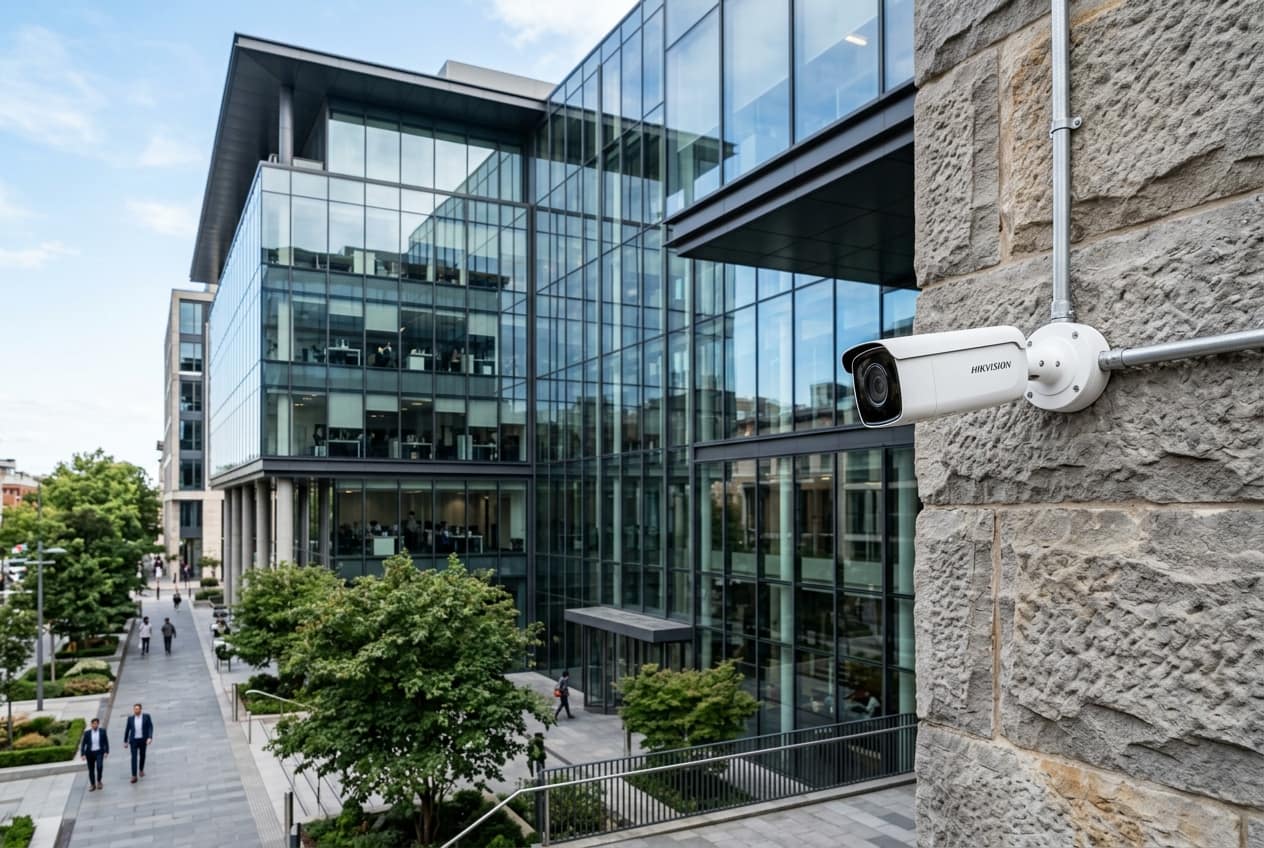
Wireless and remote site surveillance delivers CCTV where trenching cable is impractical, using point-to-point and point-to-multipoint radio links, 4G/5G connected cameras and edge recording. We survey line of sight, design link budgets, choose recording locations, specify power where needed, and set up health monitoring that alerts you when a link, camera or battery fails.
At a glance
- Typical timeline
- 3 to 8 weeks including link survey, depending on number of locations and approvals.
- Key standards
- IEC 62676, ONVIF, WPC rules for licence-free bands in India, IP66 enclosures.
- What you receive
- Link survey, link budget sheets, installed radios and cameras, edge recording and alert configuration.
- Best suited for
- Highways, construction sites, pipelines, solar parks, quarries and remote assets.
- Our scope
- Wireless links, 4G/5G cameras, edge recording, power coordination and health monitoring.
- Site survey
- Line-of-sight check, signal measurement and pole assessment at each endpoint.
Wireless & Remote Site Surveillance Overview
Wireless and remote site surveillance covers the places where a trench and a cable are either too slow or too expensive: a quarry face, a pipeline pumping station, a highway stretch under construction, a solar park perimeter. The cameras are the easy part. The real engineering is in the link: will it hold in monsoon rain, in a dust storm, when a crane swings into the beam, or when cellular signal drops in the evening?
We offer three connectivity routes and choose among them honestly. Point-to-point and point-to-multipoint radio carries video between your own poles and buildings and gives you control over capacity. 4G and 5G cameras use public networks and suit scattered, low-bandwidth locations. Edge recording stores video at the camera or a local box, so footage survives when a link does not. Most real projects combine these.
This page is about connectivity and remote operation. If your main question is how to power cameras from solar panels and batteries, our solar-powered CCTV page covers sizing and energy in depth, while here we concentrate on getting video, alerts and health information back to you reliably.
Remote sites also carry operational risk. A camera that went offline last Tuesday is useless today. So we pair every wireless installation with health monitoring: link signal levels, camera heartbeat, storage status and battery condition, delivered as alerts to the people who can act. The aim is a system you can trust without driving out to check it.
Ideal for: Highways, construction sites, pipelines, solar parks, quarries and remote assets.
What Our Wireless & Remote Site Surveillance Includes
This scope concentrates on connectivity and remote operation, with power coordinated where the site has no grid supply.
Point-to-point and point-to-multipoint wireless links
We survey paths, calculate link budgets, install and align radios, and record signal levels and throughput. You get a link sheet per hop. Tip: ask for real throughput tests under load, not just the radio's rated speed, and keep antenna mounts rigid since a swaying pole detunes the link.
4G and 5G cameras and edge recording
We choose cellular cameras, test signal at pole height, set up edge recording and event-based upload, and plan the data usage. You receive a data plan estimate. Tip: use sub-streams for live view and keep the main stream local, which can cut data use sharply.
Solar and battery power coordination for off-grid poles
We work with the solar team to size panels and batteries to the camera and radio load and fit charge controllers, surge protection and earthing. You get a load list. Tip: design for the cloudiest week, not the average, and mount panels out of easy reach.
Remote health monitoring and alerts
We set up monitoring of link signal, camera heartbeat, storage and battery, with alerts by SMS, email or app. You get a list of thresholds and contacts. Tip: define who responds to an alert at 2 am, otherwise the alert is only a message.
Relocation and expansion support
Where sites change, we plan portable poles, quick-mount brackets and spare radios, and document alignment procedures. You get a relocation guide. Tip: label every radio and camera with its address and role so crews can move them correctly.
Why wireless CCTV often disappoints on remote sites
Many wireless projects fail at the survey. Radios are fitted on poles at heights that looked fine on a map, only to discover a ridge, a tree line or a stack of containers blocking the path. Radio links need a clear first Fresnel zone, which means that clearance must exist not just on the straight line but in a surrounding ellipse. Skipping a proper line-of-sight check leads to unstable links that work in the afternoon and fail at night.
Capacity is the next trap. A radio advertised as 300 Mbps rarely delivers that as real throughput, especially in the presence of interference and over distance. Eight cameras at 4 Mbps each need 32 Mbps of steady load, plus headroom. Designs that load a link to near its limit start dropping frames when conditions worsen. We plan to use around 50 to 60 percent of realistic link capacity.
Cellular cameras bring their own issues. Data plans are costed per gigabyte, signal varies by site and time, and continuous HD streaming over 4G can be expensive. Many sites do better with edge recording and event-triggered upload than with constant streaming.
Finally, remote assets are targets for theft and weather. Poles get struck by lightning, solar panels walk away, and batteries age. Without surge protection, theft-resistant mounting and monitoring, a wireless system becomes a recurring maintenance burden.
What You Gain
Coverage without trenching
Radio links and cellular cameras reach locations where digging cable is slow, costly or not allowed. Many sites come online in days rather than months.
Video survives link loss
Edge recording keeps footage at the camera or a local recorder during outages and syncs afterwards, so incidents during a link failure are not lost.
Own your network
Point-to-point links on your poles avoid monthly carrier fees and give you control over capacity and security.
Proactive health alerts
Signal level, camera heartbeat, storage and battery data trigger alerts. You learn about a failing link before an incident reveals it.
Movable and scalable
Radios and cameras can be moved as a construction site evolves or a quarry face advances, and more nodes can be added without new cable work.
Fits mixed networks
We combine wired, wireless and cellular segments into one VMS view, so operators do not need to know how each camera is connected.
How the Work Is Delivered
Remote work leaves little room for guesswork. Our process puts the link survey first and keeps monitoring in view from the start.
- 1
Requirements and location mapping
We list each location, the view needed, the bandwidth, the power source and the monitoring point. Coordinates, access routes and local constraints are recorded.
- 2
Radio and signal survey
Engineers check line of sight, Fresnel clearance, possible interference and cellular signal strength at each endpoint, using test radios or SIM trials where useful.
- 3
Link budget and architecture design
We compute link margins, capacity and fall-back options, and decide where recording sits. The design pack shows each link, pole height and expected throughput.
- 4
Supply and bench configuration
Radios, cameras, switches and recorders are configured and tested at our facility, including addressing, encryption and alerts, so site work is only mounting and alignment.
- 5
Installation and alignment
We mount poles or brackets, align antennas with measured signal levels, seal outdoor connections, fit surge protection and earth the poles. Alignment results are recorded.
- 6
Commissioning and soak test
We run the system for several days, including at night and, where possible, in rain, to check stability, throughput and recording. Settings are tuned and results logged.
- 7
Handover, monitoring and AMC
You receive link records, drawings and alert settings. An AMC covers alignment checks, firmware, cleaning and responses to health alerts, on service levels agreed per site.
Link design, bandwidth and recording at the edge
Radio link design begins with a link budget: transmit power, antenna gains, path loss and receiver sensitivity give a fade margin, and a margin of around 15 to 20 dB is a sensible target for reliability in Indian monsoon conditions. Clear first Fresnel zone, at least 60 percent, is a standard design rule. Licence-free 5 GHz bands are common for point-to-point links in India, subject to current WPC regulations, which you should confirm for your site. Point-to-multipoint suits a cluster of cameras around a base station, but shares capacity across all clients, so we count the total load. Where one hop is too long, we add a relay pole rather than stretching the link.
At the camera, edge recording to a card or local NVR keeps footage when links fail. For cellular cameras, we use event-triggered upload and lower-bitrate secondary streams for live view, which reduces data use. H.265 helps. A 4 MP stream might need 2 to 4 Mbps in the main stream and well under 1 Mbps in a sub-stream. Remote health uses SNMP or the VMS device status to watch signal, heartbeat and storage. Poles carry lightning protection and surge devices on both power and data lines, because remote poles are often the tallest object in the area.
Radio link design rules
Fade margin of about 15 to 20 dB and 60 percent clear first Fresnel zone guide pole heights and hop lengths. We record the actual signal values at commissioning.
WPC licence-free band rules
Radio equipment and bands must follow current Indian Wireless Planning and Coordination rules. We choose compliant equipment and note any approvals that remain with the owner.
IEC 62676 and ONVIF
Guide video system design and interoperability, so remote cameras join your VMS like any other camera.
IP66 enclosures and IS/IEC 62305 practice
Weatherproof housings and lightning protection principles protect poles and equipment. Earthing follows IS 3043 practice.
Cellular coverage and data planning
Signal strength, carrier choice and data volume per camera are checked before design. We avoid assuming that coverage seen on a phone applies to a pole-mounted antenna.
Digital Personal Data Protection Act 2023
Links carrying identifiable video use encryption, and access is logged. Compliance decisions remain with your organisation, and we configure the system to support them.
Worked example: surveillance for a 6 km highway construction stretch
Suppose a contractor needs surveillance at four material yards, a batching plant, two bridge sites and a site office along 6 km of highway under construction. There is no fibre, grid power is only at the office, and the layout changes monthly as work progresses.
The design uses a radio backbone from the office tower to relay poles every 1.5 to 2 km, with point-to-multipoint base stations at the yards. Cameras at each location record at the edge for 15 days and stream a lower-bitrate view to the office. Outlying bridge sites use 4G cameras with event-triggered upload since they are outside the radio coverage. Poles at remote points take solar and battery power sized by the energy team.
The system is monitored for signal and storage, and radios are moved as the work front advances. A typical result is stable visibility of key locations with alerts on any failure. The contractor usually sees fewer disputes over material movement and faster insurance reporting.
- Link margins documented per hop
- Edge recording covering link outages
- Health alerts for signal, camera and storage
- Relocatable nodes as the site changes
This is an illustrative scenario built from typical site conditions. Actual quantities, timelines and results depend on your site survey.
Wireless & Remote Site Surveillance Across Four States
We are based in Nashik and deliver across Maharashtra, Gujarat, Madhya Pradesh and Rajasthan. Each state has its own utilities, approvals and site conditions, and these are the points that matter most for this service.
Maharashtra
Typical Maharashtra locations include construction sites, quarries, highway projects and water infrastructure. Link planning must allow for monsoon rain fade on higher frequency radios and for hills that break line of sight, so we confirm paths with a field test.
Gujarat
Gujarat remote sites include ports, salt pans, wind and solar farms and long canal or pipeline routes. Salt air and strong winds stress masts and radios, so mounting hardware, grounding and corrosion protection need extra attention. We also use stainless fasteners and sealed connectors on exposed masts, since ordinary hardware rusts quickly near the coast.
Madhya Pradesh
Madhya Pradesh has many forest edge sites, mining areas and highway construction camps where mobile coverage is uneven. We survey 4G and 5G signal on site before relying on cellular cameras, and use point to point radio where coverage is weak.
Rajasthan
Rajasthan remote assets such as solar parks, mines and pipelines need links that survive heat, dust and sand. Wide open terrain helps long radio paths, but sandstorms and temperature swings affect mounts and batteries, so we choose enclosures and power systems for desert conditions.
Where This Work Is Most Often Needed
Why Teams Work With Us on This
Survey-first approach
We measure the path before promising a link, and we tell you when a relay, a different route or a cellular option works better than the plan you started with.
Fibre and wireless under one roof
We also build fibre networks, so we can recommend cable where it truly pays back and wireless where it does not, without bias.
Power and connectivity coordinated
Our solar and electrical teams work with the surveillance team on pole power, earthing and surge protection, so the whole pole is designed together.
Monitoring and AMC for remote sites
Maharashtra-based teams handle alignment checks and fault response under AMC terms agreed per site, with health alerts to guide visits.
Need AMC for an existing system?
We maintain installations done by other vendors too, after a short audit of what is already on site.
Guides and Projects Related to This Service
- ArticleHow to Calculate CCTV Storage: A Worked Example for a 64 Camera Site
- ArticleHow Many Pixels Do You Need? Choosing CCTV Resolution by Pixel Density
- ArticleWhat to Ask Before You Sign an AMC: A Checklist for Buyers
- ArticleHow to Size a UPS and Battery Bank: A Worked Example for a Small Server Room
- ArticlePoE Power Budget for IP Cameras: How to Check a Switch Before You Buy
- ArticleVoltage Drop in CCTV Cable: Choosing the Right Size for 12 V Cameras
- ArticleHow CCTV Surveillance Improves Business Security & Operational Governance
- ArticleAI Video Analytics & ANPR: Turning CCTV into Actionable Intelligence
- ProjectCommercial Complex, Nashik
Frequently Asked Questions
01How far can a wireless CCTV link reach?
It depends on frequency, antennas, power and line of sight. Licence-free 5 GHz point-to-point links can span several kilometres with good clearance, but real range is set by the link budget and obstacles. We survey the path and calculate margin, then add a relay pole if a single hop would leave too little margin.
02Is 4G CCTV a good option for remote sites?
It can be, for sites with reliable signal and modest bandwidth needs. Continuous HD streaming uses a lot of data, so we normally combine 4G with edge recording and event-triggered upload. Check signal at the actual pole height before committing, since coverage on the ground can differ.
03What happens to recording when the wireless link fails?
With edge recording, the camera or a local recorder keeps storing video and the footage can be retrieved or synced later. Without it, the footage during the outage is lost. For critical locations we always specify local storage, and we test it by disconnecting the link during commissioning.
04How much bandwidth do I need for remote cameras?
Add up the streams that cross the link. A 4 MP camera on H.265 typically needs about 2 to 4 Mbps, so eight cameras need 16 to 32 Mbps. Keep the link at roughly half to 60 percent of real throughput, since weather and interference reduce capacity. Sub-streams for live view reduce load.
05Do wireless links work in monsoon rain?
Yes, if designed with adequate margin. At 5 GHz, heavy rain has a modest effect on links of a few kilometres, but poor alignment or thin margin fails first. We design with a fade margin and soak-test the system. Higher frequency bands are more rain-sensitive, so we choose accordingly.
06Can you monitor remote cameras for us?
We set up health monitoring for link signal, camera status, storage and batteries, with alerts to your team or ours under an AMC. Live video monitoring by operators is a different service, usually done from your control room. We agree responsibilities and response times in the contract per site.