
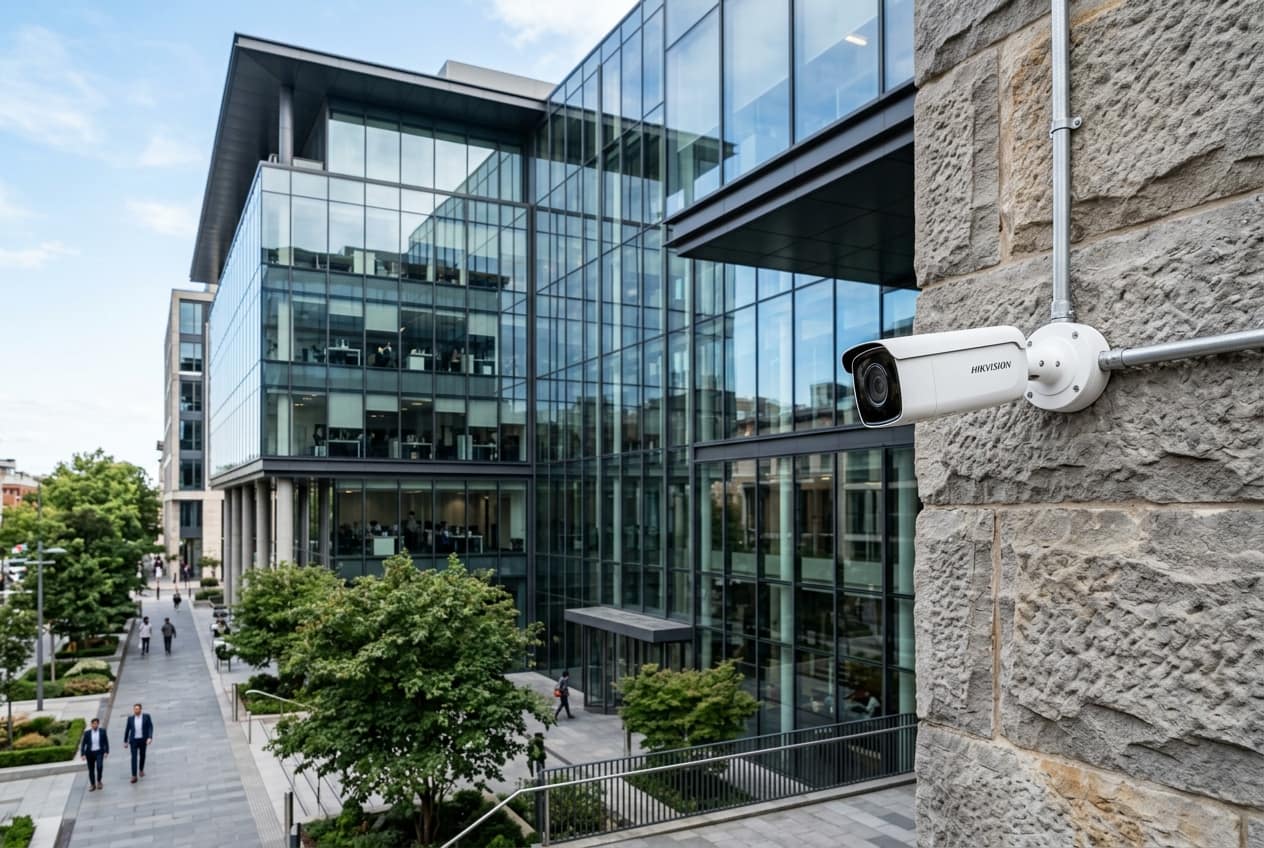
CCTV installation and commissioning is the supply, mounting, cabling, configuration and testing of a surveillance system until it records reliably and your staff can operate it. We install dome, bullet, PTZ and specialty cameras, run structured cabling and PoE switching, configure the recorder or VMS, and hand over as-built drawings, test reports and training.
At a glance
- Typical timeline
- 2 to 4 weeks for a 30 to 60 camera site once materials are on site, depending on site readiness.
- Key standards
- IEC 62676, ONVIF profiles, TIA-568 cabling practice, IS 732 for power wiring.
- What you receive
- As-built drawings, IP and port schedule, cable test reports, configuration backup and trained operators.
- Best suited for
- Factories, warehouses, offices, hospitals, campuses and residential townships.
- Our scope
- Supply, mounting, cabling, PoE and rack work, recorder or VMS setup, testing and handover.
- Site survey
- Pre-installation check of routes, mounting points and power, even when a design already exists.
CCTV Installation & Commissioning Overview
CCTV installation and commissioning turns a design on paper into cameras that record clean images at the right place, every hour of every day. The work looks simple from outside: mount a camera, pull a cable, plug it in. In practice, the quality of a system is decided by dozens of small decisions, such as how a cable is terminated, where a camera tilts, how the recorder clock is synced and whether the PoE switch has the headroom for infrared at night.
We deliver the full chain under one contract. That includes supply of cameras and recorders, conduit and cable, junction boxes, poles or brackets, PoE switches, racks and UPS, followed by configuration and testing. You deal with one project manager and one site supervisor, and they are accountable for the system working as a whole rather than for individual boxes.
Most of our installations are in operating plants, hospitals and offices where work cannot stop. We plan shutdown windows with your facility team, protect finished surfaces, keep cable trays tidy and label everything. Across our four states the site conditions matter: summer heat inside metal sheds, monsoon moisture in outdoor junction boxes, fine dust in cement and engineering units, and salt laden air near the Gujarat coast. Those conditions shape the enclosures, glands and mounting methods we choose.
Commissioning is where we spend the most care. A system that is merely switched on is not commissioned. We check every stream against its designed field of view, verify recording and retrieval, test remote access, confirm time sync and alarm paths, and record the results. You sign off against a checklist, not against our word.
Ideal for: Factories, warehouses, offices, hospitals, campuses and residential townships.
What Our CCTV Installation & Commissioning Includes
Installation covers everything between the BOQ and an accepted, operating system, including the unglamorous items that decide reliability.
Supply and mounting of dome, bullet, PTZ and specialty cameras
We supply BIS-registered cameras matched to the design, then mount them with correct brackets, junction boxes and sealing. Heights and angles follow the camera schedule and are corrected after live view checks. You receive a mounting record per camera. Tip: avoid mounting on thin cladding, and add a secondary safety lanyard on high positions.
Structured cabling, conduiting, PoE switching and rack work
Cat6 or Cat6A cabling in conduit or tray, terminated, labelled and tested, with PoE switches sized to the camera load and installed in ventilated racks with patch panels and UPS. You get test reports and a port map. Tip: ask for the PoE budget calculation, since heaters and IR raise draw.
NVR and VMS configuration, user roles and remote viewing
We configure recording modes, retention, time sync, alarms, user groups and mobile or web access, with unique credentials and a backup of the settings. You decide who can view, export or delete. Tip: give managers viewing rights without delete rights, and review access every quarter.
As-built drawings, test reports and operator training
We update drawings to what was actually installed, issue test results and train your operators on live view, search, export and alarm response, with a quick guide for the console. Tip: schedule training for every shift, since night staff handle most incidents.
Commissioning checklist and defect closure
A written checklist covers view verification at day and night, retrieval tests, failover, time sync and alarm paths. Open points are tracked and closed before sign-off. Tip: tie a payment milestone to checklist completion, not to the date the cameras were switched on.
Where CCTV installations usually fall short
Poor workmanship hides well at first. Loose RJ45 terminations pass a quick ping but drop packets when the cable warms up. Unsealed outdoor junction boxes work until the first heavy monsoon week. Cameras fixed to a thin sheet cladding shake in wind and give shaky footage. None of these show up on the day of handover, but they produce missing video within a season.
Mounting decisions are another weak point. A camera installed two metres higher than designed loses face detail, and one pointed slightly into a light source flares every evening. Installers working without a design pack tend to place cameras where the cable is easiest, not where the coverage is best. Always ask for a camera schedule showing location, height, lens and target view, and check it against what you see on the monitor.
Configuration errors are the quietest failures. Recorders left on default passwords, time zones not set, motion recording enabled when continuous was specified, or disks not in the intended RAID group are common findings when we audit systems installed elsewhere. Without a configuration record, nobody knows what was set and why.
Finally, many projects end with a handshake. No as-built drawing, no port map, no test results. When a camera fails a year later, the maintenance team spends hours tracing a cable that nobody drew. Documentation is part of the product, not an extra.
What You Gain
One accountable contractor
Supply, civil, cabling, power and configuration sit under one project manager. When something fails, there is no argument between a camera vendor and an electrician about whose fault it is.
Clean, labelled work
Every cable, port and camera carries a label that matches the drawing. Maintenance staff can find and replace a faulty unit in minutes instead of hours.
Verified image quality
We check each camera view against the design target, at day and night, before sign-off. You see the actual footage at the planned pixel density, not a promise.
Reliable recording
Storage, RAID and retention settings are configured and tested, including a retrieval test of old footage. You know the system will keep the days you specified.
Trained operators
Security staff learn live view, playback, export, search and alarm handling on your own system. Short quick-reference sheets stay at the console.
Warranty and AMC continuity
The team that commissioned the system supports it. Warranty claims and AMC visits start from our own records, so diagnosis is faster.
How the Work Is Delivered
Each installation follows the same disciplined sequence. We adapt the details to your site, but never skip the checks that protect you after handover.
- 1
Survey and route confirmation
Even with a design in hand, we re-walk the site. We confirm mounting points, cable routes, conduit paths, power sources and access constraints, and agree work windows and permit needs with your facility team.
- 2
Design confirmation and BOQ
We finalise the camera schedule, rack layout and switch plan, and reconcile quantities with the BOQ. Any deviation from the design is raised in writing before material is ordered.
- 3
Supply and inspection
Equipment arrives with serial numbers recorded. We check BIS CRS registration, firmware versions and packaging damage, and pre-configure recorders and cameras at our bench where practical to save site time.
- 4
Cabling, conduit and mounting
We lay conduit and cable, terminate and label both ends, mount brackets or poles, and seal outdoor boxes. Copper channels are held within 100 m and power and data runs are kept apart.
- 5
Configuration and integration
We set IP addressing, VLANs where specified, user roles, recording schedules, motion or analytic rules, time sync and remote viewing. Passwords are unique and recorded in a sealed handover record.
- 6
Testing and commissioning
Cable tests, PoE load checks, view verification, night checks, retrieval tests and failover checks are carried out and logged. Findings are closed out before you are asked to sign.
- 7
Handover, training and AMC
You receive as-built drawings, schedules, test reports, configuration backups and warranty papers. We train operators and offer an AMC so preventive visits begin from day one.
Installation practice that protects image quality and uptime
Cabling is where most reliability is won. We use Cat6 or Cat6A for camera runs within the 100 metre channel limit, with fibre and media converters or PoE extenders only where distance demands it. Outdoor cable runs go in UV-stable conduit, with drip loops and sealed glands at the camera. Power budgets are checked per switch: a PoE switch advertising 240 W rarely delivers that for cameras with heaters and IR in summer and winter extremes, so we plan for about 80 percent of rated budget. Surge protection is added on long outdoor runs and poles, and earthing follows your site earth arrangement.
Recorders and servers are installed in racks with ventilation, filtered power and a UPS sized for the load and the autonomy you need. For example, a 600 W rack at 80 percent inverter efficiency and a 30 minute ride-through needs roughly 0.4 kWh of usable battery. Clocks are synchronised to an NTP source so footage from different devices lines up in an investigation. Where cameras connect to a VMS, we use ONVIF profiles to keep devices interoperable, and we test export formats so evidence plays on a standard PC.
IEC 62676 series
Guides system design, performance and image quality for video surveillance. We refer to its categories when verifying that installed views match the design target.
ONVIF Profile S, T and G
Interoperability between cameras, recorders and software, including streaming, advanced video and storage retrieval. We confirm conformance before mixing devices.
TIA-568 and ISO/IEC 11801 practice
Governs termination, channel length and testing for copper and fibre cabling. We test each link and record the results for your file.
IS 732 wiring practice
Applies to the mains side of the system: supply to racks, switches, junction boxes and pole feeds. Earthing and separation from data cable follow this practice.
IP66 and IK10 equipment classes
Outdoor and vandal-prone positions use cameras and enclosures at these classes so they survive Maharashtra rain, dust and impact.
BIS CRS registration for cameras
We supply cameras that carry the registration required for sale in India and keep the details in your handover file.
A typical project: a 48-camera warehouse and office complex
Picture a logistics warehouse with six loading docks, internal aisles, a yard and a small admin block. The design calls for 48 cameras: 12 at docks and gates, 20 in aisles, 10 in the yard and 6 in offices and reception. The client needs 30 days of recording, remote access for two managers and sign-off against a written acceptance list.
The install begins with conduit and tray, because cable work drives the schedule. Dock cameras go on short poles to avoid forklift strikes. Aisle cameras use bullets on racking beams with lens angles set after a test walk. The yard uses IR bullets with surge protection. Two PoE switches serve each end of the building, linked by fibre to a rack with the recorder, a UPS and a labelled patch panel. Typically the physical work takes two to three weeks for a site like this.
Commissioning checks each view at midday and after dark, fixes two glare problems by adjusting angles, and confirms that a clip from day three can be exported on the manager's laptop. The client typically receives drawings, port schedule, test sheets, a configuration backup and a one-hour operator session, with AMC starting after the defect-liability period.
- Every camera view signed off against the design schedule
- Labelled cabling traceable from drawing to port
- Storage retention verified by a retrieval test
- Operators trained on live view, search and export
This is an illustrative scenario built from typical site conditions. Actual quantities, timelines and results depend on your site survey.
CCTV Installation & Commissioning Across Four States
We are based in Nashik and deliver across Maharashtra, Gujarat, Madhya Pradesh and Rajasthan. Each state has its own utilities, approvals and site conditions, and these are the points that matter most for this service.
Maharashtra
Installations in Maharashtra range from MIDC factories to hospitals and townships. Plan shutdown windows with the plant team, protect cable routes from monsoon seepage, and confirm that the building power supply is stable before PoE switches and recorders are commissioned.
Gujarat
Gujarat sites are often large chemical, textile and port related facilities. Cameras near the coast need corrosion resistant housings and sealed cable entries, and hazardous areas may need certified enclosures. Confirm the plant safety officer's rules before mounting anything in classified zones.
Madhya Pradesh
Sites in Madhya Pradesh include industrial areas, warehouses and large campuses with long cable runs between buildings. Expect to use fiber between blocks, and plan pole foundations and earthing for outdoor cameras because open ground exposes equipment to lightning during the monsoon.
Rajasthan
Rajasthan installations face high ambient temperatures and dust. Indoor racks need proper cooling, outdoor housings should be rated for heat, and sunshades help prevent camera overheating. Cables in exposed trays need UV resistant sheathing, which is easy to overlook when specifying a project.
Where This Work Is Most Often Needed
Why Teams Work With Us on This
Trained in-house site teams
Installers and supervisors are part of our 50+ strong team, not casual labour hired per job, so workmanship and accountability stay consistent.
Single window for the whole building
We also handle structured cabling, access control, fire alarm, PA and electrical work, so trays, racks and power are coordinated rather than fought over.
Records that survive staff changes
As-built drawings, port maps, configuration backups and test reports are handed over in print and soft copy and stay useful years later.
Support from the same team
Based in Nashik, we serve sites across Maharashtra, Gujarat, Madhya Pradesh and Rajasthan and offer AMC after commissioning, with service levels agreed in the contract per site.
Need AMC for an existing system?
We maintain installations done by other vendors too, after a short audit of what is already on site.
Guides and Projects Related to This Service
- ArticleHow to Calculate CCTV Storage: A Worked Example for a 64 Camera Site
- ArticleHow Many Pixels Do You Need? Choosing CCTV Resolution by Pixel Density
- ArticleWhat to Ask Before You Sign an AMC: A Checklist for Buyers
- ArticleHow to Size a UPS and Battery Bank: A Worked Example for a Small Server Room
- ArticlePoE Power Budget for IP Cameras: How to Check a Switch Before You Buy
- ArticleVoltage Drop in CCTV Cable: Choosing the Right Size for 12 V Cameras
- ArticleHow CCTV Surveillance Improves Business Security & Operational Governance
- ArticleAI Video Analytics & ANPR: Turning CCTV into Actionable Intelligence
- ProjectCommercial Complex, Nashik
Frequently Asked Questions
01How much does CCTV installation cost per camera?
There is no honest single figure, because the camera is only part of the cost. Price depends on camera class, cable length, mounting type, civil work, storage days and licences. A camera on an existing wall costs much less to install than one needing a pole and trenching. Send us your site details and we will price the complete system.
02How long does a CCTV installation take?
A typical 30 to 60 camera site takes two to four weeks once materials arrive. The schedule depends on cable routes, working hours, height access and how many areas stay in operation. Large campuses are phased. We agree a plan with your facility team and report progress against it.
03Should I choose dome, bullet or PTZ cameras?
Choose by purpose. Domes suit indoor ceilings and vandal-prone spots, bullets suit long fixed views and outdoor walls, and PTZ cameras suit wide areas where an operator tracks activity. PTZ units cost more and only see one direction at a time, so they should supplement fixed cameras, not replace them.
04What documents should I ask for at handover?
Ask for as-built drawings, a camera schedule with locations and IPs, cable test reports, configuration backups, device serial numbers, warranty papers, user manuals and an admin credential record. Also request proof of a retrieval test. If any of these are missing, handover is incomplete and payment milestones should reflect that.
05Can you install CCTV while the facility is operating?
Yes. We schedule noisy and disruptive work for agreed windows, protect equipment and finished areas, and keep cable trays tidy. Hospitals and production lines need extra planning around infection control and shutdowns. We discuss restrictions at the survey and write them into the work plan.
06Do you offer warranty and maintenance after installation?
Yes. Equipment carries the manufacturer warranty and our workmanship is covered for a defect-liability period agreed in the contract. After that, an AMC keeps the system inspected and cleaned. Response times and what is covered are agreed per site, and we explain the options before you commit.