
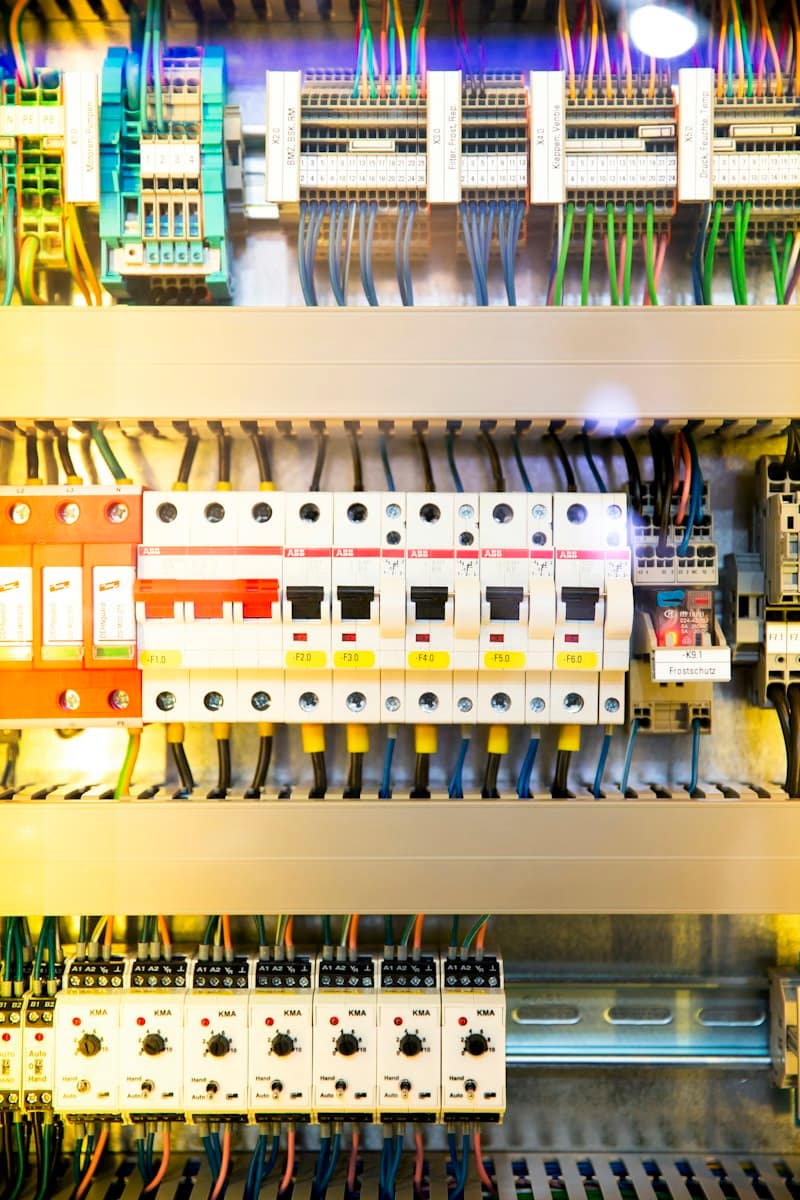
Electrical panels are the enclosures that receive, protect and distribute power inside a facility. LT and PCC panels handle main distribution, MCC panels control motors, APFC panels correct power factor, and distribution boards feed final circuits. We supply, install, test and commission them against your single-line diagram, with routine test reports for each assembly.
At a glance
- Our scope
- LT, PCC and MCC panels, APFC panels, distribution boards and feeder pillars
- Typical timeline
- 4 to 10 weeks from approved drawings, depending on size and component lead time
- Key standards
- IS 8623 and IEC 61439 for assemblies, IS 13947 for breakers, IS 2516 and IS 732
- What you receive
- GA and wiring drawings, routine test reports, bill of materials and commissioning sheets
- Best suited for
- Factories, commercial buildings and infrastructure projects with defined feeder lists
- Site survey
- Panel room, cable entry and ventilation check before final drawing
Electrical Panels: LT, MCC, APFC & DB Overview
Electrical panels are where power is divided, protected and controlled. A factory might have an LT main panel, three MCC panels for production lines, an APFC panel for power factor and a dozen distribution boards across floors. Each one is a fabricated and wired assembly, and each is a possible point of failure if specified or built carelessly.
We supply and install these panels against a single-line diagram that you approve. The design stage fixes the incomer rating, busbar rating, short-circuit withstand, feeder list, protection settings and enclosure type. A panel that is ordered before this information is complete usually needs rework, and rework in a panel costs more than the delay that caused it.
On the shop floor and on site we focus on practical details that decide life: busbar sizing with temperature rise margin, cable entry space, gland plates, ventilation, segregation form, labelling and spare ways. Panels that fit the room, allow cable bend radius and can be maintained safely tend to last decades.
Shruti IT Service has installed panels for industrial plants, commercial buildings, highway and campus projects since 2014, working from Nashik and serving Maharashtra, Gujarat, Madhya Pradesh and Rajasthan. We commission each panel with functional and insulation tests, record the results, and hand them over with drawings so your maintenance team can work on them without guessing.
Ideal for: Factories, commercial buildings and infrastructure projects.
What Our Electrical Panels: LT, MCC, APFC & DB Includes
Our panel scope covers supply, installation and testing, with the drawings and records that maintenance teams need later.
LT, PCC and MCC panels
We supply main LT or PCC panels and motor control centres built to your SLD, with busbars, breakers, starters and metering. Each assembly is inspected before dispatch. Tip: insist on drawings showing busbar rating and fault withstand, not just a bill of materials.
APFC panels for power-factor correction
APFC panels use a controller, contactors and capacitor banks to hold power factor near target. Where harmonics are present we add detuned reactors. Tip: ask for a recent load log or utility bill before sizing, since an oversized bank can push power factor leading at light load.
Distribution boards and feeder pillars
DBs with MCBs, RCCBs and isolators serve floors and areas, while outdoor feeder pillars serve roads and campus loads. We label every way and leave spares. Tip: specify at least 20 percent spare ways, because adding a circuit later to a full board is expensive.
Panel testing and commissioning
We test insulation resistance, continuity, interlocks, protection trips and control circuits, then record values on a commissioning sheet. You sign it and receive a copy. Tip: witness the first energisation and keep the settings record, since it will be needed after any trip.
Panel installation and cable termination
We place panels on plinths, earth them, and terminate cables with correct lugs and glands, torqued and labelled. Tip: check the cable entry side and bend radius on the drawing before ordering, as moving entry after delivery is one of the most common panel changes.
What goes wrong with panels bought on price alone
The classic failure is a busbar that was rated for the incomer but not for the temperature rise inside the enclosure. In an Indian summer, and more so in Rajasthan or Madhya Pradesh, a poorly ventilated panel room can reach 45 degrees Celsius ambient. Components derate, joints heat, and a breaker trips on a day when load is not even at peak.
Another problem is a panel with no room to work. Cable entries too small for the cable size, no gland plate space, no bend radius, tightly packed terminals. Installers cut corners, strands are trimmed, lugs are forced, and the first loose joint appears within a year. A drawing review catches this in an hour, but only if someone reviews it.
Documentation is the third gap. Many panels arrive with a hand-drawn wiring diagram, no routine test report and no nameplate data. When a drive fails or an expansion is planned, nobody knows the breaker settings or the busbar rating. Maintenance turns into trial and error.
What You Gain
Built to your feeder list
Incomer, outgoing ways, ratings and spare capacity are fixed on an approved SLD. The panel matches your loads instead of a catalogue size that is close enough.
Correct short-circuit rating
Breakers and busbars are chosen for the fault level at that point of the network. A breaker with too low a breaking capacity is a hazard, not a saving.
Power factor under control
APFC panels with properly sized capacitor steps and detuned reactors where harmonics are present help avoid power factor penalties on the utility bill.
Maintenance-friendly design
Cable space, clear labelling, accessible terminals and spare ways let your team work safely and extend the panel without a rebuild.
Tested before energisation
Insulation resistance, functional checks, interlock tests and protection trip tests are done and recorded for each panel before it is energised.
Single contractor for panel and cable
We terminate the cables into the panels we supply, so glanding, lugging and labelling are done once and tested together.
How the Work Is Delivered
Panels follow a fixed order of design, fabrication, inspection, installation and testing. This is how we handle a typical project.
- 1
Requirement and feeder list
We collect the load schedule, feeder list, motor ratings, control philosophy and room details. We also note ambient temperature, dust, moisture and whether the panels will sit indoors or outdoors, since that decides the enclosure rating.
- 2
Design and drawing approval
We produce the SLD, general arrangement, busbar layout, bill of materials and wiring diagrams. You review feeder ratings, protection and layout, and approve them before fabrication starts. Changes after this point are logged.
- 3
Fabrication and factory inspection
Panels are fabricated with sheet steel of agreed thickness, powder coating, busbars of specified material and clear segregation. We inspect dimensions, busbar clearances, wiring and labelling, and witness routine tests before dispatch.
- 4
Delivery and plinth preparation
Delivery is planned around the panel room being ready. Plinths, cable trenches and floor cut-outs are checked for level and dimensions so that panels sit square and doors open fully.
- 5
Installation and cable termination
Panels are positioned, anchored and earthed. Cables are glanded and terminated with correct lugs, torqued and labelled, with phase sequence and identification checked at each end.
- 6
Testing and commissioning
We test insulation resistance, continuity, interlocks, protection relays, metering and control circuits. APFC steps are checked for response. Results are recorded on commissioning sheets signed by you.
- 7
Handover and AMC
You receive as-built drawings, test reports, settings records and a spares list. Annual maintenance under an AMC covers tightening, cleaning, thermography and breaker checks.
How LT, MCC and APFC panels differ
An LT or PCC panel is the main distribution panel. It receives power from the transformer through an incomer breaker, divides it over busbars, and feeds outgoing breakers to sub-panels, MCCs and large loads. Busbar rating is chosen for incomer current with margin, and short-circuit withstand matches the fault level. An MCC panel houses starters for motors, using contactors, overload relays or drives in withdrawable or fixed modules, and gives coordinated protection for each motor.
An APFC panel measures reactive power and switches capacitor steps to hold power factor near the target, often 0.95 to 0.99. Where drives and rectifiers create harmonics, capacitors need detuning reactors, or they overheat and fail early. Distribution boards sit lower in the chain and feed lighting, sockets and small machines through MCBs and RCCBs. Feeder pillars are outdoor boxes that tap power from cable networks for campuses and roads.
IS 8623 and IEC 61439
These govern low-voltage switchgear and controlgear assemblies, including temperature rise, short-circuit withstand, dielectric properties and routine tests. We request the routine test report for each panel.
IS 13947 for circuit breakers
Breakers, MCCBs and ACBs are selected for rated current, breaking capacity and trip characteristics under this standard series, matched to the fault level at the panel.
IS 2516 and IEC 60947 series
Contactors, overload relays and motor starters follow these standards. Selection depends on utilisation category, starting current and motor duty.
Enclosure protection (IP rating)
IP54 or IP55 is common for dusty plant floors and IP65 for outdoor feeder pillars. The rating affects ventilation, so heat load is calculated for sealed enclosures.
Segregation forms and arc safety
Form 2, 3 or 4 segregation limits contact with live parts during maintenance. Higher forms cost more but allow safer work on one section while others stay energised.
A typical project: panels for a plastics processing factory
Imagine a plastics unit with six injection moulding machines, two extruders, a chiller plant and a small office block. Total connected load is around 700 kW, with a maximum demand near 420 kW. The design calls for an LT main panel with an incomer of 1000 A, an MCC for the machines, an APFC panel of 200 kVAr in steps, and distribution boards in the office and utility area.
At design review we check the transformer fault level, which sets the breaking capacity of the incomer at 50 kA, and we check ambient temperature in the panel room. The room is naturally ventilated, so we derate and add an exhaust fan. Drives on the extruders bring harmonics, so the APFC uses detuned reactors. Cable entry is from the bottom, so we add gland plates and confirm trench depth.
Factory inspection happens before dispatch, with torque checks, wiring checks and routine tests. On site we place the panels on a levelled plinth, terminate cables, and commission with functional tests. The power factor reads close to 0.98 at full load after APFC stabilisation.
- Panel ratings and fault levels documented on an approved SLD
- Routine test reports for each panel at handover
- Cable entry, bend radius and gland plates checked before dispatch
- Power factor held in the 0.95 to 0.99 band under normal load
This is an illustrative scenario built from typical site conditions. Actual quantities, timelines and results depend on your site survey.
Electrical Panels: LT, MCC, APFC & DB Across Four States
We are based in Nashik and deliver across Maharashtra, Gujarat, Madhya Pradesh and Rajasthan. Each state has its own utilities, approvals and site conditions, and these are the points that matter most for this service.
Maharashtra
Panels for MIDC factories are commonly metered at HT by MSEDCL, so the LT main must match the transformer and the tariff's power factor rules. Monsoon humidity in the Konkan and ghat regions calls for anti-condensation heaters in outdoor feeder pillars and a tight cable gland seal.
Gujarat
GIDC process plants often combine corrosive atmospheres with large motor loads. Coastal and chemical belt sites need powder coating with a higher thickness, stainless fasteners and sealed busbar chambers. Check the DISCOM's power factor and demand billing rules before sizing APFC steps.
Madhya Pradesh
Industrial areas such as Pithampur and Mandideep run mixed motor and drive loads. Hot summers and the monsoon both test panel rooms, so we calculate heat load for ventilation and add space heaters in rooms that stay damp. Confirm tariff power factor terms with the regional DISCOM.
Rajasthan
Ambient heat and fine desert dust decide the design. Choose IP54 or better enclosures with filtered fans or air conditioning, derate breakers and busbars for temperature, and schedule dust cleaning. RIICO estate plants and solar parks both need panels that keep working above 45 degrees Celsius.
Where This Work Is Most Often Needed
Why Teams Work With Us on This
Drawings reviewed with your engineers
SLD, GA and busbar layout are reviewed with your team before fabrication, so ratings and layout match your plant, not a template.
Inspection before dispatch
We check dimensions, wiring and routine tests at the fabricator, so faults are corrected before the panel reaches the site.
Installers who terminate what they supply
The same team glands, lugs and tests the cables into the panel. Responsibility for a loose joint does not bounce between vendors.
AMC from the commissioning record
Annual tightening, cleaning and thermography start from the values recorded at commissioning, which makes trends visible.
Need AMC for an existing system?
We maintain installations done by other vendors too, after a short audit of what is already on site.
Guides and Projects Related to This Service
- ArticleSizing a Rooftop Solar Plant and Checking Its Payback: A Worked Example
- ArticleWhat to Ask Before You Sign an AMC: A Checklist for Buyers
- ArticleHow to Size a UPS and Battery Bank: A Worked Example for a Small Server Room
- ArticleVoltage Drop in CCTV Cable: Choosing the Right Size for 12 V Cameras
- ArticleIndustrial Electrical Infrastructure: Earthing, Panels & Safety Compliance
Frequently Asked Questions
01What is the difference between a PCC panel and an MCC panel?
A PCC, or power control centre, distributes power to major feeders, while an MCC, or motor control centre, houses starters and protection for individual motors. PCC panels carry high current on large busbars. MCC panels contain many smaller modules, often withdrawable, so one motor circuit can be isolated without shutting down the line.
02How long does it take to build and install panels?
Allow roughly 4 to 10 weeks from approved drawings to delivery, depending on panel size and the lead time of breakers or drives. Installation and commissioning add days to weeks. Drawing approval is the step that most often delays the schedule, so decide your feeder list early and avoid changes after fabrication begins.
03How much does an electrical panel cost?
Price depends on current rating, number of feeders, breaker class, enclosure type, busbar material and test scope. A firm quote needs the SLD and feeder list. When comparing offers, check busbar rating, breaking capacity and component class line by line, because a cheaper panel often has lighter busbars or lower fault withstand.
04Why do I need an APFC panel?
An APFC panel keeps power factor close to the level your utility tariff rewards, commonly 0.95 or higher, and can avoid penalties. It switches capacitor steps automatically as load changes. If you run drives or rectifiers, ask for detuned reactors, because plain capacitors can be damaged by harmonics.
05What tests should be done on a panel before energisation?
At minimum, insulation resistance between phases and to earth, continuity of earth connections, mechanical interlock checks, protection relay trip tests and control circuit functional checks. Routine tests at the factory and site tests at commissioning are separate. Ask for both reports, signed and dated, and keep them with the panel drawings.
06What is a panel form of segregation?
Form of segregation describes how busbars, functional units and terminals are separated inside the panel using barriers. Form 1 has none, Form 2 separates busbars from units, Form 3 separates units from each other, and Form 4 also separates terminals. Higher forms allow safer maintenance on one section while others remain live.