
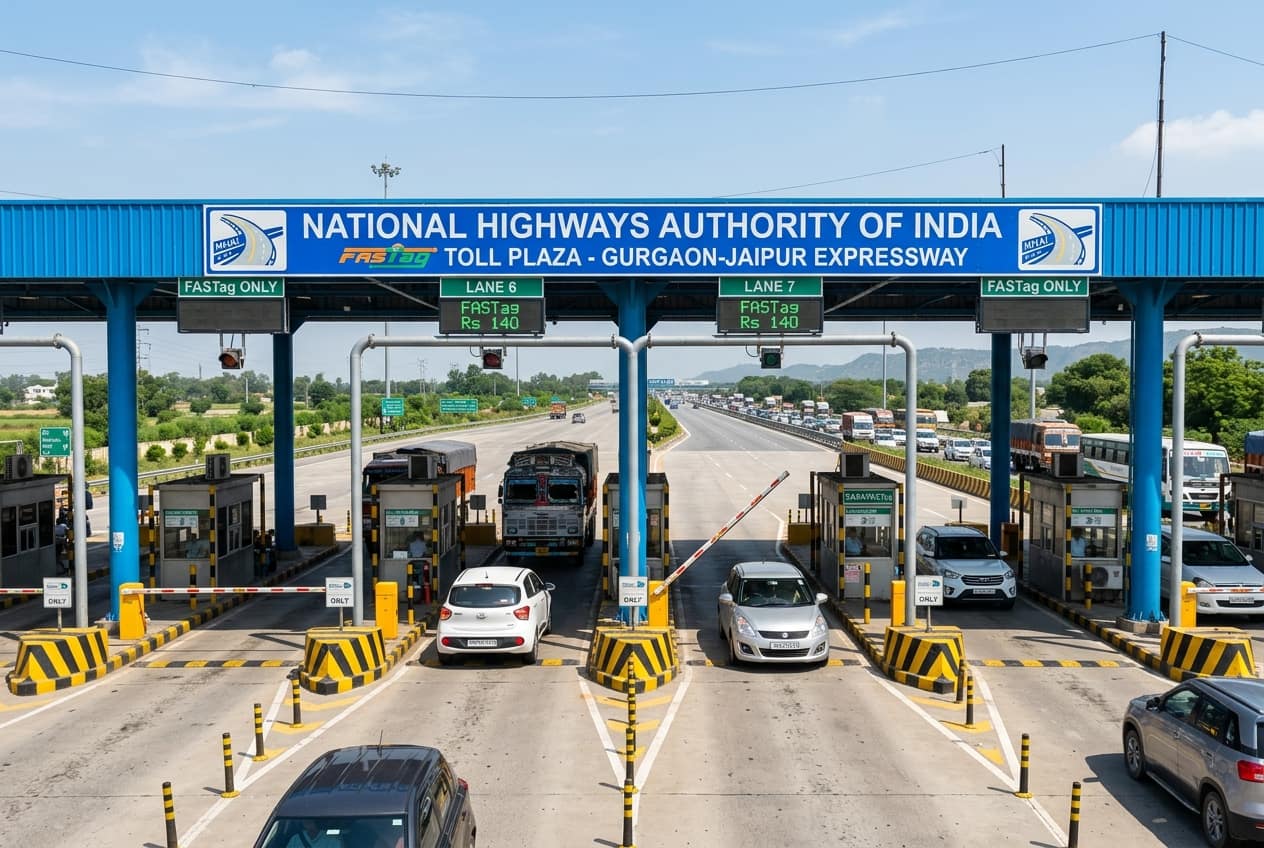
India's national and state expressways handle over 6 billion vehicle transits annually. Toll plazas form the financial nerve center of highway concessionaires and NHAI projects. Minimizing lane transit times to under 3 seconds per vehicle requires an intricately orchestrated harmony of RFID transceivers, optic curtain vehicle profilers, high-speed boom barriers, and transaction engines.
Key Engineering Takeaways
- FASTag lane clearance times have decreased from 60 seconds (cash era) to under 3.5 seconds with high-performance readers.
- Automatic Vehicle Classification (AVCC) using IR light curtains and axle sensors eliminates revenue leakage.
- High-cycle torque motor boom barriers withstand over 3 million opening cycles without gearbox fatigue.
- A ring topology gives traffic a second path if one link is cut, so a single cable fault does not take a lane offline. Failover time depends on the switches and the protocol, so test it at commissioning.
1. The Hardware Ecosystem of an Automated ETC Lane
A single high-speed ETC (Electronic Toll Collection) lane integrates at least eight distinct electro-mechanical and computing subsystems operating in real-time synchronization:
- Overhead Long-Range RFID Transceiver (865-867 MHz) with beam-steered directional antenna.
- Automatic Vehicle Classification (AVCC) consisting of optical light curtains and piezo axle sensors.
- Lane Controller Industrial PC running low-latency Toll Management Software (TMS).
- High-Speed Automatic Boom Barrier with 0.9 to 1.2-second open/close stroke speed.
- Dual-lens ANPR Cameras for number plate extraction and visual fraud auditing.
- Traffic light indicators, lane overhead cross/arrow signals, and user fare displays (UFD).
2. Eliminating Concessionaire Revenue Leakage with AVCC
One of the largest vulnerabilities in highway tolling is vehicle category misclassification, such as commercial multi-axle freight trucks tagged fraudulently as light commercial vehicles (LCVs).
Advanced AVCC systems scan the profile silhouette of approaching vehicles with continuous infrared curtains and magnetic inductive loop detectors. If the physical profile or axle count mismatches the FASTag tag class, the lane controller automatically logs an audit violation before clearing the gate.
3. Mission-Critical Power and Redundant Fiber Loops
Toll plazas operate in harsh outdoor environments exposed to severe temperature swings, exhaust particulate build-up, and highway lightning surges. Industrial optical fiber ring networks run across all lanes, terminating into redundant plaza servers with online hot-standby UPS systems.
Conclusion & Next Steps
As India moves toward barrierless Multi-Lane Free Flow (MLFF) and satellite GNSS-based tolling, dependable roadside electronic infrastructure remains the backbone of toll operations. Shruti IT Service works on toll plaza automation, from lane equipment and plaza software to maintenance.
Need a site survey or project quote?
Our engineers provide comprehensive BOQs, system designs, and turn-key execution across Maharashtra and neighboring states.
Related services
Want this done at your site? These pages explain the scope, the process and the standards we work to.