
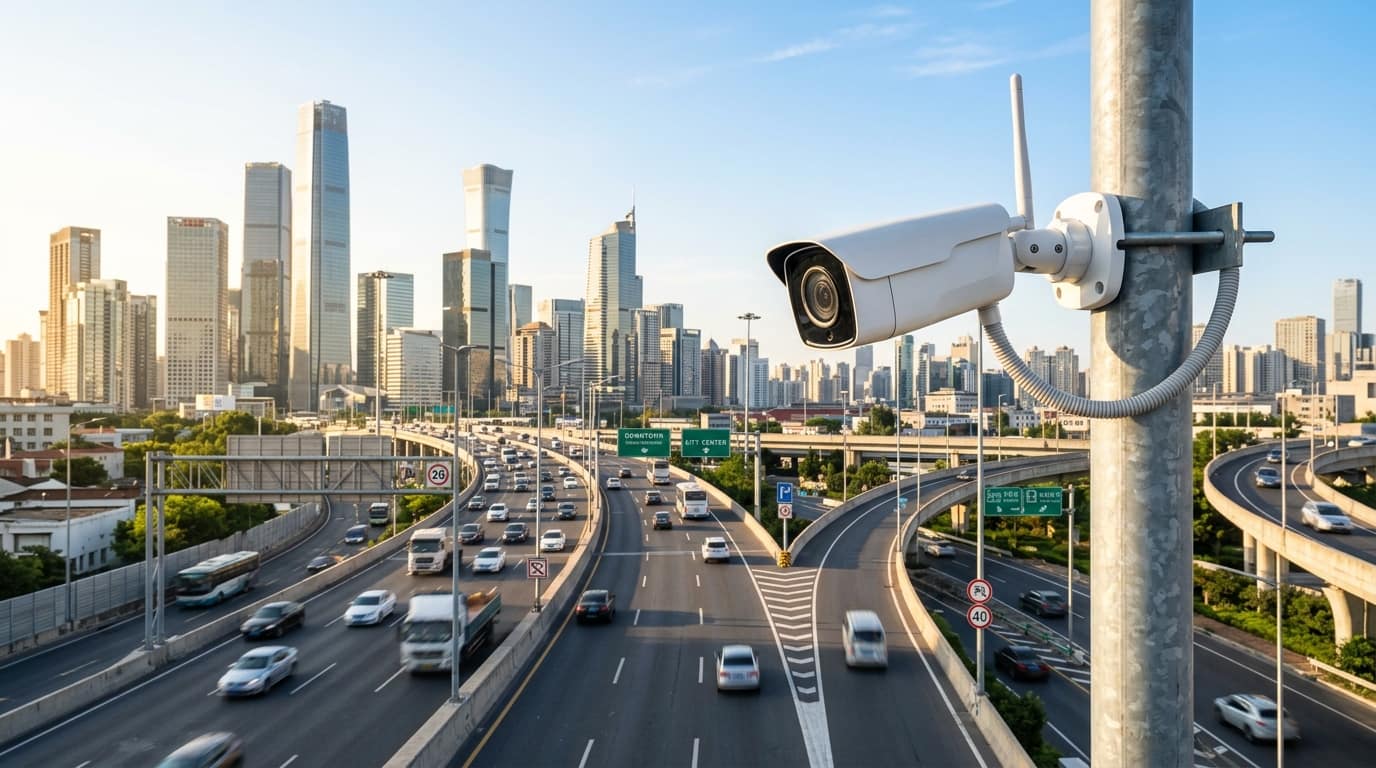
Traffic violation detection uses roadside cameras, ANPR and AI analytics to detect offences such as red-light jumping, over-speeding, wrong-way driving and missing helmets or seat belts, then captures plate and scene evidence for e-challan systems. Speed enforcement needs calibrated sensors and legal approval of the equipment. Analytics can also count and classify vehicles for traffic planning.
At a glance
- Typical timeline
- Six to sixteen weeks for a junction or corridor, depending on civil work and approvals.
- Key standards
- IEC 62676, ONVIF, Motor Vehicles Act enforcement rules, IS 3043 earthing practice.
- What you receive
- Detection cameras, ANPR, evidence packages, e-challan interface, calibration records and reports.
- Best suited for
- Smart cities, traffic police, municipal corporations and highway authorities.
- Our scope
- Survey, design, supply, installation, calibration, integration with challan systems, training and AMC.
- Site survey
- Junction geometry, signal phases and traffic mix recorded at peak and off-peak hours.
Traffic Monitoring & Violation Detection Overview
Traffic violation detection is a roadside system that watches vehicles and flags offences automatically. Cameras at a junction or along a road run analytics that recognise a vehicle crossing the stop line on red, travelling against the flow, riding without a helmet or driving without a seat belt. The system then captures a package of evidence: plate image, overview image, clip and time stamp.
Enforcement is only one part of the value. The same cameras count and classify vehicles, giving the volume of cars, two-wheelers, trucks and buses by hour. Planners use this for signal timing, road design and safety studies. Highway operators use it to detect stopped vehicles and wrong-way entry on carriageways.
The system sits between the road and your back office. Detection is done on the roadside, evidence is sent to a central server, and a review step lets an officer confirm each case before a challan is issued. The way the evidence package connects to the e-challan system, and to vehicle registration look-ups, is the part that decides whether enforcement actually works.
We design traffic systems around geometry, legal requirements and data flow. Every junction is different. Our team surveys signal phases, stop line positions, lane markings and sight lines before any camera position is chosen. We also set out clearly what the authority must approve and supply, because enforcement involves legal steps outside our scope.
Ideal for: Smart cities, traffic police, municipal corporations and highway authorities.
What Our Traffic Monitoring & Violation Detection Includes
Our traffic scope covers detection, evidence, integration with challan systems and the counting data planners ask for.
Red-light, speed and wrong-way violation detection
We set up detection tied to the signal phase, speed sensors and lane direction rules, and test each on site. You receive a calibration record. Tip: ask who approves the speed measurement method, and get that decision before ordering sensors.
Helmet and seat-belt non-compliance detection
We position cameras for a clear view of riders and drivers and route every case to a review screen. Tip: expect a lower detection rate at night and in glare, and plan reviewer capacity for the volume of cases.
Vehicle counting and classification
We configure counts by class and direction, with hourly and daily reports and data export for traffic studies. Tip: define the vehicle classes with planners, so counts match the categories used in your studies.
Evidence capture and e-challan system integration
We build the evidence package and the interface to your challan platform, with role-based review and logs. Tip: test with a set of known cases, including bad ones, to confirm the review step catches errors.
Roadside civil, power and surge protection
We provide poles, foundations, ducts, power supply and earthing with surge protection. Tip: ask for the pole wind-load calculation and earthing resistance record, since roadside failures often start there.
Why manual enforcement and plain cameras miss most violations
Traffic officers cannot be present at every junction at every minute. Manual challans cover the offences an officer sees and chooses to act on, which is a small share of the total. Violations are highest where enforcement is thinnest, such as late at night and on the long stretches between junctions. Behaviour changes only when drivers expect a consequence.
Plain surveillance cameras record offences but do not detect them. Operators cannot watch hundreds of feeds, and reviewing footage after the fact is slow. Even with a good picture, a standard camera may not produce a readable plate, nor tie the violation to a signal phase, a speed reading or a lane. Evidence that cannot support a challan is only a video.
Badly planned enforcement systems have their own issues. A red-light camera that is not linked to the signal controller cannot tell the phase reliably. Speed estimation by video alone, without proper calibration, is open to challenge. Helmet and seat-belt detection depends on camera angle, glare and the speed of the vehicle. And without a review step, wrongly issued challans damage public trust in the whole programme.
What You Gain
Round-the-clock detection
Cameras and analytics watch every lane at every hour, including nights and festival days, which makes enforcement predictable. Drivers learn that offences are recorded wherever they occur.
Evidence packages ready for challan
Each case includes plate image, vehicle image, scene overview, clip, time, location and the violation type. Officers verify one package, not hours of video.
Integration with e-challan systems
The system sends confirmed cases to your challan platform through the interface you agree, with vehicle registration look-up done on the authority side. Manual data entry is removed.
Traffic counts and classification
Counts by vehicle class and direction support signal timing, road design and safety studies, from the same cameras used for enforcement.
Detection of risky behaviour
Wrong-way driving, stopped vehicles on a carriageway and missing helmets or seat belts can be flagged for control room action or for enforcement, depending on your policy.
Operator review for fairness
A review screen lets an officer accept or reject each case with a log of decisions, which cuts errors and keeps the system defensible if a challan is contested.
How the Work Is Delivered
Traffic enforcement projects have more stakeholders than most. This sequence keeps design, approvals and integration moving together.
- 1
Stakeholder and legal review
We meet the authority, traffic police and any control room operator to list the violations to detect, the approvals needed for equipment and the challan workflow. Enforcement rules and equipment approval are the authority's responsibility, and we plan around them.
- 2
Junction and corridor survey
We record junction geometry, stop line positions, signal phases, lane markings, pole locations, power and network availability at peak and off-peak hours. We also check sun direction, since glare at dawn and dusk affects plate reading.
- 3
Design and BOQ
We choose cameras, ANPR units, radar or loop sensors for speed, and the local controller and server. The BOQ includes poles, foundations, power and links. You receive a layout drawing per junction with camera fields of view marked.
- 4
Civil, power and installation work
We fix gantries or poles with wind-load allowance, run power and communication cabling in ducts, and install surge protection and earthing. Equipment is aligned to the stop line and lane geometry, and positions are marked for future maintenance.
- 5
Calibration and field testing
We test detection for each violation type, with test vehicles and live traffic, day and night. Speed sensors are calibrated with a reference method accepted by the authority, and results are recorded for your sign-off.
- 6
Integration with e-challan and control room
We connect to the challan platform and the control room software through the agreed interface, set up review screens and user roles, and test the full chain from detection to a draft challan with sample cases.
- 7
Training, handover and AMC
Operators and officers are trained on review, reports and exceptions. You receive calibration records, drawings and credentials. AMC covers lens cleaning, alignment, sensor checks and recalibration, with terms agreed in the contract per site.
How roadside detection is built: sensors, analytics and evidence
Red-light detection works best when the camera receives the signal phase from the traffic controller, so it knows exactly when the light is red. Video-only phase detection can be used but is more error-prone. Speed is measured by radar, loop or laser sensors, or by tracking a vehicle across a measured distance in video. Any speed method used for challans must be calibrated and accepted by the authority. A radar sensor is a common choice because it gives a direct reading that is easy to defend.
Helmet and seat-belt detection use image analytics on a camera aimed at the vehicle front or side. Accuracy depends on resolution, speed, glare and windscreen tint, so these rules usually need a review step. Evidence capture uses a fast shutter camera, IR lighting for plates at night and a wide camera for the scene. All images are time-stamped from a synchronised source and stored with a hash or similar integrity check so the record can be shown to be unaltered.
Motor Vehicles Act and enforcement rules
Electronic enforcement is governed by the Motor Vehicles Act and the rules made under it, including provisions for electronic enforcement devices. The authority decides the approved devices and procedure. We design the system to produce evidence that fits that procedure.
IEC 62676 image quality approach
We apply its approach to define pixel density at the plate and at the scene overview, and test that each camera meets the target in the lane it covers.
ONVIF and open interfaces
Open interfaces let cameras and analytics integrate with your control room and challan systems without lock-in. We document each interface and its data fields.
IS 3043 earthing and surge protection
Roadside poles are exposed to lightning and surges. Earthing to IS 3043 practice, with surge protectors on power and data lines, protects equipment on open roads.
Time synchronisation and evidence integrity
Evidence needs an accurate time source and tamper-evident storage. We use time synchronisation across devices and log every access to evidence files.
Worked example: enforcement and counting at a four-arm city junction
Consider a busy four-arm junction in a city in Maharashtra with signals, mixed traffic including many two-wheelers, and a history of red-light jumping and riding without helmets. The traffic police want automatic detection of red-light violations and helmet offences, plus counts by vehicle class to review signal timing. The junction has power and a nearby fibre point.
We would plan a gantry or pole per approach with an ANPR camera at the stop line, a scene camera and, on the main arm, a radar sensor for speed. The camera units would take the signal phase from the controller. Helmet detection would use a front camera angle, with every case sent to a review screen. Counts and classification would run on the same cameras and feed a weekly report.
After calibration, the police team typically sees a manageable daily queue of cases to review, and a drop in red-light jumping over the first months as drivers learn the junction is covered. Planners then use the vehicle class counts to retime the signal, which would have been guesswork before.
- Red-light and helmet cases queued with plate, scene and clip.
- Officer review step before any challan is generated.
- Hourly vehicle counts by class and direction.
- Calibration and test records handed over for the authority's file.
This is an illustrative scenario built from typical site conditions. Actual quantities, timelines and results depend on your site survey.
Traffic Monitoring & Violation Detection Across Four States
We are based in Nashik and deliver across Maharashtra, Gujarat, Madhya Pradesh and Rajasthan. Each state has its own utilities, approvals and site conditions, and these are the points that matter most for this service.
Maharashtra
Maharashtra cities and highways already use enforcement cameras, and new projects must integrate with the authority's e-challan process. Junction geometry, signal phases and lane discipline are surveyed first, and evidence rules are confirmed with the traffic authority. We also document camera positions and calibration so the authority can defend evidence if a notice is challenged.
Gujarat
Gujarat cities have dense two wheeler traffic and major highway corridors. Helmet and seat belt detection needs good camera height and lighting, and we confirm with the authority how violations are verified before notices are generated. We also check that the signal controller and camera clocks are synchronised so violation timing stands up.
Madhya Pradesh
Madhya Pradesh cities and highways are adding enforcement and monitoring. Projects usually need integration with an existing control room and the state's challan system, so data formats and responsibilities are agreed in writing. We also plan power and network links early, since many junction poles have neither close by.
Rajasthan
Rajasthan highways and tourist city junctions mix heavy trucks, tourist traffic and animals. Camera poles must handle strong sun, dust and wind, and speed detection sites need survey and calibration planned with the enforcing authority. We also schedule lens cleaning and recalibration around the dusty season to keep detection accuracy steady.
Where This Work Is Most Often Needed
Why Teams Work With Us on This
ANPR, fibre and power in one delivery
We build the ANPR, the fibre links and the electrical work for roadside poles. A single contractor handles the civil, power, network and camera layers, which avoids gaps at the interfaces.
Honest about approvals
Equipment approvals, enforcement procedure and legal notices belong to the authority. We list these early in the plan, so they do not delay commissioning.
Evidence designed for the challan chain
We build the evidence package around what your challan process needs: plate, scene, time, location and integrity. We test the chain with sample cases before go-live.
Field teams across Maharashtra
Our crews handle roadside work, monsoon conditions and the long maintenance cycle that outdoor equipment needs, under an AMC agreed per site.
Guides and Projects Related to This Service
Frequently Asked Questions
01How does automatic red-light violation detection work?
A camera at the stop line receives the signal phase from the traffic controller and watches for vehicles crossing the line while the light is red. When that happens, it captures plate, scene and clip with a time stamp. An officer then reviews the case before a challan is issued, which keeps the process fair.
02Is speed enforcement possible with video alone?
It is possible in some designs, but radar or loop sensors give a direct reading that is easier to defend. Any speed method used for challans needs calibration and acceptance by the authority. We recommend confirming the approved method before design, and recording calibration results at commissioning and at set intervals.
03How much does a traffic violation detection system cost?
Cost depends on the number of approaches or lanes, violations detected, sensor types, poles and civil work, power and links, server and licence scale and challan integration. A single junction costs far less than a corridor. We price after a survey and give a line-item BOQ for each junction.
04Who is responsible for issuing the challan?
The enforcing authority, such as the traffic police or the designated agency, issues the challan under the Motor Vehicles Act and related rules. Our system produces and delivers the evidence package and, where agreed, sends it to the e-challan platform. Vehicle registration look-up and notices are handled on the authority's side.
05How accurate is helmet and seat-belt detection?
Accuracy depends on camera angle, resolution, glare, vehicle speed and windscreen tint. It is usually lower than plate reading, so we route each case to human review and measure detection and false alert rates during commissioning. Expect better results in daylight at slower junctions than at high speed or at night.
06Can the same cameras count and classify traffic?
Yes, the same analytics can count vehicles by class and direction, such as cars, two-wheelers, buses and trucks, and produce hourly reports. This helps with signal timing and road planning. Counting accuracy depends on camera placement and lane layout, and we calibrate it against a manual sample at handover.