
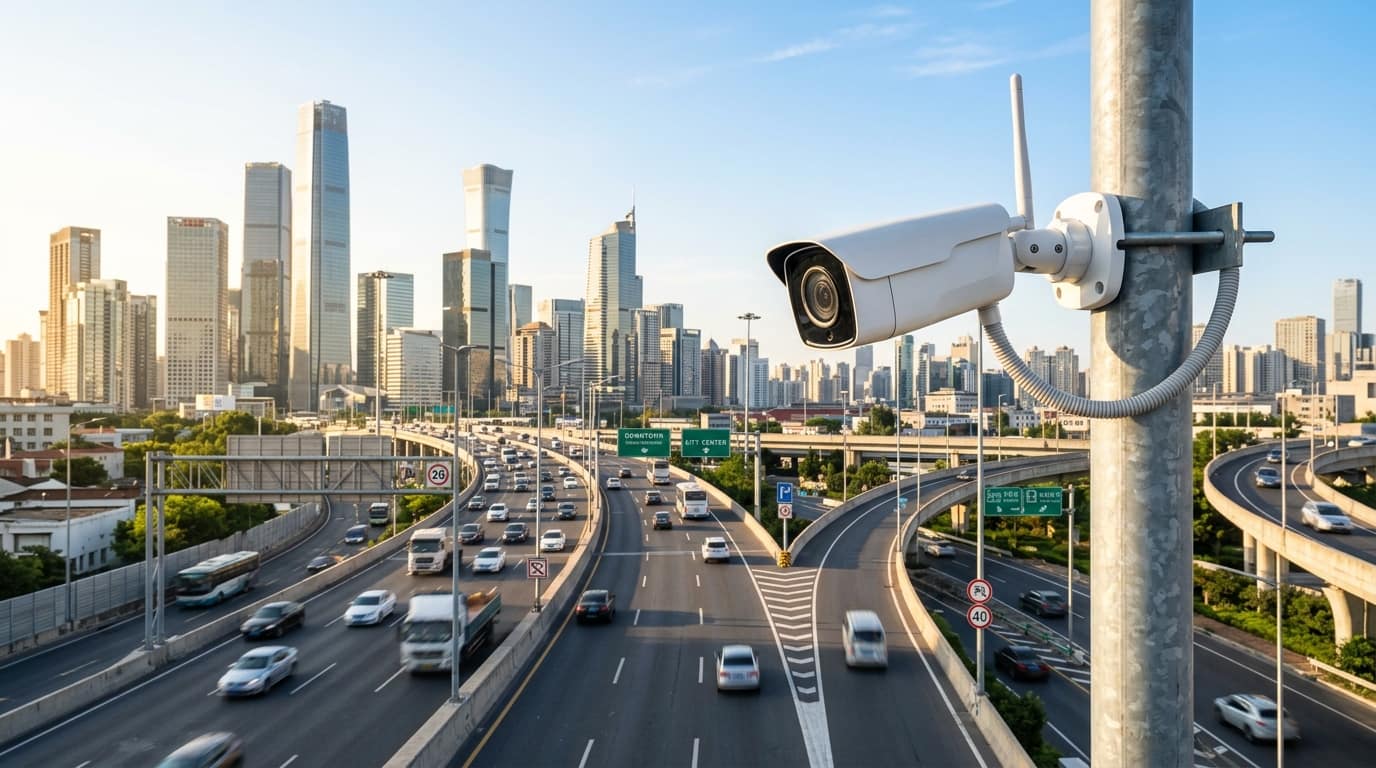
ANPR (Automatic Number Plate Recognition) uses a purpose-set camera, infrared lighting and recognition software to read vehicle registration plates and match them against whitelist and blacklist records. A well-built gate installation reads plates at roughly 95 percent or better in normal conditions, logs time-stamped images, and can trigger boom barriers, parking billing or alerts to a control room.
At a glance
- Typical timeline
- Two to six weeks for a gate or small yard, depending on civil work and barrier readiness.
- Key standards
- IEC 62676 for video systems, ONVIF for interoperability, BIS CRS registration for cameras.
- What you receive
- Calibrated cameras, searchable vehicle database, barrier integration, test records and as-built drawings.
- Best suited for
- Industrial gates, logistics yards, townships, parking facilities and toll plazas.
- Our scope
- Survey, camera and IR design, supply, installation, tuning, integration, training and AMC.
- Site survey
- Done at your gate in real traffic, at the hours your vehicles actually arrive.
ANPR: Automatic Number Plate Recognition Overview
ANPR, or automatic number plate recognition, is a camera system that reads the registration plate of every vehicle that passes through a defined lane and turns it into a record you can search. A dedicated camera captures a short burst of images, infrared light keeps the plate readable at night, and software converts the characters into text. That text is compared against your lists of approved, blocked and watched vehicles in a fraction of a second.
For a plant, warehouse or township the practical result is simple. The register at the gate stops being the only record. Every truck, tanker, staff car and visitor vehicle has a time-stamped entry and exit with a photograph of the plate and the vehicle. When a dispatch dispute, a missing consignment or a trespass complaint comes up three weeks later, you search by plate number or by date and get the evidence in minutes.
ANPR also removes a lot of small friction. Approved vehicles can be passed through without a guard stopping them, which cuts queue time at shift change. Blacklisted or unregistered vehicles raise an alert before they reach the barrier. Parking operators can compute dwell time from entry and exit stamps and bill without paper tickets, and a logistics yard can see how long a truck waited for a bay.
We design ANPR as a gate engineering job, not a camera purchase. The lane width, vehicle speed, approach angle, headlight glare, plate condition and the barrier response time all decide whether the system reads plates reliably. Our team, based in Nashik and mobilised to sites across Maharashtra, Gujarat, Madhya Pradesh and Rajasthan, surveys the lane at the hours your traffic actually arrives, then size the camera, the lens and the lighting for that lane rather than for a brochure.
Ideal for: Industrial gates, logistics yards, townships, parking facilities and toll plazas.
What Our ANPR: Automatic Number Plate Recognition Includes
Our ANPR scope runs from the first lane visit to a working, integrated gate. These are the work packages, and what you receive from each.
ANPR camera selection, positioning and IR illumination
We choose the sensor, lens and IR illuminator for the lane speed and width, then fix height, angle and distance on a drawing. You receive the camera schedule and the expected pixel width on plate. Tip: ask for a night test with your own vehicles before final sign-off.
Whitelist and blacklist vehicle alerts and gate triggers
We set up approved, blocked and watched lists, with fields for owner, category and validity dates. Alerts go to the guard screen, the control room and mobile users. Tip: decide who may edit the lists, and keep an audit trail of every change.
Vehicle entry and exit logs with a searchable database
Each event is stored with plate text, plate crop, overview image, lane and time. We configure search, export and retention, and agree on a backup. Tip: fix a retention period early, because storage grows with every lane and every year of history.
Integration with boom barriers, parking and toll systems
We connect relays or network links to barriers, parking controllers and, where needed, a toll back office, with safety interlocks. You receive an integration note and a test record. Tip: confirm the barrier opening time, because a slow arm defeats a fast read.
Calibration, seasonal tuning and reporting
After go-live we review read rates against real traffic, adjust exposure for the season and set scheduled reports for dwell time, visitor counts and exceptions. Tip: log false reads for a month, since patterns show up in the first thirty days.
Why manual gate registers and general CCTV fail at vehicle control
A guard with a register can record a plate, but not accurately at volume. During a shift change or a dispatch rush, entries are written late, plate numbers are mis-copied and exit times are skipped. The register cannot be searched by partial plate, cannot be cross-checked automatically and is easy to alter. Most plants only discover the gap when a loss or an insurance claim demands an exact time.
General CCTV does not solve this either. A standard dome camera set for a wide scene shows the vehicle but renders the plate as a few blurred pixels, especially on a moving truck at night. Headlights bloom, reflective plates saturate and shutter speeds that look fine for people are too slow for a vehicle at 20 km/h. Footage exists, but nobody can read the plate from it.
Poorly specified ANPR fails in its own ways. A camera mounted too high or too far off-axis distorts characters. A fixed lens that suits a car lane misses plates on a wide two-way gate. Sun glare at low angles in the morning or evening, dirty plates in monsoon, and non-standard plates such as fancy fonts or mud-covered number plates all cut accuracy. A vendor who quotes one accuracy figure without asking about your lane is guessing.
What You Gain
A searchable vehicle history
Every entry and exit is stored with plate text, image, lane and time. You search by full or partial plate, by date range or by lane, and export the result for a dispute, an audit or an insurer.
Faster gate movement
Approved vehicles are recognised and passed without a stop. At a plant with several hundred vehicle movements per day, the saving shows up as shorter queues at shift change and fewer guards needed per lane.
Blacklist and watchlist alerts
Vehicles you have blocked, or that are flagged by your security team, raise an alert to the guard and the control room before they reach the barrier. Unknown plates can be held for manual approval.
Accurate dwell and turnaround data
Entry and exit stamps give you the real time a truck spent inside. Logistics teams use this to find slow bays, check detention claims from transporters and plan dock schedules on facts.
Automatic barrier and parking control
The system triggers the boom barrier, gate motor or parking controller through a relay or network integration, with an interlock so the barrier does not close on a vehicle. Parking billing runs from the same data.
Evidence that stands up
Plate crop, overview image and optional short clip are stored with a consistent time source. When you need to hand material to the police or a client, the record is clear, ordered and traceable.
How the Work Is Delivered
Every ANPR job follows the same path, but the survey and the tuning stages decide the result. These are the steps we run, and the documents you should expect at each one.
- 1
Lane survey and traffic study
We visit the gate during real traffic. We note lane width, approach speed, stopping point, vehicle mix (cars, trucks, two-wheelers), plate types and light sources. We photograph glare conditions at dawn and dusk and decide whether you need one camera per lane or per direction.
- 2
Design, camera positions and BOQ
We fix the camera height, horizontal angle and distance, choose the lens and the IR illuminator, and draw the pole or bracket position. You receive a bill of quantities, a lane layout drawing and a statement of the expected read rate and its assumptions.
- 3
Supply and pre-configuration
Cameras, IR units, controller or server and network gear are supplied as one set. Before dispatch we configure shutter, gain and region of interest on the bench, so site time goes to fitting and tuning, not to unboxing.
- 4
Installation and cabling
We mount cameras on rigid poles that do not sway, run shielded cable in conduit with drip loops, fit surge protection and earth the pole. Cat6 runs stay within 100 m, and fibre is used where the distance or lightning exposure calls for it.
- 5
Tuning and live testing
We test with actual vehicles at the gate speed, day and night, in clear and wet conditions where possible. We tune exposure, trigger zones and character confidence thresholds, and record read rate on a test sample that you can witness.
- 6
Integration with barrier and software
We wire the relay or network link to the boom barrier or gate controller, add the loop or radar interlock, and map approved lists from your visitor or ERP records. Alerts are routed to the control room and to named mobile users.
- 7
Handover, training and AMC
Guards and administrators are trained on live screens, list management and report export. You receive as-built drawings, IP and password records, test sheets and a maintenance schedule. AMC terms are agreed per site and cover lens cleaning, alignment checks and software updates.
How an ANPR lane is built: camera, light and recognition engine
The camera is the most important choice. For fast or wide lanes we use a global-shutter or fast rolling-shutter sensor with a varifocal lens, a shutter near 1/1000 s for moving vehicles and a fixed IR band around 850 nm to light retro-reflective plates without blinding drivers. For a slow gate with a stopping point, a good 2 to 4 MP IP camera with a tight field of view is enough. As a rule of thumb the plate should be at least 130 pixels wide in the image, with characters at least 20 pixels high.
Recognition runs either at the edge, inside the camera, or on a server taking several streams. Edge units suit one or two lanes and keep working if the network drops. Server-based engines suit multi-lane plazas and centralised lists. Either way, the software should return plate text, a confidence score, plate crop and vehicle image, and should support the Indian plate formats you see: standard state series, Bharat series, commercial yellow plates and the high security plates with the chromium hologram. We do not promise reading of damaged or hand-painted plates.
IEC 62676 for video surveillance systems
This series covers system requirements and performance testing for video surveillance. We use its approach to image quality and test methods when we document what the camera must resolve at the lane, and how it was verified.
ONVIF profiles for interoperability
ONVIF conformant cameras let you stream into a VMS from another maker and avoid being locked to one supplier. We confirm the profile support before ordering and test the stream on your VMS during commissioning.
BIS CRS registration for cameras
CCTV cameras sold in India need registration under the Compulsory Registration Scheme of the Bureau of Indian Standards. We supply registered models and share the registration reference, which also matters for government tenders.
Pixel-on-plate design rule
We design to a minimum plate width in pixels, not to a megapixel number. This rule decides camera count and lens choice. A 2 MP camera aimed tightly at one lane can outperform a 8 MP camera framing the whole gate.
Vehicle and data handling
Plate data links to a person indirectly, so we limit access by role, set retention periods with you and keep exports logged. We advise on the Digital Personal Data Protection Act 2023 but the data fiduciary duties stay with you.
Worked example: ANPR at a two-lane factory gate in an industrial estate
Consider a manufacturing unit in an industrial estate (an MIDC, GIDC or RIICO area, depending on the state) with one entry lane and one exit lane, about 400 vehicle movements a day, mostly trucks and staff cars. Vehicles stop at a boom barrier at about 5 km/h. The estate road faces west, so low evening sun shines directly toward the gate, and the unit runs a night shift. The client wants every truck logged, staff vehicles whitelisted and unknown vehicles held for approval.
We would plan one ANPR camera per lane, pole mounted at around 1.2 to 1.5 m above the plate height, with an IR illuminator and a hood against sun glare. A loop or radar sensor would trigger capture so the camera reads at the stopping point. The recognition software would run on the camera for the exit lane and on a small server for the entry lane, where the whitelist is kept. The barrier would be interlocked so it never closes on a vehicle.
After commissioning, the client typically sees guards stop entering plate numbers, the register replaced by a searchable report, and a clear alert when an unlisted truck arrives. Tuning does not end on day one. We usually revisit the lane after the first few weeks of traffic and monsoon, adjust thresholds, and clear any false triggers from reflective vehicle bodies.
- Plate, vehicle image and time stored for each entry and exit.
- Approved staff and fleet vehicles pass without stopping at the barrier.
- Unlisted vehicles raise an alert and wait for guard approval.
- Monthly dwell-time report for dispatch and logistics review.
This is an illustrative scenario built from typical site conditions. Actual quantities, timelines and results depend on your site survey.
ANPR: Automatic Number Plate Recognition Across Four States
We are based in Nashik and deliver across Maharashtra, Gujarat, Madhya Pradesh and Rajasthan. Each state has its own utilities, approvals and site conditions, and these are the points that matter most for this service.
Maharashtra
Maharashtra plants sit mostly in MIDC estates, where gates serve a steady mix of trucks, tankers and staff vehicles. Monsoon rain and mud on plates reduce read rates, so we plan lens hoods, cleaning schedules and a re-tune after the first heavy rains. Power for gate poles usually comes from the plant, not from MSEDCL directly.
Gujarat
Gujarat has dense GIDC estates and port-linked logistics yards with very high truck volumes, so lane throughput and queue length matter more than a single camera. Coastal areas such as Kutch and Saurashtra have salt-laden air that corrodes brackets and connectors, so we specify stainless fixings and sealed glands.
Madhya Pradesh
Madhya Pradesh industrial areas such as Pithampur and Mandideep carry heavy goods traffic on long approach roads, which often means trucks arrive at speed. We check approach length and barrier timing carefully. Summers are hot and the monsoon is strong, so housings need good heat dissipation and drainage.
Rajasthan
Rajasthan sites, including RIICO industrial areas and mining or cement yards, face extreme summer heat and fine desert dust that coats lenses and IR windows. We choose wide-temperature equipment, add sun shields and set a shorter cleaning interval in the AMC. Dust-covered plates also call for a realistic accuracy discussion.
Where This Work Is Most Often Needed
Why Teams Work With Us on This
One team for camera, barrier and network
We also install boom barriers, access control and fibre. The ANPR lane, the barrier controller and the cabling are designed together, so you do not chase three vendors when a barrier lags behind a read.
Surveyed at your gate, in your traffic
A site team mobilised from our Nashik base walks the lane at the hours your vehicles arrive, whichever state the plant is in. Sizing follows measured speed, light and plate mix, and the design note states the assumptions we used.
Documents you can audit
You receive the lane layout, camera settings, test sheets with read-rate samples, IP and credential records and as-built drawings. A new vendor or your IT team can take over the system using these papers.
AMC that matches the failure modes
Lens fogging, misaligned poles and failed IR lamps are the usual causes of falling accuracy. Our AMC schedules cleaning, alignment checks and read-rate spot tests, with response terms agreed in the contract for each site.
Guides and Projects Related to This Service
Frequently Asked Questions
01How accurate is ANPR in real Indian conditions?
A properly designed gate installation commonly reads 95 percent or more of standard plates, and accuracy drops for damaged, muddy, hand-painted or non-standard plates. Accuracy depends on camera angle, shutter speed, IR lighting, vehicle speed and plate condition. Ask any vendor to demonstrate on your lane with your vehicles, and to state how read rate is counted.
02How much does an ANPR system cost?
Cost depends on the number of lanes, camera class, whether recognition runs on the camera or a server, barrier integration and civil work such as poles and conduit. A single-lane gate costs far less than a multi-lane plaza with a central database. We price after a lane survey and give a line-item BOQ so you can compare like for like.
03Can ANPR work at night and in the monsoon?
Yes, with the right design. Infrared lighting reads reflective plates in the dark, and hoods and correct shutter settings help against headlight glare. Heavy rain and mud cut accuracy a little, so lenses need regular cleaning. We tune once in dry weather and again after the first monsoon, and AMC covers seasonal checks.
04What is the difference between ANPR and normal CCTV?
ANPR is built to read a plate, normal CCTV is built to show a scene. An ANPR camera uses a fast shutter, a narrow field of view and infrared light aimed at the plate, and software that converts it to text. A dome camera at the same gate usually cannot produce a legible plate on a moving vehicle.
05Can ANPR open the boom barrier automatically?
Yes, the system sends a relay or network command to the barrier controller when a plate matches the approved list. We add a loop or radar interlock so the arm never lowers on a vehicle, and keep a manual override for guards. Unknown plates stay closed until a guard approves them.
06What documents should I ask for at handover?
Ask for the lane layout, camera and IR settings, a read-rate test sheet signed on site, the integration test record for the barrier, credential and IP records, as-built drawings and the BIS CRS registration references for cameras. These let your team or another vendor support the system without guesswork.