
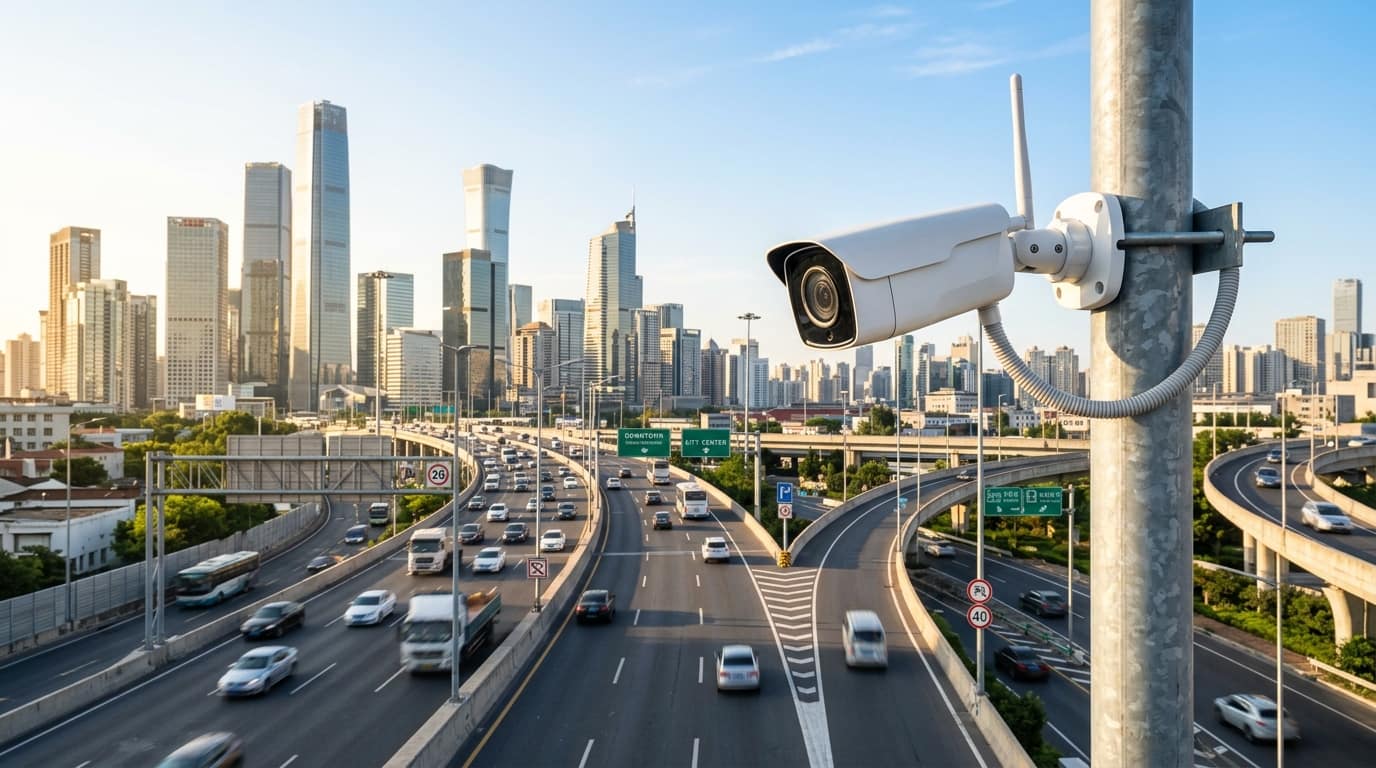
Perimeter intrusion detection uses video analytics, often with thermal or long-range cameras, to detect people or vehicles crossing a virtual line or entering a defined zone along a boundary. Verified alerts reach the control room and mobile devices within seconds, and can start sirens, lights or audio warnings. It works best when cameras, lighting and a response plan are designed together.
At a glance
- Typical timeline
- Four to ten weeks, depending on perimeter length, power and civil work.
- Key standards
- IEC 62676, ONVIF, IP66 or better enclosures, IS 3043 earthing practice.
- What you receive
- Zone map, camera layout, analytics rules, alarm routing, test log and as-built drawings.
- Best suited for
- Plants, warehouses, substations, solar parks and critical infrastructure.
- Our scope
- Survey, design, supply, installation, analytics tuning, deterrence integration and AMC.
- Site survey
- Walked on foot along the boundary, at night as well as by day.
Perimeter Intrusion Detection Overview
Perimeter intrusion detection is a layered approach to knowing when someone crosses the edge of your site. Cameras watch the fence line or open boundary, analytics software draws virtual lines and zones on the image, and an alarm is raised when a person or vehicle crosses or lingers where they should not. A guard or control room operator sees the alarm with a short video clip, which allows quick verification.
Physical fences and walls delay an intruder, but they do not tell you that someone is there. A wall can be climbed in seconds. Detection gives you the time between the first touch and the moment the intruder reaches the asset, and that time is what lets a response team act. The longer the perimeter and the thinner the guard cover, the more value detection adds.
For a plant, warehouse, substation or solar park the boundary is long, often poorly lit and sometimes remote. Guards on foot cannot watch every metre. Video analytics acts as a tireless observer for the entire line, and alarms are raised only on events that match your rules. That reduces the load on operators who would otherwise stare at dozens of feeds.
We design perimeter systems by walking the boundary. Terrain, vegetation, animals, lighting, power and network access decide which camera type fits each segment. Our site teams, based in Nashik and mobilised across Maharashtra, Gujarat, Madhya Pradesh and Rajasthan, know how dust, monsoon growth and stray animals trigger nuisance alarms, and we design to limit them before installation rather than apologise afterwards.
Ideal for: Plants, warehouses, substations, solar parks and critical infrastructure.
What Our Perimeter Intrusion Detection Includes
Our perimeter scope covers detection, verification and deterrence, along with the power and links needed to keep them running.
Line-crossing, zone-intrusion and loitering detection
We configure virtual lines, no-go zones and dwell timers per camera, with direction and schedule rules. You receive a rule sheet for every camera. Tip: use different rules for day and night, since staff movement is normal at noon and not at 2 a.m.
Thermal and long-range cameras for dark or large perimeters
We select thermal and long-range cameras by segment length and background, and pair them with visible verification. You receive a coverage drawing with detection ranges. Tip: ask the vendor to demonstrate detection of a walking person at the stated distance on your site.
Siren, strobe and PA-based auto-deterrence
We connect verified alarms to sirens, strobes, floodlights and PA speakers, with logic that avoids triggering for staff. Tip: check local noise limits and neighbours, and set deterrence for night hours only if needed.
Instant alerts to control room and mobile
We route alarms with image and clip to the VMS, to named mobile users and to the guard post, with escalation. Tip: test alert delivery over mobile data from the far end of the site, where coverage is weakest.
Power, links and lightning protection for remote poles
We plan power, fibre or wireless links and surge protection for isolated poles, using solar supply where mains is not available. Tip: budget for earthing at every pole, because outdoor cameras fail most often from surges.
Why fences, guards and plain CCTV do not give early warning
A fence tells an intruder where the boundary is, and little more. Guards on patrol cover a stretch for a short time, then move on. A typical boundary of a few kilometres cannot be watched continuously by a few people, and at night attention falls. Intrusions then become known only at the next morning check, when a cut fence or a missing item is found.
Plain CCTV records the intrusion but rarely warns about it. Operators cannot watch every camera, and recording alone gives only after-the-fact evidence. Basic motion detection inside cameras produces floods of false alarms from shadows, rain, insects at the lens, swaying branches and small animals, until operators ignore it. A system that cries wolf is no better than no system.
Weak designs also leave blind spots at corners, gates and low points. Cameras mounted too far apart miss slow crawlers. Visible-light cameras see nothing on a moonless night without lighting, and lighting itself can create glare and shadows. And when an alarm does come, there is often no agreed response, so the alert sits unanswered. Detection is only worth the response that follows it.
What You Gain
Early warning at the boundary
Alerts fire when a person crosses a virtual line, not when they reach the building. That gives your guards or response team the minutes they need to reach the spot.
Fewer false alarms
Object classification separates people and vehicles from animals, shadows and weather. Tuned zones and schedules keep operators looking at real events, which keeps them alert.
Day and night coverage
Thermal cameras detect heat signatures in complete darkness, fog and light haze, and do not need lighting. Visible cameras with IR cover shorter zones at lower cost.
Automatic deterrence
A verified alarm can trigger a siren, strobe, floodlights or a recorded voice warning. Many intruders leave when told they are seen, which avoids a confrontation.
Verified alerts to any device
Operators see a snapshot and clip with the alert, on the control room screen and on mobile. A short look decides whether to dispatch, which saves wasted patrols.
Evidence for police and insurers
Time-stamped clips of crossing, direction and route are stored and exportable. This helps with police complaints, insurance claims and review of response times.
How the Work Is Delivered
Perimeter work is long and outdoors, so the survey and the commissioning tests carry the most weight. This is how we run it.
- 1
Boundary walk and threat review
We walk the whole boundary with your security head, note terrain, vegetation, gates, drainage lines and existing lights, and discuss what you are protecting and how intruders have approached before. Photographs and GPS points feed the design.
- 2
Zone design and camera layout
We divide the perimeter into segments and assign camera type, spacing and mounting. A segment may use thermal at long range, a fixed camera with IR in short runs and a PTZ for verification. You receive a layout drawing and an alarm zone schedule.
- 3
Power, network and civil planning
We plan poles, foundations, cable routes and power. Long runs use fibre or wireless links, and remote sections may use solar power. We design surge protection and earthing to IS 3043 practice, because lightning is a common killer of outdoor cameras.
- 4
Supply and installation
Cameras with IP66 or better enclosures go on rigid poles or walls, with sun shields and drip loops. We set the field of view at fixed points and mark each camera so that later maintenance finds the same view.
- 5
Analytics rules and tuning
We draw lines and zones on each camera, set the minimum object size, direction rules and schedules, and filter known motion such as swaying trees. We then run walk tests at different distances and times and record detection results.
- 6
Alarm routing and deterrence integration
We connect alarms to the control room, mobile users and sirens, strobes, lights or PA speakers. Escalation rules say who is called if the first operator does not respond within the time you set.
- 7
Handover, drills and AMC
We hand over the zone map, rule sheets, walk-test log and as-built drawings, and train operators. A drill with your response team checks the full chain. AMC covers lens cleaning, vegetation notes, alignment checks and re-tuning each season.
Choosing cameras for each stretch of the boundary
Thermal cameras detect the heat of a body against the background, so they work in total darkness and are less fooled by headlights, shadows and rain than visible-light analytics. They suit long open boundaries, because one thermal camera can cover far more fence length than a visible camera with IR. Their cost is higher, and their image gives less detail for identification, so we pair them with a visible or PTZ camera for verification at key points.
Visible cameras with IR illumination and analytics suit shorter runs, gates and built-up edges, where lighting is practical. For detection, a person typically needs to be at least 10 percent of the image height for dependable analytics, and a common design rule is to overlap fields of view so a gap never opens when one camera fails. Cameras should be fixed on rigid poles, since sway causes false alarms. Radar and fence vibration sensors can complement video where you need an extra layer, and we say so when a segment needs it.
IEC 62676 for system design and testing
We follow the series for system requirements and acceptance testing. In practice that means we define the detection task, such as detect a walking person at the far end of the zone, and test it, rather than rely on a brochure range.
IP66 or higher enclosure rating
Outdoor cameras and junction boxes need dust-tight and strong-jet protection for monsoon and dusty plant conditions. We specify the rating and add sun shields in summer heat.
IS 3043 earthing and surge protection
Poles are tall metal targets, and surges travel down long cable runs. Earthing to IS 3043 practice, with surge arrestors at both cable ends, saves cameras and switches from damage.
ONVIF for integration
ONVIF conformant cameras and analytics can be brought into your VMS and alarm panel without locking you to one maker. We confirm event support before purchase.
Detection range and overlap rule
We state the detection distance for a defined target size and design with overlap between neighbouring cameras. This avoids blind spots when a camera is under maintenance.
Worked example: a 2 km boundary at a solar park and substation
Consider a ground-mounted solar park with an attached substation and a 2 km boundary on open ground outside Nashik. There is no mains lighting along the fence, grass grows fast in the monsoon and stray dogs and nilgai move at night. Theft of cable and inverter parts is the main risk, and the control room is at the substation.
We would use thermal cameras on poles at spaced intervals along the straight fence, each covering a long segment, and visible IR cameras with PTZ verification at the gate and the substation corner. Analytics would classify people and vehicles and ignore animals under a set size. Alarms would trigger a siren and floodlight at the segment and show a clip on the control room screen and on the site supervisor's phone.
After commissioning, the client typically sees alerts only on genuine approaches and a small number of nuisance alarms from vegetation, which are removed by trimming and zone adjustments over the first month. Response drills usually reveal that the route from the control room to far segments takes longer than expected, which then shapes patrol points.
- Boundary crossings detected and verified on video in seconds.
- Animals and weather filtered out of the alarm stream.
- Siren and light triggered at the exact segment.
- Clip and location available on the control room and supervisor phone.
This is an illustrative scenario built from typical site conditions. Actual quantities, timelines and results depend on your site survey.
Perimeter Intrusion Detection Across Four States
We are based in Nashik and deliver across Maharashtra, Gujarat, Madhya Pradesh and Rajasthan. Each state has its own utilities, approvals and site conditions, and these are the points that matter most for this service.
Maharashtra
Maharashtra boundaries range from MIDC plants to substations and wind and solar sites on open plateau. Monsoon growth is the main source of nuisance alarms, since grass and branches move in front of cameras. We plan vegetation clearance along the fence and a re-tuning visit once the rains settle.
Gujarat
Gujarat has long boundaries at ports, refineries, GIDC estates and large solar parks, many near the coast. Salt-laden air attacks poles, brackets and connectors, so we specify corrosion-resistant fittings and sealed enclosures. Fog and sea haze favour thermal cameras over visible ones on exposed stretches.
Madhya Pradesh
Madhya Pradesh has substations, industrial areas and large open campuses in forested or rural surroundings, where animals cross fences at night. Object classification and minimum size filters matter here. Remote segments may lack reliable mains power, so we check for solar-backed poles and a stable link.
Rajasthan
Rajasthan desert solar parks and mining sites have very long boundaries, extreme heat and fine blowing dust. Thermal cameras handle dust haze better than visible ones, but heat shimmer at midday limits range. We derate detection distances for summer, choose wide-temperature equipment and plan frequent lens cleaning.
Where This Work Is Most Often Needed
Why Teams Work With Us on This
Solar, power and network under one roof
We build solar plants, electrical systems and fibre networks too. Poles, power, earthing and links for a remote boundary are designed together instead of being passed between contractors.
Boundary walked in person
A field team mobilised from our Nashik base walks the full perimeter, by day and at night. The camera layout comes from what we saw on the ground, not from a satellite image.
Tuned against nuisance alarms
We log false alarms in the first weeks, trace each to its cause and fix the zone or the site. You receive a tuning record that explains each change.
Response plan included in the handover
We help you write who responds, in what order and with what escalation. A drill is part of acceptance, because detection that nobody answers has no value.
Guides and Projects Related to This Service
Frequently Asked Questions
01How does perimeter intrusion detection work?
Cameras watch the boundary and analytics software compares what it sees with rules you set, such as a virtual line or a no-go zone. When a person or vehicle crosses the rule, an alarm is raised with an image and clip. An operator verifies it and starts the response or deterrence.
02Are thermal cameras necessary for a perimeter?
Not always, but they are the best choice for long, dark or open boundaries. Thermal cameras detect people by heat and need no light. Visible cameras with infrared suit shorter runs, gates and built-up edges. We often mix both, using thermal for detection and visible cameras to verify who is there.
03How do you reduce false alarms from animals and weather?
We use analytics that classify objects by type and size, set zones that avoid moving vegetation, apply schedules and rely on rigid mounting. We then log alarms for the first weeks and tune each cause. Some residual nuisance alarms are normal, and a good design aims to keep them at a level operators can manage.
04How much does a perimeter detection system cost?
Cost depends mainly on boundary length, camera type per segment, power and network availability, civil work for poles and the deterrence you choose. Thermal segments cost more than visible ones. A walk survey is the way to get a firm figure, and we then give a segment-wise BOQ.
05Can it work at a remote site without mains power?
Yes, if power and a link are designed properly. Solar power with battery storage can run cameras and a wireless or cellular link, and we size autonomy for several cloudy days. Remote sites need careful earthing and a plan for maintenance visits, which we cover in the design and the AMC.
06What happens when an alarm is raised?
An operator sees the image and clip, confirms whether it is a real intrusion, and then follows the response plan you agree with us. That may mean sounding a siren, calling the guard post, dispatching a patrol or informing the police. We test the whole chain in a drill at handover.